Thursday, February 9, 2012

Announcing BMFI's Oscar Party Winner!

By Devin Wachs, Public Relations Manager

We may not know which films are going to win at the Oscars, but we can tell you which BMFI patron has won two tickets to BMFI's fourth annual Oscar Party! We enjoyed all of the entries, but we could only give the grand prize to one (much like the Academy).

The Task: To make a case for which nominated film you thought should win the Best Picture Oscar this year in 140 characters or less, judged on persuasiveness and panache.

The Prize: Two tickets to watch the Academy Awards in style at BMFI's Oscar Party on Sunday, February 26!

The Winner: Elana Starr for Hugo:
Hugo is beguiling as a paean to early cinema, as a personal statement from our greatest living director, and as a timeless (excuse the pun) work of art.
Congratulations, Elana!

Runners up: Much like the nominees swag bags at the Oscars, our favorite runners up also will go home with a little something: two tickets to a regular movie screening at BMFI.

1) Emily:
The Tree of Life needed Help; War Horse was Extremely Loud & Incredibly Close; Hugo made a Moneyball; I loved every Artist in Midnight in Paris; but The Descendants was transcendent.

2) Kristin Kimmell:
Hugo delighted my senses
With effects viewed through two 3D lenses
Mixing old with the new
It beguiled as it flew
Through a series of stunning sequences!

Runners up, please contact me, Devin Wachs, for information about how to collect your prizes by calling 610-527-4008 x105.

You can read all of the entries in the comments section here.

Thanks to everyone who participated. If you didn't win this time, there will be other contest opportunities in the future. If you'd like to come to the Oscar Party, you can still get tickets here.

Tuesday, February 7, 2012

Dangerous: The Method or the Men?

BMFI guest blogger Diane Mina Weltman attended a screening of A Dangerous Method and BMFI's "Inside the Characters" monthly discussion group, hosted by the Psychoanalytic Center of Philadelphia, this past Sunday. Read her thoughts about the film's portrayal of Jung, the post-movie chat, and more below.  


Dangerous: The Method or the Men?
By Diane Mina Weltman, BMFI Member and Guest Blogger

Overstepping the slender line that separates the doctor/patient relationship is one of the most dangerous decisions a health professional can make—at least that was the consensus reached by moviegoers discussing the film A Dangerous Method following a Sunday afternoon screening during its recent opening weekend at Bryn Mawr Film Institute.

An alternative event to the Super Bowl, some 20 or so filmgoers joined Dr. John Frank of the Psychoanalytic Center of Philadelphia to talk about their impressions regarding the film's characters as part of BMFI’s "Inside the Characters" forum. The guided discussion, offered monthly at BMFI, opens an opportunity to answer the timely post-movie question, "What did you think?" or, more specifically, "What did you think of the characters?"

Michael Fassbender and Viggo Mortensen play Carl Jung
and Sigmund Freud in David Cronenberg's new drama,
A DANGEROUS METHOD

The discussion initially focused on the expanded view of Sigmund Freud and Carl Jung as two of the film's trio of main characters during a period where they collided on their professional journeys. The film looks at how these forces of psychoanalysis navigated their work and relationship with each other, as well as how they formulated and employed the 'talking method' of treatment. The discussion was equally rich and uncomfortable as moviegoers wrestled with the way these men’s personalities and practices collide in their search to understand the human psyche.

Today, using talking as a way of emotionally healing is the predominant path taken in psychoanalysis. At the turn of the 20th century, this method was in its infancy. Its use (and abuse) provided the basis of one of the film's troubling themes.

Jung (Michael Fassbender) successfully treats a young female patient whose consuming hysteria blasts the movie's first scene wide open. The patient, Sabina Spielrein (Keira Knightly) responds exceedingly well to the talking method of treatment. It not only reduces both her uncontrolled bouts of fear and the sexual arousal they ignite, but opens the door for her intuitive intelligence to emerge.

Keira Knightly plays Jung's patient, Sabina Spielrein.

Audience members seemed to appreciate the defined success of the married Jung's care for his patient until his suppressed sexual needs supersede Spielrein's treatment. Spielrein's portrayal as the one who initiates the physical relationship with Jung did not sway the discussion participants from the overriding concern about the damage done when a patient/doctor relationship breaks the bond of appropriateness. Said one participant, "This goes to the basis of aberrant behavior and abuses any trust between the two." The group seemed unanimous in demanding that, as the professional, the doctor’s role in protecting that trust was paramount.

In the post-movie chat, other participants whose professional life is/was in social work or mental health also took pointed exception to Jung's breach of conduct. One woman explained, "We'd be in a terrible state if everyone did whatever they wanted." Added another, "Jung goes directly against keeping the necessary boundaries of the doctor/patient relationship." The film's presentation of this taboo behavior tainted Jung's professional achievements for many in the discussion.

In the film, psychologist Otto Gross (Vincent Cassel) represents uninhibited expression and freedom to the extreme. Gross described a patient's desire for the same freedom to both have an affair with her doctor and to commit suicide as a consistent expression that should not be "cured." "Freedom is freedom," he quips much to the audience and Jung's disdain. The audience was as critical of his character as they were of Jung’s malfeasance. One participant noted, "He was a horror."

[Spoiler alert] The character of Sabina Spielrein was interesting because of how she seeks answers while remaining acutely aware of her scarred past. "I give Sabina credit," one male participant stated, noting that she benefits from Jung's initial treatment and unhappily moves beyond their sexual relationship to "ultimately succeed in getting better and living a very productive life." The contrast from this woman's uncontrollable breakdown at the outset to her resounding intellectual achievements received appreciation from some—but not all—in the group.

Another woman noted, "Sabina was never really cured, even though she achieved a great deal in her field." This led to a discussion regarding how much does one need to be healed to live a productive life. As discussion leader, Dr. Frank added, "Sabina was seen as someone history cast aside early on, but her work in the new area of child psychology was eventually recognized as groundbreaking."

Viggo Mortensen's Freud fills the
role of a substitute father for the conflicted Jung.

Freud's (Viggo Mortensen) influence as father figure to Jung and to the psychoanalytic movement in Europe received notable emphasis in the film and also with the discussion participants. Said one woman, "The film supported the view that Freud and Jung were smart men but when it came to their personal relationship, Jung struggled with having Freud as a substitute father."

Spielrein's deeply rooted humiliation at the hands of her biological father also influenced how she saw both Jung and Freud. "Each character was traumatized in some way by the other," added one gentleman. "The father-figure role impacted all their lives."

Delving inside the film's characters with other moviegoers added a dimension to the movie experience that mirrored its intent—by talking through our impressions of the film's players, we not only had our say but had to consider how others saw them. The power of talk, whether as a psychoanalytic tool or vehicle for discussion, gives us all a chance to be heard.

Upon exiting A Dangerous Method, I reflected that the film’s title was somewhat misleading since 'the method' was not necessarily dangerous. The danger lay with how Jung, Freud, and Gross chose to use it, reminding me that sometimes the disease seeps into the cure.


Diane Mina Weltman is a BMFI member who enjoys attending performing and visual arts events and writing about them. Check out her blog, A Subject for Consideration.

Notes from Art House Convergence 2012

By Juliet Goodfriend, Bryn Mawr Film Institute President

This year three of us from BMFI went to the ever-expanding Art House Convergence to confer with our colleagues around the country about the joys and challenges of running independent, community-based, mission-driven, art house movie theaters.
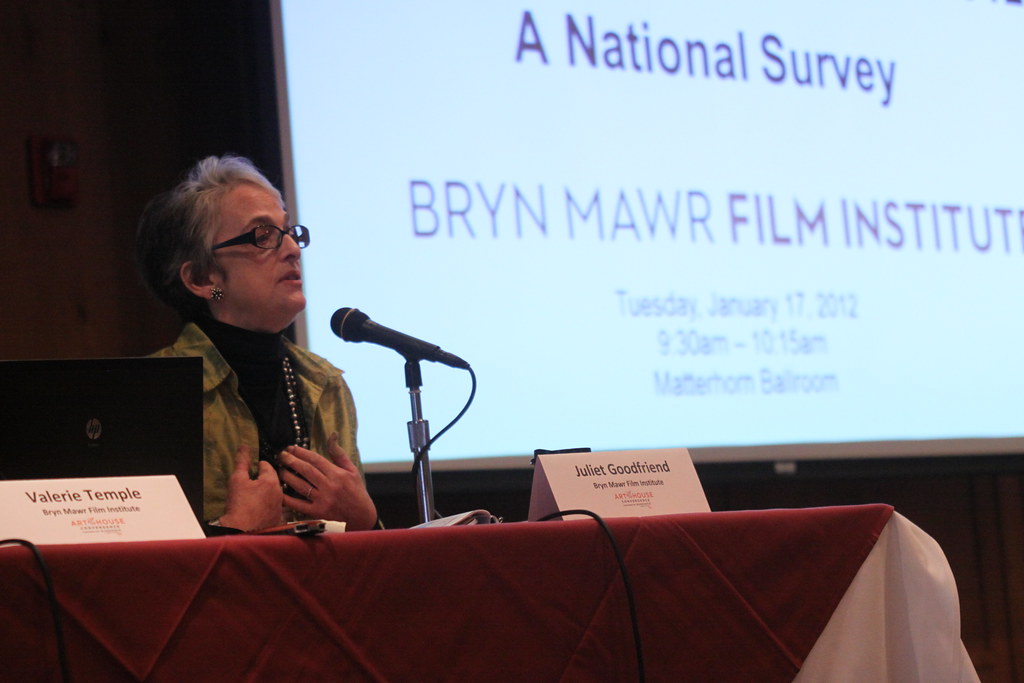
This was my fourth Convergence, Programming Manager Valerie Temple’s second, and Lead Theater Manager Mike McCracken’s first, and each of us profited significantly. It turns out there is always more to learn, new “best practices” to consider, new solutions and new problems to mull over. We had a good dose of “Improving Customer Service” and one cannot get enough new ideas on that subject which is, after all, the essential foundation of our business. Mike and I spent most of our time at sessions that helped us fully grasp the digital transformation that all major art houses must undergo. Some new concession design concepts will be especially useful as we commence our final renovation projects. In listening to talks about “pre-shows” and trailers we got some creative notions to try and we also realized that our pre-show ranks well. Valerie walked away from the Convergence with lots of ideas about adventurous programming and "event-izing" and went on to attend her first ever Sundance Film Festival. At the festival she got a chance to see 24 films, a few of which were not great but many that we would be excited to screen at BMFI in the future.

Valerie and I started off the substantive part of the Convergence with a very well-received report on the health of art houses taken from the national survey BMFI does each year. (A big thank you to our consultant, Cordelia Stone.) Art houses are doing well and in many cases better than the entire national market, but they face daunting expenses as they transition to digital.

We were thrilled to learn that David Bordwell, Jacques Ledoux Professor of Film Studies at University of Wisconsin-Madison, was attending. His numerous books and his penetrating blogs have transformed and informed our film viewing. He is just one of the very best film historians and analysts in the world. He enthusiastically incorporated our national survey into his blog.

Reproduced here (with permission) is an excerpt from David Bordwell’s take on the Convergence, with particular emphasis on digital cinema. To read his full post and find more of his insights into film past and present, visit his blog, Observations on Film Art.


An Excerpt from Pandora’s digital box: Art house, smart house
by David Bordwell

Theatres’ conversion from 35mm film to digital presentation was designed by and for an industry that deals in mass output, saturation releases, and quick turnover. A movie comes out on Friday, fills as many as 4,000 screens around the country, makes most of its money within a month or less, and then shows up on VoD, PPV, DVD, or some other acronym. The ancillary outlets yield much more revenue to the studios, but the theatrical release is crucial in establishing awareness of the film.

Given this shock-and-awe business plan, movies on film stock look wasteful. You make, ship, and store several thousand 35mm prints that will be worthless in a few months. (I’ve seen trash bags stuffed with Harry Potter reels destined for destruction.) Pushing a movie in and out of multiplexes on digital files makes more sense.

After a decade of preparation, digital projection became the dominant mode last year. Today “digital prints” come in on hard drives called Digital Cinema Packages (DCPs) and are loaded (“ingested”) into servers that feed the projector. The DCPs are heavily encrypted and need to be opened with passkeys transmitted by email or phone. The format is 2K projection, more or less to specifications laid down by the Digital Cinema Initiatives (DCI) group, a consortium of the major distributors.

Upgrading to a DCI-compliant system can cost $50,000-$100,000 per screen. How to pay for it? If the exhibitor doesn’t buy the equipment outright, it can be purchased through a subsidy called the Virtual Print Fee. The exhibitor can select gear to be supplied by a third party, who collects payment from the major companies and applies it to the cost of the equipment. The fee is paid each time the exhibitor books a title from one of the majors. See my blogs here and here for more background.

It’s comparatively easy for chains like Regal and AMC, which control 12,000 screens (nearly one-third of the US and Canadian total), to make the digital switchover efficiently. Solid capitalization and investment support, economies of scale, and cooperation with manufacturers allow the big chains to afford the upgrade. But what about other kinds of exhibition? I’ve already looked at the bumpy rise of digital on the festival scene. There are also art houses and repertory cinemas, and here one hears some very strong concerns about the changeover. “Art houses are not going to be able to do this,” predicts one participant. “We will lose a lot of little theatres across the country.”

The long, long tail
‘Plexes, whether multi- or mega-, tend to look alike. But art and rep houses have personality, even flair.

One might be a 1930s picture palace saved from the wrecking ball and renovated as a site of local history and a center for the performing arts. Another might be a sagging two-screener from the 1970s spiffed up and offering buns and designer coffees. Another might look like a decaying porn venue or a Cape Cod amateur playhouse (even though it’s in Seattle). The screen might be in a museum auditorium or a campus lecture hall. When an art house is built from scratch, it’s likely to have a gallery atmosphere. Our Madison, Wisconsin Sundance six-screener hangs good art on the walls and provides cafĂ© food to kids in black bent over their Macs.

Most of these theatres are in urban centers, some are in the suburbs, and a surprising number are rural. Most boast only one or two screens. Most are independent, but a few belong to chains like Landmark and Sundance. Some are privately held and aiming for profit, but many, perhaps most, are not-for-profit, usually owned by a civic group or municipality.

What unites them is what they show. They play films in foreign languages and British English. They show independent US dramas and comedies, documentaries, revivals, and restorations.
In the whole market, art houses are a blip. Figures are hard to come by, but Jack Foley, head of domestic distribution for Focus Features, estimates that there are about 250 core art-house screens. In addition, other venues present art house product on an occasional basis or as part of cultural center programming.

Art house and repertory titles contribute very little to the $9 billion in ticket sales of the domestic theatrical market. Of the 100 top-grossing US theatrical releases in 2011, only six were art-house fare: The King’s Speech, Black Swan, Midnight in Paris, Hanna, The Descendants, and Drive. Taken together, they yielded about $309 million, which is $40 million less than Transformers: Dark of the Moon took in all by itself. And these figures represent grosses; only about half of ticket revenues are passed to the distributor.

More strictly art-house items like Take Shelter, Potiche, Bill Cunningham New York, Senna, Snow Flower and the Secret Fan, Certified Copy, Page One, The Women on the 6th Floor, and Meek’s Cutoff took in only one to two million dollars each. Other “specialty titles” grossed much less. Miranda July’s The Future attracted about half a million dollars, Uncle Boonmee Who Can Recall His Past Lives grossed $184,000, and Godard’s Film Socialisme took in less than $35,000. For the distributors, art films retrieve their costs in ancillaries, like DVD and home video, but the theatres don’t have that cushion.

Something else sets the art and rep houses apart from the ‘plexes: The audience. It’s well-educated, comparatively affluent, and above all older. Juliet Goodfriend’s survey of art house operators indicates that only about 13% of patrons are children and high-school and college students. The rest are adults. A third of the total are over sixty-five. As she puts it, “Thank God for the seniors!” However much they like popcorn, they love chocolate-covered almonds.

Almonds aside, how will these venues cope with digital? To find out, I went to Utah.

Read the rest of David Bordwell's Art House Convergence post here.


Photos of Valerie Temple and Juliet Goodfriend (c) Chuck Foxen.

Tuesday, January 31, 2012

"Deconstructing the Beatles" Contest Winner!

By Devin Wachs, Public Relations Manager, BMFI

Thanks to everyone who submitted an entry to our Deconstructing the Beatles Contest! We asked our readers to submit an idea for a screenplay inspired by one of the songs that presenter Scott Freiman will discuss tonight at tonight's event (“Strawberry Fields Forever”, “Penny Lane”, or “A Day in the Life”).

The winner is Katie Pfieffer. Here's her idea:

Strawberry Fields Forever
Set in a farmer's market, Anna helps her family sell their farm produce. She meets Tom, a lonely mushroom farmer, and they set out on a life-changing trip across the U.S. circa 1974.

Congratulations, Katie, you've won two free tickets to tonight's event.

Check out the other entries in the comments here. There are some fun ones!

Thanks to everyone who contributed. Next time you come to BMFI, you'll enjoy a free small popcorn and drink on us! We'll leave the popcorn and drink passes for you at the Box Office.

For more information about A Trip Through Strawberry Fields: Deconstructing the Beatles and to buy tickets, click here.

Alan Webber: Why I Love Moira Shearer

On the anniversary of Moira Shearer's death, BMFI patron and film fan Alan Webber shares with us his movie memories of the luminous dancer and actress and her best-known performance in The Red Shoes.


Autumn Bonfire
By Alan Webber, BMFI Patron

Like many American males I first fell in love in the darkened balcony of a movie theatre. The reader has no need for caution here: I was no stumbling Clearasil-addicted teenager groping at elbows, but a young boy of six years. It was somewhere around 1950 in Larchmont, New York and my mother dragged me, a runny-nosed youth I’m sure, to a matinee one October Saturday. It was a nearly perfect autumn day and I remember that my new white sneakers brushed against the embers of burning leaves at the curb of Chatsworth Avenue on the way. Little did I know of  what was in store for me that crisp day or the gifts I was about to receive…the first of a lifetime of movie loves and my first movie memory.

Moira Shearer in The Red Shoes

A little over two hours later when “FINIS” lit across the blackness, I knew that I was totally infatuated with movies and this alluring beauty on the screen. I didn’t know what “FINIS” meant but the film appeared to end very tragically for her in Monte Carlo…wherever that was. I knew it was very far from Larchmont.

Her name in the film was Victoria Page and she was a fiery redhead who raged across my innocence in a spinning fantasy of Technicolor and dance. “Vicki” was her screen name, but I gradually learned she really was Moira Shearer of the Sadler Wells Ballet and I have never fallen out of love with her in The Red Shoes, Michael Powell and Emeric Pressburger’s eccentric, melodramatic and voluptuous masterpiece. Even director Powell was taken by her "cloud of  red hair," which "flamed and glittered like an autumn bonfire.” In retrospect, I see that she was my very first Object of Desire even before my younger self flirted with an idea of sex. She was also the probable origin of a lifelong smoldering fondness for fair-skinned redheads.


After the release of The Red Shoes in 1948 she became the best-known ballet dancer in the United States and perhaps the world and with this fame she was able to popularize ballet more than any other contemporary. Many today, myself included, believe that it is still the greatest ballet movie ever made and Moira Shearer was crucial to this success. However, the reception of the film by the public wasn’t without problems. “The film was a huge success when it opened in London in the spring of 1948,” she said to one interviewer, “but, just as I had suspected, the British public didn’t much approve of my appearing in it…..I just wish I had been a more rounded performer at the time.” It was never a movie she wanted to make for she believed she was a novice at acting and felt hampered by her lack of experience. If she felt that way, it didn’t show on the screen.

Following The Red Shoes, Moira Shearer made four other films in which she danced and acted including The Tales of Hoffman for Powell and Pressburger and Black Tights for choreographer Roland Petitt. Her dancing career essentially ended in 1952, after which she acted, wrote, and lectured.

She died on January 31, 2006 at the age of 80.

In the film, Vicki, who has fallen in love with the ballet company’s composer, is warned, “A dancer who relies upon the 'doubtful comforts' of human love will never be a great dancer…never.”

On those scarlet autumn days when I am in a reflective mood and the air is crisp again and I watch The Red Shoes, I can rely on these “doubtful comforts” and remember the Moira Shearer of my boyhood, the autumn bonfire, who has warmed my heart for a movie-going lifetime.


Thanks, Alan!

Film fans, if you would like to submit a post of your own about a movie or film star that you love, please contact Devin Wachs with your idea.

Friday, January 27, 2012

Music Fans: Win Free Tickets to "Deconstructing the Beatles"

Win free tickets to Scott Freiman's fascinating lecture, A Trip Through Strawberry Fields: Deconstructing the Beatles! This in-depth exploration of the making and meaning of three of The Beatles' most beloved songs comes to Bryn Mawr Film Institute on Tuesday, January 31 at 7:30 pm. For more information and to buy tickets, click here.

Contest: Pretend you’re writing a screenplay inspired by a favorite Beatles tune. Choose a song that Scott will discuss (“Strawberry Fields Forever”, “Penny Lane”, or “A Day in the Life”) and tell us your movie idea based on it in 30 words or less. Jazz it up and have fun!

Post your entries (including your name) in the comments below. The first fifteen people to submit a pitch will win a pass for free popcorn and soda at the event. The entry that we find most compelling will win two free tickets! Submissions must be made by Monday, January 30 at 6:00 pm.

*Please Note: When posting your comment, you will be asked to select a log-in from a list. If you do not have a Google account, etc., please select either 1) "Name/URL", which requires that you have a valid website address of your own, or 2) "Anonymous". If you select the latter, please be sure to sign your name in the post.

Take "A Trip Through Strawberry Fields" with Scott Freiman

By Daniel Santelli, Jr., BMFI Programming Intern

Think you know everything about the Fab Four? Think again!

On Tuesday, January 31 at 7:30pm, BMFI will host Scott Freiman’s interactive lecture A Trip Through Strawberry Fields: Deconstructing The Beatles. Mr. Freiman, a composer and Beatles expert, will examine three iconic songs (“Strawberry Fields Forever”, “Penny Lane”, and “A Day in the Life”), revealing hidden messages and layered subtext as he uses archival footage and anecdotes to illuminate the Beatles’ creative process. He has performed the lectures across the country in packed theaters, sharing his valuable insights on the tide-turning band.

Click here to win free tickets and more!

Mr. Freiman was kind enough to answer a few questions in a brief email interview:
What about The Beatles do you see as most important? Why deconstruct their work?
The Beatles are incredibly important in popular music--and in music overall. They helped evolve rock and roll and influenced countless artists. They were instrumental in having rock music be taken seriously by music critics. They influences clothing, video, and popular culture. Their music still resonates with people more than fifty years since they first formed.
How does deconstructing the music and lyrics further our understanding of these classics?
My presentations attract audiences from age 8 to 88.  There's no other musicians or musical group where people with such a wide range of age and experience can enjoy the same music.
What do you hope audiences who attend the lectures take away from them?
I have always found that understanding more about how a piece of art is constructed (what were the circumstances behind its creation, what creative decisions were made as it was created) helps lead to a greater appreciation of the art. The one comment I consistently get after my presentations is that "I will never listen to music the same way again."
What is your favorite Beatles’ tune?
I'm not great with picking favorites, but "Strawberry Fields Forever" is certainly up there for me.  It is fascinating to listen to the song evolve from a simple demo to the sonic masterpiece that landed on vinyl. I plan to share that journey with the audience at the Bryn Mawr Film Institute. "A Day In The Life" is another amazing piece of music.  The orchestral climax still gives me chills.  I'll also be talking about that song on Tuesday night.
We hope to see you on Tuesday! You can get tickets online here.

Wednesday, January 25, 2012

Win Tickets to BMFI's Oscar Party!

By Devin Wachs, Public Relations Manager
The Oscar nominations have been announced! One of these films will become a "Best Picture" winner. They could make you a winner, too! Make a case for which Best Picture nominee you think should win in 140 characters or less. You could win two tickets to BMFI's fourth annual Oscar Party!


Cheer as your favorite front-runners win their statuettes (and you win your bragging rights) as the Academy Awards play on our big screen. Enjoy a delicious dinner as you chat with your fellow film fans. And treat yourself to something fun from our silent auction when you're proven right about a dark horse. Because on Hollywood's biggest night, you deserve to feel like a star, too.

Submit your entry as a comment on this post. Our staff will pick a winner based on the entries' persuasiveness and panache. (Who knows? Maybe the Academy will agree with you, too.)

I look forward to reading your entries and seeing you at the Oscar Party!

Please note: When posting your comment, you will be asked to select a log-in from a list. If you do not have a Google account, etc., please select either 1) "Name/URL", which requires that you have a valid website address of your own, or 2) "Anonymous". If you select the latter, please be sure to sign your name in the post. Thanks!

Wednesday, January 18, 2012

Paul Thomas Anderson's Boogie Nights: An Introduction

Last week we showed Boogie Nights in conjunction with our new film education course, Paul Thomas Anderson: Cinematic Cypher. Taught by Paul Wright, Ph.D., the class starts tonight. In case you couldn't come to one or both, you can check out an abridged version of BMFI Manager Alexis Mayer's introduction to Boogie Nights below.


Boogie Nights: An Introduction
By Alexis Mayer, BMFI Theater Manager

Boogie Nights is Anderson's second film and he was 26 when he made it. The inspiration came from his own fascination and love of pornography, a fascination which he has made clear in countless interviews, he is neither embarrassed nor apologetic about. The film takes place over the transitional period of pornography--on film and in movie theaters, to video and at home.  It is an homage to a time when Anderson felt there was more emphasis on story and characters, and pornography was its own genre, rather than a sleazy parallel culture.

While the film is about pornography, it's not one that takes a political stance, and that was not Anderson's intention. He didn't want to tell a story about pornography's impact on society, but rather the lives of the pornographers themselves and their human qualities. As Roger Ebert puts it in his review, "They may live in a disreputable world, but they have the same ambitions and in a weird way similar values as mainstream Hollywood."

Many of the characters in Boogie Nights are influenced by real life porn figures and their real life experiences and two of the supporting actors are porn actors themselves. Mark Wahlberg's character Dirk Diggler is loosely based on porn star of the time John Holmes, and the final chapter reflects similar events in which Holmes was a murder suspect. Nina Hartley plays the wife of William H. Macy's character Little Bill. And the role of the family court judge in the custody hearing between Amber Waves, played by Julianne Moore, and her ex-husband is performed by actress Veronica Hart, who Anderson likes to call the Meryl Streep of pornography.

Anderson does gloss over some details. Most notably, it was illegal to film pornography in California in the '70s, where and when Boogie Nights takes place. But I forgive him that one. This is a great story, with great performances from a great supporting cast, including Don Cheadle, Phillip Seymour Hoffman, John C. Riley, Ricky Jay, and Alfred Molina, to name a few not already mentioned. Mark Wahlberg plays the central character of the film Dirk Diggler but the role was originally offered to Leonardo DiCaprio. DiCaprio turned it down to play Titanic. The role of Jack Horner, porno producer, director and father figure to his gang of actors, is played by Burt Reynolds who refused the role several times before finally accepting, believing it to be an exploitation flick. And supposedly, after seeing a rough cut of the film, he was so disappointed that he fired his agents. And then of course, the film got nominated for three Oscars, including best supporting actor for Mr. Reynolds.

There's a parallel between the character of Dirk Diggler and Paul Thomas Anderson himself that I really like. Anderson says in an interview for Creative Screenwriting Magazine that following big disappointments with his debut feature Hard Eight, he wrote Boogie Nights "fueled by a desire for revenge on all the people who told me I'd ever amount to anything." I think of the scene in the beginning of Boogie Nights where Eddie, before he becomes Dirk, has a fight with his mom and says, "You don't know what I can do, what I'm gonna do, or what I'm gonna be. You don't know I'm good, I have good things you don't know about, and I'm gonna be something! I am!" Dirk goes on to win an Adult Film Award for Best Penis, and Anderson gets his Oscar nomination for Best Original Screenplay.

For Further Reading:
Mottram, James, The Sundance Kids - How the Mavericks Took Back Hollywood, New York: Faber and Faber, Inc., 2006


Theater Manager Alexis Mayer is a film handler and projectionist with a B.F.A. in Visual and Media Arts from Emerson College and a professional certificate in the Preservation and Restoration of Motion Picture Films from the L. Jefferey Selznick School of Film Preservation.

Thursday, January 12, 2012

Announcing "The Late Show" Spring Programming Contest

By Devin Wachs, Public Relations Manager, BMFI

BMFI's first The Late Show series kicks off with the fan favorite The Room on January 20. In case you haven't heard, this new series features unusual and cult films on the big screen on select Friday nights at 11:30 pm. But just as the series is beginning, it's time to finalize the films for its spring edition! (Yes, we book our special programming several months in advance.) Here's where you come in.

We're hosting our second programming contest! What film would you like to see added to the spring Late Show schedule? Tell us what you think we should show and why. If we choose your suggestion, you'll win cool prizes including four tickets to the screening for you and your friends! Interested? See below for details about how to enter and what you will get if you win.

In addition to The Room, the first Late Show series features Giorgio Moroder Presents Metropolis on February 3, the Japanese horror flick House on February 17, the bizarre family drama/satire Dogtooth on March 16, and the Monkees' Head on March 30. The latter was suggested by Ann Capozzolo, who won our winter programming contest! See her winning entry here.

How it Works:
In the comments section below, write the title of the film that you’d like us to show, and a few sentences about why you think we should feature it. (Hint: Try to make it something that isn’t shown in theaters very often.) Make sure to leave your name!* Entries are due by Wednesday, January 25 at 6:00 pm. We’ll announce the winner right here on our blog.

We’ll choose the film suggestion and write-up that we like best from your entries, and (pending film availability) we'll include it in the series!

If you've already emailed your programming ideas directly to vtemple@brynmawrfilm.org, as we listed in Projections, then we'll consider your suggestions as contest entries and you'll be eligible to win the prize, should we select your idea.

What You Win:
If you’re selected, you’ll win four tickets for you and your friends to go see the movie you chose on the big screen, plus four popcorn and drink passes. A version of your write-up will appear in Projections, our programming guide, and on our blog (with credit, of course). You can also introduce the film the night of the event as well—but you don’t have to if you don’t want to.

I look forward to reading your entries!

*Please Note: When posting your comment, you will be asked to select a log-in from a list. If you do not have a Google account, etc., please select either 1) "Name/URL", which requires that you have a valid website address of your own, or 2) "Anonymous". If you select the latter, please be sure to sign your name in the post.