Showing posts with label Why I Love Movies. Show all posts

Friday, April 5, 2013

Gus Cileone: Why I Love Sidney Lumet's THE VERDICT

In advance of our four-week class on filmmaker Sidney Lumet starting Tuesday, April 9 at the National Museum of American Jewish History, film fan Gus Cileone looks at the depiction of truth in one of his favorite Lumet films, The Verdict, starring Paul Newman.


Why I Love Sidney Lumet's The Verdict
By Gus Cileone, BMFI Patron and Film Fan
*Spoiler Alert*

We lost one of our most gifted and prolific directors not too long ago. Sidney Lumet made such great films as: Long Day's Journey into Night, Fail-Safe, The Pawnbroker, and Network. However, a number of his films deal with crime and the legal system. These include: 12 Angry Men, Serpico, Murder on the Orient Express, Dog Day Afternoon, and Prince of the City.

My favorite movie in this area, one that deals with who stands for what is right and what is wrong, is The Verdict. You cannot find another title of a movie that has so much to do with what the film is about. The word "verdict" is derived from the Latin and means "to speak the truth." This movie shows how lies can have tragic consequences and how outward appearances are not good indicators as to who is the most reliable source of truth. It is here where the marriage of Lumet with writer David Mamet is a match made in screenwriting heaven. Mamet, too, deals with the line between justice and injustice, society's rules and the breaking of those rules, in such films as House of Games, The Spanish Prisoner, Glengarry Glen Ross, and The Edge.

The Verdict, a 1982 film, showcases Paul Newman—in maybe his best performance—as Frank Galvin, a promising lawyer who has fallen from legal and ethical grace in the Catholic world of Boston's jurisprudence. We first see him as an alcoholic who tries to fund visits to his favorite bar by browsing the obituaries and soliciting representation from grieving families at funerals, pretending to be a friend of the deceased. His foul-mouthed mentor, Mick (Jack Warden), throws a potentially lucrative malpractice case his way. At first, Frank is just out for the money, looking for a quick settlement. He reassures the family of the comatose victim while not revealing his dilapidated office (an expressionistic touch that mirrors his life), under the pretense that it is filled with paper for another case (a lie). He also hangs a sheet of paper on his door that says he is meeting with the judge (untrue).

Paul Newman stars as a lawyer seeking redemption in Sidney Lumet's The Verdict.

The way setting is presented in this film depicts who has power and who are the downtrodden. In his book, Making Movies, Lumet says, "In The Verdict we used a very narrow color selection and older architecture. No modern buildings were seen in the movie." St. Catherine's (the Catholic Hospital), the courtroom, the office of James Mason's defending lawyer Concannon (whose name implies he is a big shot), Frank's sleazy apartment, and even the bar Frank frequents are old fashioned in style, but are differentiated as to level of refinement by those who populate them. The heft of the dark hardwood weighs everything down, emphasizing how difficult it is to alter society's entrenched power structure. Lumet emphasizes the disparity as to the opposing sides as he cuts between the old legal library where Newman and Warden prepare for the case, and the army of litigators in the opulent conference room presided over by Mason.

Editing is essential in showing Frank gravitating back to his ethical base (and living up to his name which means "free from guile"). As Lumet writes in Making Movies, "In The Verdict, the most important transition in the movie was illuminated by the close-ups of Paul Newman examining a Polaroid photograph. He had taken the picture of the victim, and he watched it develop. As the photograph took on life, he did too. I could feel the present breaking through for a man who, up until then, had been trapped in the detritus of his past life. It was the intercutting between the developing Polaroid and the close-ups of Newman that made the transition palpable." When Frank meets the Bishop (played by Edward Binns), he cannot accept the low offer that the Bishop gives him because "no one will know the truth" that those who should have looked after his client failed her. If he takes the hush money, he will be "lost."

James Mason and Paul Newman face off in Sidney Lumet's The Verdict.
Past lies have derailed Frank before and hinder his forward movement in the present. Warden tells Frank's new girlfriend, Laura (Charlotte Rampling), that Frank was forced to lie and take the fall for his law firm's jury tampering after he threatened to expose his partners. He lost his job and his wife. In the current case, he has a doctor willing to testify against a peer, but that physician is forced out of the country by the powers-that-be, so he cannot tell the truth. Even Frank is not honest with the relatives of the patient about no longer wanting to settle out of court. Concannon is always one step ahead of Frank and we find out why: Mick finds Concannon's check made out to Laura, who is a spy, feeding information to Concannon. Ironic that on their second meeting Frank tells Laura, "Tell me the truth. You can't lie to me." But she has fallen for Frank, and does not tell Concannon about the admitting nurse (Lindsay Crouse), who Frank convinces to testify. The esteemed doctor had not read that the patient had a full meal one hour prior to the delivery of her baby, and she aspirated vomit in her mask, causing her to lose oxygen, creating the vegetative state. The doctor then coerced the nurse to lie about the time of the meal, changing the "1" to a "9." The lies of the powerful spread like a virus to infect those working for them. It is ironic to see Concannon, who has been duplicitous with Laura, lecture the nurse about perjury. Even though the photocopy of the original admitting form is tossed out, the testimony is heard by the jury. The Bishop asks an underling, after the nurse's testimony, that despite Concannon's legal prowess, did he believe her? The other's silence shows that the jury saw the truth. The irony that the supposedly trustworthy Catholic Church is behind such a distasteful cover-up is evident here. Earlier in the film, Frank tells Laura, "The jury wants to believe. I mean they want to believe." In his summation, Frank says that we hear so many lies, we doubt our institutions, we feel powerless, and we become victims. But he tells the jury the outward signs of stature and tradition don't matter because today they are the law, and he believes that there is justice in our hearts.

Ultimately, the financial settlement is not as important as is the moral victory and truth may bring redemption, but it does not erase the betrayal of lies.


Gus Cileone is a retired government employee who worked for the Department of Veterans Affairs. He has received several writing awards and has published two novels, A Lesson in Murder and Feast or Famine. You can visit his web site at www.augustuscileone.com.

Monday, March 18, 2013

Alan Webber: Why I Love BADLANDS

BMFI patron and film fan Alan Webber shares with us his reflections on Terrence Malick's directorial debut Badlands, the first film featured for discussion in our four-week Special Topic: Philosophy on Film - Terrence Malick’s World program, which starts on Thursday and is sponsored and presented by the Greater Philadelphia Philosophy Consortium.


Death and Poetry on the Prairie
By Alan Webber, BMFI Patron
*Spoiler alert*

One of the perks of getting married is that your spouse brings to the marriage all of the great books and authors she has come to love. Thus, it came to be that my wife introduced me to the “prairie” stories and novels of Willa Cather (1873-1947), most notably My Ántonia (1918). A true masterpiece of American literature, My Ántonia is a lyrical tribute to the Eastern European immigrants who settled the harsh landscape of the Nebraska prairie where Cather had spent her youth. In My Ántonia, the land becomes a character and shapes everyone on the hardened soil and under the vast prairie sky. It is a novel of astonishing beauty.

Like Cather, Terrence Malick also is enraptured with nature, and this is immediately evident in his debut feature film, Badlands (1973). This film changed the way I view all movies, and in its own way, Badlands is as much a masterpiece as My Ántonia.  In addition, when writing and directing Badlands, Malick was inspired by real events that took place in the same Nebraska landscape where Cather had grown up.

Caril Ann Fugate and Charles Starkweather, the inspiration for Terrence Malick's Badlands
Charles Starkweather, the notorious “Mad Dog Killer”, emerged from rural Nebraska as a poor 19-year-old in the waning weeks of 1957. He fashioned himself to be another James Dean after seeing Nicholas Ray’s Rebel Without a Cause, and was frantic to marry his baton-twirling, 14-year-old girlfriend, Caril Ann Fugate. Starkweather had failed at every job he encountered, which was another reason he wanted to get out of the Nebraska town where everyone thought of him as a loser. He had what people today would call an “attitude problem,” himself noting that, “...the more I looked at people the more I hated them, because I knowed (sic) that there wasn’t any place for me with the kind of people I knowed (sic).”

He and Caril Ann would embark on a two-state murder spree that horrified the country and left eleven people dead, including her mother, stepfather, and half-sister. They were captured on January 29, 1958. Charlie was executed seventeen months later, while Caril Ann served seventeen years in prison, always claiming that she was a reluctant participant.

Charlie and Caril Ann’s deadly exploits from 1958 have inspired more than a few American artists, and several films have been directly influenced by them, including Tony Scott’s True Romance (1993) and Oliver Stone’s Natural Born Killers (1994).

Terrence Malick's prairie landscapes in Badlands are integral to the film.
In Malick's version of the events, the story is moved to the South Dakota prairie where Martin Sheen, in a great screen performance, plays Kit, a 25-year-old garbage man who begins dating Holly (Sissy Spacek), a 15-year-old schoolgirl who is inflamed with romanticized notions of love despite her boring life. She is smitten with Kit because he looks like James Dean and, as she says, “he wanted to die with me.” When Holly's father (Warren Oates) discovers the relationship and forbids Kit from seeing his daughter anymore, he is gunned down. Kit and Holly end up on the run from the law, and as they make their escape, they leave a trail of death behind them. Holly’s stream-of-consciousness narrates events, revealing her belief in her romance-novel fantasy to be unwavering and stating that it is “better to spend a week with one who loved me for who I was than years of loneliness.”

Martin Sheen and Sissy Spacek as the murderous young lovers in Badlands
When Kit sets fire to Holly's childhood home, I realized that Badlands was no ordinary film. This scene is set to the music of Carl Orff's "Musica Poetica", mesmerizing pieces of artistry that are echoed again as Kit and Holly go into hiding in a forest and roam mindlessly across the empty prairie. There is additional music by Eric Satie and George Tipton, which is touchingly romantic in contrast to the events on the screen.

It is this contrast between the violence of Kit and Holly’s lives and the lyricism of Malick’s visual and aural expression that gives the film its greatness. As they are driving north to Canada, the lights of Missoula, Montana on the horizon, they seem to enter a mythic landscape. We almost hope they will make it and forget the violence that they have wrought. In a big, stolen Cadillac, they leave paved roads and ride across unfenced prairies that connect them to the pioneer settlers who came to the land in the century before, and whom Cather loved so dearly.

On the way, as Roger Ebert has noted, “There is always much detail, of birds and small animals, of trees and skies, of empty fields or dense forests, of leaves and grain, and always of too much space for the characters to fill… There is a strong sense of humans uneasily accommodated by the land.” This is a recurring theme in Malick’s films, as it is in Cather's “Prairie” tales, especially My Ántonia. Badlands is haunting, violent, and disquieting--a lyrical descendant and an artistic equal of Cather's masterpiece--and one of the greatest American films.


Thanks, Alan!

Film fans, if you would like to submit a post of your own about a movie or film star that you love, please contact
Devin Wachs with your idea.

Thursday, December 13, 2012

Erin Korth: Why I Love THE SOUND OF MUSIC

In celebration of our enormously popular annual The Sound of Music Sing-along on Tuesday, December 18, BMFI Intern Erin Korth shares why she loves this "utterly irresistable" classic. Check back for more posts from BMFI staff and community members that discuss the films we love.


Why I Love The Sound of Music
By Erin Korth, BMFI Intern
 
I joined the musical appreciation club a bit late in my movie-watching career. For years my parents were haunted by the sounds of Disney’s Beauty and the Beast on permanent repeat, and while I did enjoy the occasional musical film outside the animated genre, if it didn't involve a dancing candlestick, I generally wasn't interested. That's since changed.

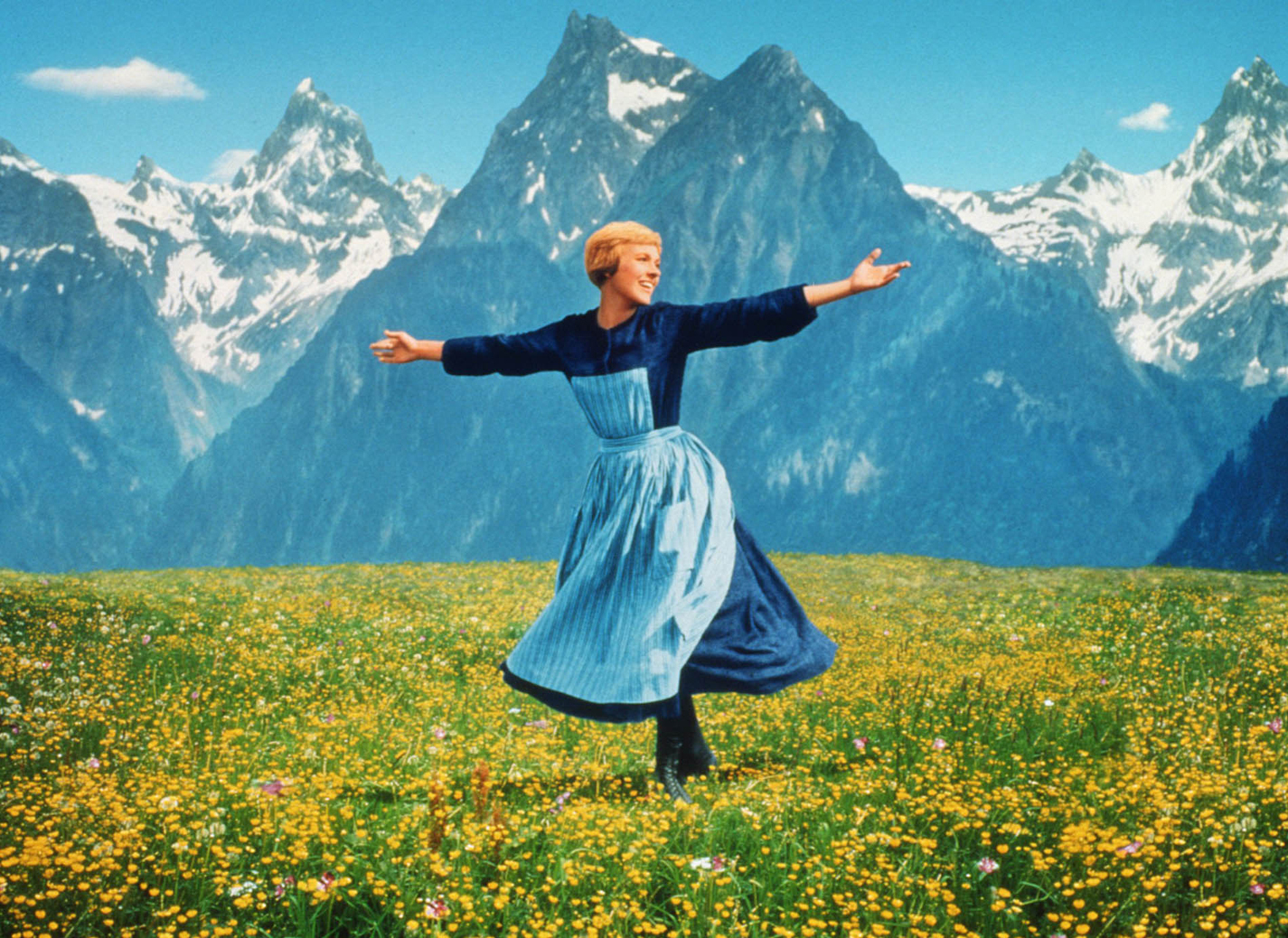
There is something about the musical genre that gives it an aura of timelessness. Watching the luminous Julie Andrews charm her way into the hearts of the von Trapp clan, even for the first time, feels like sinking into a warm and well-worn armchair, and while my first time watching The Sound of Music was just a few years ago, I think on it with the fondness of having loved it all my life. 

Julie Andrews fills the hills with "the sound of music" in the 1965 film.
But what is it, exactly, that makes this film so utterly irresistible? 

Julie Andrews and Christopher Plummer
Is there anything more toe-curling than watching the steely-eyed Captain von Trapp fall for that indecently optimistic Maria? He’s miserable and wry and she makes clothes out of his curtains, and by the middle of the film I’m head-over-heels for the love story I never even saw coming (because she is a nun, after all). The snappy duo share screen time and hero credentials with an almost draconian evenness. Christopher Plummer sulks in the background as Andrews melts the hearts of Austria with her guitar and her inability to take orders from anybody, and after the wedding (the film’s figurative and literal midpoint), Plummer plays with all the good humor and coifed hair of a proper Disney prince, defeating the Nazis, and even crooning a tearful goodbye to his beloved Austria in the process. Plummer likened working with Julie Andrews to “being hit over the head with a big Valentine’s Day Card, every day.” I can only say that watching the couple spring across screen with all of their smiles, scowls, and songs has much the same effect.


Maria and Captain von Trapp share a moment while dancing the ländler.
Triumph against the odds
Let’s face it; despite the flowers and frolicking on the movie poster, this film is pretty dark. There's Maria, who wants so badly to be a nun, but just can’t find the self-discipline. The young von Trapp family is subject to the misguided parenting of the grieving, widowed Captain who doesn’t know how to relate to his children. Lurking behind the beautiful scenery and iconic songs is the ever-present Nazi party, with their very clear message for the von Trapps: join or die. Yet even the impending danger does not detract from the just-plain-happiness that underlines this wonderful story. Maria and the von Trapps find joy in music and each other, and in the end, defeat the bad guys with a song and a morning hike over the Swiss Alps. It doesn’t get much more uplifting than that.

Spoiler alert: the von Trapps have a happy ending.
The sound of all that music
Even before I saw the film, bought the soundtrack, and noted it on my top ten list of favorite movies, I knew at least three Sound of Music songs by heart. This wasn't due to my love of show tunes, but simply by merit of having been a child at one point in my life. Much like that theme of familial happiness that overshadows even the threat of Nazism, each song in The Sound of Music has such joie de vivre that they have no trouble becoming instant and often-sung classics. Whether it be learning the notes of a scale, braving a thunderstorm, or lamenting with Liesl about all of the things I still don’t understand, each time I watch this film I fall in love completely and all over again with the joyful, achingly catchy music, “whether or not I should”.

The family "do-re-mi"s their worries away.
Are you a Sound of Music fan? What are some of your favorite musicals?

Get your toes tapping with Maria and the von Trapps at BMFI’s two sing-along showings of The Sound of Music on Tuesday, December 18 at 7:00 pm and 7:15 pm. Free popcorn if you wear a costume!
 

Erin Korth is currently an intern at BMFI and a thesis-writing senior at Bryn Mawr College, studying English and Film Studies. Along with The Sound of Music, some of her favorite films include It's a Wonderful Life, The Sting, Eternal Sunshine of the Spotless Mind, Bringing Up Baby, Titus, and The Hurt Locker.

Friday, November 30, 2012

Filmmaker Grant Shaud: Why I Love Open Screen

By Devin Wachs, Public Relations Manager, BMFI

On Monday, Bryn Mawr Film Institute celebrates local filmmakers at the first Open Screen Showcase, a compilation of some of the most interesting work from our Open Screen Mondays program. The free event, which includes food and drink, will be emceed by actor/comedian and former MST3K host Joel Hodgson, and is curated by BMFI Lead Manager Mike McCracken.

You may recognize Open Screen Monday contributor Grant Shaud from his role as Miles Silverberg on the long-running TV series Murphy Brown. In the years since, he's been a frequent guest star on such TV series as Law and Order, Pushing Daisies, and Louie. But he comes to Open Screen as a budding filmmaker, and his short "A Five Minute Epic Love Story" is featured in Open Screen Showcase.


Actor and filmmaker Grant Shaud's loves the supportive environment of Open Screen Mondays. His short film is featured as part of Open Screen Showcase on Monday, December 3. (image via)

Mike McCracken interviewed the actor and filmmaker via email about the importance of the Open Screen Monday program.
Why is an Open Screen outlet important for the filmmaking community?
Open Screen is a fantastic place to get to meet people who are actively interested in the process of creating film. It’s a supportive environment for people to show their work and learn.

How is the Open Screen format different than a selective format? 
It's just friendlier and more relaxed. Everything in this country is now about a competition. At the Open Screen, people bring in work that is still in development and not finished. That's how supportive it is. And because of the nurturing environment, some of these projects have gone on to great success at festivals such as Sundance. But they were able to breathe and grow at BMFI. BMFI has tapped into a great source of talent in the Main Line area, but they didn't seem to do it for that purpose. Again, they did it just by encouraging people to come on by and bring their films.

How does this format benefit you as a filmmaker?
It takes the pressure off by not being so results-oriented. If you're not so worried about being "good", you can stumble on to "great".

What did you learn about your work through Open Screen?
I've learned that if you're motivated to actually make a film, it's beneficial to let people see it. I mean, nobody threw me out. They were actually quite effusive in encouraging me to continue to make films. Again, it's an incredibly kind environment. I like being in it whether I have a film to show or not.

Thank you, Grant! See Grant Shaud's short film, "A Five Minute Epic Love Story", at BMFI's Open Screen Showcase on Monday, December 3 at 7:00 pm.


Devin Wachs is the Public Relations Manager for Bryn Mawr Film Institute. She joined BMFI in 2005, following her graduation from Bryn Mawr College. If you send BMFI a message on Facebook or Twitter or are interested in onscreen sponsorships, she's the one who'll be in touch!

Friday, August 24, 2012

Diane Mina Weltman: Why I Love BEN-HUR

BMFI member Diane Mina Weltman discusses why she loves the 1959 epic Ben-Hur, showing Tuesday, August 28 at 7:00 pm at Bryn Mawr Film Institute. Check back for additional posts by BMFI staff and community members that explore the movies we love.


Why I love Ben-Hur
By Diane Mina Weltman, BMFI Member and Film Fan

The chariot race.

While it is not the only reason that William Wyler's Ben-Hur is a favorite, the chariot race ranks at the top of my list of reasons to see the film on a cinema screen. Nine four-horse chariots race around a Circus Maximus set, the definition of grandeur. In a film laced with trumpet and string orchestration, the actual race sequence has no music. This means the thundering beat of horses hooves, the snap of whips, the grinding of wheels by metal spikes, the roar of the 5,000 extras cheering in the stands fill the senses for nine glorious minutes as Charlton Heston (as Ben-Hur, a Jew) and Stephen Boyd (as Tribune Masalla, a Roman) race for glory and revenge.

Charlton Heston as Ben-Hur in the famed chariot race.
In what could be characterized as a showing of uber machismo, the chariot race grabs us by the throat, daring us to ride alongside the stampeding wonder. As I recently listened to Charlton Heston’s commentary about the race (originally taped in 1993), I expected to hear some swagger. After all, he was to become the NRA spokesperson who, in support of his Second Amendment rights, thrust a rifle into the air famously announcing it would have to be removed “from my cold dead hands.”

Heston (who died in 2008) was circumspect, lathering praise for the chariot training he received as well as lauding the work of his stunt double, Joe Canutt. Joe was the 24-year-old son of Yakima Canutt, the film’s stunt supervisor and trainer who went on to work with Heston in El Cid and Khartoum. Heston recalled the elder Canutt telling him to “Just stay in the chariot. I guarantee you’ll win the damn race.”

Heston also debunked three myths that sometimes surface regarding the making of Ben-Hur. The rumors that there was a red Ferrari parked inside the arena, that a stuntman was killed, and that Heston was wearing a wristwatch during the race are all false. His last comment about the race came wistfully; letting the work speak for itself, he said, “Best action scene ever filmed.” While our politics may have differed, I agree 100 percent with his succinct review.

Ben-Hur, a Jewish prince, is sold into slavery after being betrayed by his friend, a Roman.
Ben-Hur blends pageantry with raw beauty in epic fashion. Filmed in Italy and the US, it is a testament to a pre-computer graphics era. Grand scenes provide wonder. Intimate scenes offer emotion. The 3 hour 27 minute running time serves them up banquet style.

Unlike films such as The Ten Commandments or The Robe in which Christ’s life is central to the story, this film incorporates it peripherally, integrating pieces in a parallel storyline. The face of Christ is never revealed, nor is his voice heard.

The impact of a foreign power occupying another country is a theme in Ben-Hur that resonated in America following World War II. The Roman Empire’s sovereignty over Jerusalem mirrored the groundswell of hate and resentment that the world was still recovering from in the post-war ‘50s. However, it is the film’s personal stories within this larger context—a man and his mother and sister, a man and his childhood friend, a Roman consul and his adopted son—that pierce our emotions and make an ancient story relatable.

I remember watching black and white gladiator movies on UHF in the sixties with my two older brothers. The campy grandiosity was irresistible. It hooked me into the Roman-era style movie. Ben-Hur, with its eleven Academy Awards, elevated the genre to combine storytelling and staging to levels unseen at the time.

No film of its type comes close to the impact of Ben-Hur.


Diane Mina Weltman is a BMFI member who enjoys attending performing and visual arts events and writing about them. Check out her blog, A Subject for Consideration.

Dan Santelli: Why I Love THEY LIVE

BMFI concludes its summer season of The Late Show tonight at 11:30 pm with a screening of John Carpenter's 1988 cult classic, They Live. BMFI's Programming Intern, Dan Santelli, tells us why he loves this politically charged thriller. Dan will also introduce the film screening. Check back for additional posts by the BMFI staff and community members that explore the movies we love.


Why I Love They Live
By Dan Santelli, Programming Intern, BMFI

As a movie lover, I’ve always held a personal—and admittedly contrarian—stance that societal problems and issues (be they contemporary or historical) are worked out better and are more attention grabbing when placed in the context of the genre film than that of the “prestige” film (a la Forrest Gump). With genre films, you know what to expect when you go to see one, which gives you a greater opportunity to uncover hidden subtexts and messages. Never has there been a better example of the transcending power of the genre film than John Carpenter’s 1988 thriller They Live, which will screen at BMFI tonight at 11:30 pm as the final entry in the summer season's Late Show series.

Director John Carpenter (Halloween, The Thing) with cast members on the set of They Live.

The premise of They Live is remarkably simple: Nada (WWE’s Rowdy Roddy Piper), a wandering construction worker, rolls into Los Angeles seeking a job. He discovers a box filled with sunglasses, which look as if they were stolen from the set of a Frankie Goes To Hollywood music video. When he tries on a pair, he realizes that the world he thought knew is merely a mirage created by power hungry, capitalist-minded extraterrestrials bent on brainwashing society with upper-class and conservative values.

From the get go, They Live is downright silly and preposterous, as all the Body Snatchers films and rip-offs inevitably are. And yet, this facet doesn’t undermine the movie as much as it only affirms Carpenter’s skill and assurance as a director. His deft, political touch involves us in the increasingly absurd tale of a burly, asocial hero as he blasts his way through Los Angeles conquering aliens and trading insults with them. It’d be too easy to criticize Piper’s characterization of Nada as less a full-fledged character than an expansion on his “Hot Rod” wrestling persona. Doing so misses the point. Much like Jack Torrance (Nicholson) in Kubrick’s The Shining, Nada is an archetype—a cipher standing in for the middle- and working-class Americans lost amidst the corruption and greed of the late ‘80s yuppie culture. Pitted in a world where friend could be foe and almost everyone’s against you, Nada carries the belligerent swagger of a conservative general (think Patton) with a liberal agenda.


John Nada (WWE Superstar "Rowdy" Roddy Piper) ready to kick some butt in They Live.

A USC film school grad who broke into the movies amidst the New Hollywood movement, Carpenter learned his craft by studying and lifting from masters such as John Ford, Sergio Leone, and Howard Hawks (his favorite director). With They Live, Carpenter indulges his love of the 1950s science fiction genre and their themes of Cold War paranoia (Invasion of the Body Snatchers, The Thing from Another World, Red Planet Mars). He uses the tropes while turning their underlying values on their head. What was once a genre telling the audience to “fear the outsider” and promote conservative values has been updated and injected with liberal minded ideology, as well as Carpenter’s contempt for the ‘80s approach to those right-wing politics.

They Live might not be Carpenter’s greatest film, but it remains an essential 1980s genre outing and the work of an oft-misunderstood auteur. Furthermore, it possesses a power that most non-genre films lack because it plays to the mass movie-going public by employing genre conventions while, simultaneously, expressing social/political fears and anxieties in the subtext. With They Live, John Carpenter transcends the genre tropes, while still adhering to them, and offers an elaborate, scrutinizing examination of—at least from Carpenter’s viewpoint—the “evils” of Reaganomics and the ills it inflicted upon society. You might not agree with Carpenter’s political agenda, but there’s no denying his ambitions.


"They" demand that you attend a screening of Mr. Carpenter's They Live.

In this respect, he ranks alongside fellow filmmaker and pop-satirist Joe Dante, whose vastly underappreciated Small Soldiers—a scathing anti-war satire disguised as a kids’ summer blockbuster—plays like a hybrid of Dante’s own Gremlins and They Live by creating an intelligent argument against the practice of packaging war for mass youth consumption. The Dante/Carpenter comparison could be explored further, on a surface level at least, as both directors are apparent cinephiles and Baby Boomers who grew up in the 50s and 60s, compulsively consuming science fiction and horror movies. This love is expressed through each director’s filmography, which divides critics, audiences, and cineastes, but has garnered both directors massive international cult followings (particularly in France). Their subversive wit, macabre interests, and scattershot bankability has ultimately forced them to work outside the studio system in order to express their love and craft.

Directors John Carpenter (above) and Joe Dante (below): Masters of the (Subversive) Macabre.

Of course, one can’t discuss They Live without noting what is, perhaps, the movie’s most memorable scene: an infamously prolonged slugfest between Piper and actor Keith David. Beginning around the 56-minute mark and lasting nearly five minutes, it’s a pile-driving, bruise-beating, no-holds-barred brawl that almost seems to have been extracted from a Chuck Norris movie. At least Carpenter has the sense of humor and intelligence to have fun with the scene—he noted in a making-of documentary that since he cast a notable wrestler as the lead, he might as well exploit his talents in the movie. As noted by film critic Jonathan Rosenbaum in his review of They Live, the Howard Hawks influence on Carpenter’s work might explain why he would extend this scene to the degree that he did: “buddies have to slug it out in order to become friends.” Boy, do they ever.

They Live is crude, lewd, trashy, goofy, and sensationally silly. At the same time, it’s an endlessly entertaining and thoughtful rumination on the ‘80s culture, with messages and themes which continue to be relevant today, post-9/11. Piper more than holds his own amidst the chaos and, while he’s by no means the world’s greatest actor, develops a persona that’s charismatic and charming. He’s a classic John Wayne-inspired Carpenter hero. Alongside the (lovingly) cheesy humor and rough-and-ready special effects is director Carpenter working to provoke thought in his audiences with stimulating political allegories and social criticism. It’s a singular, ridiculous hoot and Carpenter wouldn’t have it any other way. Even if you don’t agree with the subtext, it’s impossible not to appreciate the sublime ridiculousness of a movie that contains the line “I have come here to chew bubblegum and kick ass…and I’m all out of bubblegum.”


They Live, We Sleep: Sunglass vision reveals the aliens in hiding.

Below is the They Live "making-of" documentary referenced above. Enjoy!


Dan Santelli, BMFI's Programming Intern, is a 2012 graduate of Temple University with a Bachelor's degree in Film and Media Arts. A lifelong cineaste, his favorite films (in no particular order) include Leon: The Professional, The Night of the Hunter, Touch of Evil, Blue Velvet, Brazil, Apocalypse Now, Dressed To Kill (1980), Halloween, and Les Yeux Sans Visage.

Tuesday, August 14, 2012

Gus Cileone: Why I Love THE RIGHT STUFF

BMFI will screen The Right Stuff on Tuesday, August 21 as part of the "Director in Focus: Philip Kaufman" film series. BMFI patron and film aficionado Gus Cileone tells us why he loves this Kaufman classic. Check back for additional posts by BMFI staff and community members that explore the movies we love.


Why I Love The Right Stuff
By Gus Cileone, BMFI Patron, Student, and Volunteer

[Spoiler alert.]

There were many fine films in 1983—including The Big Chill and Terms of Endearment—but for my money, The Right Stuff, directed by Philip Kaufman, based on the book by Tom Wolfe, was the best movie that year. One thing this film is so successful at doing is showing heroes as real people with definable character traits. It accomplishes this feat without diminishing what these men achieved, or undermining the courage needed to face the unknown obstacles confronting them.

The tone is set by the opening voiceover describing test pilots in epic hero terms as they chase the "demon" out there in the sky. The men’s quest to break the sound barrier and "punch a hole in the sky" emphasizes the theme that people must break through the barriers that try to contain them.

The pilots are all distinct personalities, revealed with humor and insight. John Glenn comes off like a squeaky clean Marine. Ed Harris even looks like Mr. Clean in the TV commercials. He can't curse when he is angry, and leaves the profanity to the other pilots to fill in the objectionable words when he speaks. He is admirable as he backs up his wife, who has a speech impediment, so that she doesn't have to let in the press and the grandstanding Lyndon Johnson when they are camping out on her front lawn. Alan Shepard, played by Scott Glenn, is a mischievous prankster, who does inappropriate Hispanic impersonations of then-comic Bill Dana's politically incorrect persona. Gordon Cooper is a bragging charmer, played by Dennis Quaid, who keeps asking "Who is the best pilot you ever saw? You're looking at him." He is so cool that he has to be awakened after falling asleep in the space capsule just before his launch. His pal, Fred Ward's Gus Grissom, calls him a "hot dog," and there is a chilling scene as he holds up a burnt-to-a-crisp hot dog at a barbecue, which strikes Cooper’s wife as a bad omen. Grissom is a man of few words, and is stoical most of the time. But he knows how to get the other astronauts to unite and take control of their missions. He emphasizes how they must show their superiors that the test pilots are not just the equivalents of chimpanzees. He makes those running the program realize how much they need the astronauts, because they are the ones who generate funding, when he says, "No bucks, no Buck Rogers."


The pilots of Mercury 7 (from left to right): Gus Grissom (Fred Ward), Gordon Cooper (Dennis Quaid), Deke Slayton (Scott Paulin), John Glenn (Ed Harris), Scott Carpenter (Charles Frank), Alan Shepard (Scott Glenn), and Wally Schirra (Lance Henriksen).
Sam Shepard's Chuck Yeager, the test pilot who first broke the sound barrier and who refused to become an astronaut, is the most iconic character portrayed in the film. After breaking the barrier, he howls at the moon, presaging the time when man would land on earth's satellite. He is the essence of cool, quiet manliness. But when he gets knocked off his horse after hitting a tree branch while galloping after his wife (Barbara Hershey), he tells her, "I'm a fearless man, but I'm scared to death of you." One of the last scenes in the film has Yeager ejecting from a doomed test plane. You can't help but be moved when Yeager, his face greasy and looking burned, strides away from the wreckage. One of the soldiers asks, "Is that a man?" Another says, "Yeah, you're damn right it is!" Machismo in the most dignified sense of the term. When the bar where the first test pilots congregated burns down, it symbolizes the passing of an era, as Yeager figuratively passes the baton to the next generation of "star voyagers."


Chuck Yeager (Sam Shepard) returns after a successful test flight.
These men are supported by their long suffering wives, who shudder every time the "man in black" appears to give them the bad news whenever one of their pilot husbands crashes. Mrs. Cooper (Pamela Reed) leaves at first but later returns to back up her husband. Mrs. Grissom (Veronica Cartwright) rails against the military because they owe her for her sacrifices. As one of the wives says, the military spent a lot of money to train their men, but nothing to prepare the wives to be fearless. But these women obviously were attracted to these men; as Mrs. Yeager says, she must have been drawn to a man who "pushed the outside of the envelope."


Louise Shepard (Kathy Baker), accompanied by her fellow pilot wives, listens as her husband's fate is revealed over the phone.
Besides showing the challenges that these men face, the film is notable for its humor. Jeff Goldblum and Harry Shearer are very funny as they show films of potential astronauts to the President and his top officials. They say surfers would be good for splashdowns and car racers even have their own helmets. Eisenhower comes off pretty well as he rejects the outrageous nominees and insists on test pilots, whom his advisers consider to be uncontrollable. Since the Russians were the first to send up an orbiting satellite, our technical ability is questioned by these advisers. But they are assured by rocket scientist Wernher von Braun that "our German scientists are better than their German scientists."

The best comic scenes center on the tests that the men must pass, which look like torture treatments. You have to laugh when Scott Glenn can't remove his arm off of the table after a needle has overstimulated his muscles. The scene where he has a balloon inflated in his rectum and he must run to the bathroom to relieve himself is also hysterical. Another hilarious sequence is when the men need to provide sperm samples. Cooper knows Glenn is in the next bathroom stall because he is humming the Marine Corps theme song. Cooper tries to drown it out with the Air Force counterpart, and the sounds get louder as they race toward their respective climaxes. Of course, the scene that shows Mission Control having no contingency for going to the bathroom in space for the first flight overflows with humor. We roar as Shepard, who had drunk numerous cups of coffee, grimaces and must request permission to relieve his bladder into his spacesuit.


The pilots undergo one of their many pre-departure tests.
This film expertly shows the bravery and failings of these space pioneers, and it, along with Apollo 13, reminds us of a can-do America where "failure is not an option."


Gus Cileone is a retired government employee who worked for the Department of Veterans Affairs. He has received several writing awards and has published two novels, A Lesson in Murder and Feast or Famine. You can visit his web site at www.augustuscileone.com.

Friday, July 20, 2012

Anmiryam Budner: Why I Love REBECCA (and My Daughter Didn't)

BMFI Board Member Anmiryam Budner shares why Hitchcock's Rebecca has been a favorite since she first saw it in the 1970s, and how her own interpretation of it changed when she discovered that her teenage daughter's reaction to the film was very different. See Rebecca on the big screen on Tuesday, July 24 at 7:00 pm at Bryn Mawr Film Institute, introduced by Andrew J. Douglas, Ph.D.


Why I Love Rebecca (and My Daughter Didn't)
By Anmiryam Budner, BMFI Board Member

[Please note that this contains spoilers.]

“Last night I dreamt I went to Manderley again.”

I first heard that oh-so-famous line in 1977 sitting in the Regency Theater on Broadway between 67th and 68th streets in NYC. I was fifteen years old and had already sat through Gaslight, the first film on the double feature bill. I have never been sorry that I took those four hours to sit in the dark and watch these classics about young women facing danger, physical and psychological. And, while I still love Gaslight, it is Rebecca that enveloped me then and continues to fascinate me to this day.

My boss, who had alerted me to the program, later admitted that she sent me off to the theater knowing that I would completely and utterly identify with the second Mrs. de Winter as played by Joan Fontaine. Despite a courageous start, shouting to prevent Maxim de Winter’s presumed suicide on cliffs in the south of France, she is almost immediately revealed to be young, gauche, poor, utterly insecure, and nameless. She bites her lips, bites her fingernails—rather, Joan Fontaine gamely pretends to bite them since it’s clear that her manicured movie star fingernails had not been subject to nervous gnawing until the moment called for in the script—knocks vases over and gratefully obeys when Maxim tells her to eat up her lunch. At fifteen I yearned for romantic attachment, while also craved relief from the demands of encroaching adult responsibilities. That a handsome, brooding, rich, and English older man would notice me, like me, and, in an impulsive moment, whisk me away from the cares of a subservient existence—in my case the mundane woes of making it through high school as an unattractive bookish teenager—this was a mythic tale near and dear to my heart.

The unnamed second Mrs. de Winter looks around the deceased Rebecca's bedroom, preserved intact. 


Of course, unlike so many classic romances, marriage is not the end of Rebecca, but only the first act. The real heart of the movie only begins to unfold when the newlywed odd couple arrives back at Manderley. No mere house, but a menacing castle with a large staff, unused wings, and a routine established by the first Mrs. de Winter, the dead—but ever present—Rebecca. And, let’s not forget Mrs. Danvers, perhaps one of the most frightening figures ever seen on a movie screen. Judith Anderson’s strong, plain face with its beaky, jutting nose, framed by a wreath of black braids so tightly wound they must have hurt, and those hands, always folded, clutching each other, lest she explode… I still shudder every time she appears on screen.


I rooted for Joan Fontaine as she adapted to this overwhelming environment and winced at each of her missteps. I tensed when it appeared that Rebecca and Mrs. Danvers would destroy Maxim and his young bride. I sighed in relief when, despite the loss of Manderley, the movie ended with a promise of happiness with the unnamed second Mrs. de Winter’s emergence from the cocoon of adolescence into adult partnership and the elimination of Maxim’s guilty secret. Though, like Maxim, I mourned the loss of innocence that was necessary to their building a more adult relationship. I wasn’t ready to grow up and so I wasn’t ready for the character to do so either.

Over the decades I approached repeat viewings of Rebecca without questioning my easy adoration. In fact it held a place in my pantheon as a piece of art that allowed me to recapture the glorious loss of self that is so difficult to find in anything—books, movies, music—after childhood. I moved on through college, graduate school, career building, and parenting. Through it all, Rebecca remained visual comfort food. VHS and DVDs made it easy for me to return to Manderley again and again; to relive the sensation of being rescued, threatened, and then finding true safety. It wasn’t until I attempted to watch the film with my then-eleven-year-old daughter that I began to peel back the layers of complicated pastry that supported the strudel I was downing with relish.

I approached the moment with high expectations. We had watched a number of classic films by this point and she had also evinced a taste for romantic comedy that led me to think Rebecca would be a hit with her. Therefore, I was shocked when, fairly early in the movie, soon after the action shifted to Manderley, my daughter paused the disc and announced, “I don’t like it. She’s such a wimp. Why doesn’t she stand up for herself?”

She liked her heroines to be heroic, or at least not scared of their own shadows. The girl on the screen was lacking in everything to which she aspired: she wasn’t confident, she didn’t speak her mind. In short, she was contemptible. “Just wait,” I said. “She gets better by the end. Really, you’ll love it,” I promised. Then I begged, but she was stubborn.

I think it we ended up re-watching one of the Harry Potters. Sigh.

I was crushed that my child, my wonderful, glorious child, didn’t immediately fall under the spell of this great movie I loved so much. What had I done wrong?

Eventually I pulled back from my bitter disappointment and understood that I had done nothing wrong. In fact, her reaction was a good thing. Really, did I want my child to suffer from the same insecurities that had plagued me? Of course not. On the contrary, I was relieved to discover that she was stronger and less afraid of the world than I had been at the same age.

The second Mrs. de Winter can only be a true partner to Maxim (Laurence Olivier) after she learns the truth about Rebecca. 


Okay, that’s good. I even admitted to myself that she had a point. You pity the second Mrs. de Winter, but you also want to smack her. Why doesn’t she insist that Maxim offer a tour of his castle or confront him about his feelings for his first wife? Wouldn’t any sane person insist on firing Mrs. Danvers after taking one look at her? Did this different way of interpreting the main character mean I couldn’t love this movie anymore?

No, I still loved it, and I was surprised to discover that in looking at it without resorting to the primal response pathways I had laid down in my youth, that other meanings coexisted with my original interpretation without negating it. For one thing, it’s a morally unsettling story. Rebecca’s death is ruled a suicide, but we know Maxim is in fact guilty of killing her and hiding her body. True, she probably intended him to kill her, but does that excuse him?

Claustrophobic close ups intensify our discomfort at Mrs. Danver's attempts to intimidate and destroy the second Mrs. de Winter.

Above all, I started to develop an inkling of the true genius of Hitchcock’s direction. He used all of the tools he had—editing, mise-en-scène, lighting, and music—to produce an atmosphere of menace that permeates the entire film. He heightens psychological tension through the use of close ups, nestling actors so tightly together that it makes me as a viewer feel that the vast spaces of Manderley are overwhelmed by the claustrophobia of sexual tension and jealousy that are poisoning the household. He even manages to hint that Mrs. Danver’s obsession is fueled by repressed lesbianism without, needless to say, ever stepping past the allowable conventions of the time.

Even if you’ve seen it before, go again on Tuesday, July 24. Andrew Douglas, who knows way more about this film than I do, will help you to discover something new.


Anmiryam Budner, a life-long film addict, is a BMFI Board member and Bryn Mawr resident. In addition to sitting in the dark watching movies she is also an avid reader, knitter, and aspiring writer.

Monday, July 16, 2012

Juliet Goodfriend: Why I Love TO ROME WITH LOVE

BMFI President Juliet Goodfriend shares her thoughts about Woody Allen's latest ensemble comedy, To Rome with Love, currently playing at BMFI. Check back for more posts from BMFI staff and community members that discuss the films we love.


Why I Love To Rome with Love
By Juliet Goodfriend, BMFI President

Why do I love Woody Allen's To Rome with Love? It's more than the scenery, more than the wonderful return of comedian Woody on his screen. It's the satire he uses to propel the theme (that happiness comes only to those who get back into their own authentic skins and out of the phony world of celebrity). The film is totally unified around that theme, even if the time sequencing expands and contracts throughout the film.


But my special epiphany came an hour after I saw it, when I recalled Barcelona performance troupe La Fura dels Baus's staging of Das Rheingold, which was performed at the Palau de les Arts Reina Sofia in Spain and broadcast in HD here at BMFI. The Rhine Maidens rose from below in three lucite boxes, filled 3/4 full with water and sang and swam about for many minutes.


If that did not inspire Mr. Allen's tenor-in-a-shower delight in To Rome with Love, I don't know what did. And, by the way, throughout the Rheingold opera I was afraid the maidens would get chilly in the water or aspirate some. I had the same fears for tenor Fabio Armiliato during his arias in the shower. But no one choked or chilled, the audience just basked in the clever warmth of this artful work.

Opera star Fabio Armiliato plays an undertaker whose vocal talent is discovered while he croons in the shower in Woody Allen's To Rome with Love.

If you've seen To Rome with Love, what are your thoughts about the film?

Tuesday, July 10, 2012

Valerie Temple: Why I Love THE APARTMENT

We’re showing Billy Wilder’s The Apartment on 35 mm on Wednesday, August 11 as the official start to our “It’s a Mad Men’s World” film series. Programming Manager Valerie Temple shares three reasons why it’s her all-time favorite, film-wise. Check back for additional posts by BMFI staff and community members that explore the movies we love.


Why I Love The Apartment
By Valerie Temple, Programming Manager, BMFI

[This post contains SPOILERS, so be warned!]

The Apartment is my declared favorite movie. When someone asks me “What’s your favorite movie?” I answer, “The Apartment” without hesitation. This wasn’t always the case. Years ago, whenever someone dared to posit the dreaded favorite movie question, I would refuse to give a straight answer. “It’s too hard to pick just one,” I’d say. “I can give you my top ten, but that’s the best I can do.”

But then, during my junior year of college, I checked a certain VHS tape out of the campus media library to watch alone in my dorm room. Although hardly an ideal viewing environment for such a classic, the small screen failed to diminish the impact of Billy Wilder’s masterful direction, I.A.L. Diamond’s sparkling dialogue, and, most importantly, the intoxicating chemistry between leads Jack Lemmon and Shirley MacLaine. I was hooked immediately. It was love at first sight, and eleven years later it still tops my list.

What’s so great about The Apartment?

I’m glad you asked!

Bittersweet comedy – Although The Apartment retains the #20 spot on the American Film Institute’s 100 Years…100 Laughs list, it differs tonally from most straightforward comedies. This atypical film combines laugh-out-loud comedy with some very dark moments. I mean, how many comedies out there include a suicide attempt by one of the main characters?! And yet these tragic scenes do not detract from the overall humor of the film. In fact, they imbue the story and characters with humanity that is often not found in less sophisticated fare. The tightrope balance that Billy Wilder manages to tow between comedy and tragedy is truly commendable, and sets The Apartment apart from the rest.

C.C. "Buddy" Baxter (Jack Lemmon) receives his highly-anticipated promotion after allowing his superiors to use his apartment for their romantic encounters.

Jack Lemmon as C.C. Baxter – Jack Lemmon has infused wit and warmth into many unforgettable roles (Felix Ungar in The Odd Couple, George Kellerman in The Out of Towners and John Gustafson in Grumpy Old Men, to name a few) but his prodigious talents are on full display as lovelorn office drone C.C. Baxter. In a difficult role that requires both immense comedic timing as well as the capacity for deep, tender emotion, Lemmon shines. He can be hilarious by doing something as simple as making a pasta dinner (with a tennis racket!), but he’s equally as adept at finding poignancy in the many downbeat moments of the film. Lemmon’s even able to make you laugh even while you’re crying, like the scene where a morose Baxter tries to drink thoughts of Miss Fran Kubelik (MacLaine) away and ends up dancing cheek to cheek with a blonde barfly. He so deftly embodies the role, it’s hard to imagine anyone else in it.

Buddy tries to impress Fran (Shirley MacLaine) with his creative cooking skills.
Best last line of a movie EVER – If this was the Family Feud, the most popular answer for a question about memorable final lines in movies would most likely be “Louie, I think this is the beginning of a beautiful friendship” from Casablanca. For me, it doesn’t get better than the final line in The Apartment. After finally realizing her love for Baxter, Miss Kubelik high tails it back to the apartment, only to be stopped short by an ominous noise coming from behind the door. Is it a gunshot? No, it’s the “pop” of a champagne bottle, opened by Baxter to celebrate his plans to move from the tainted apartment (and becoming a “mensch”). The rest of the scene is a master class in understatement. As Fran talks with Baxter she takes out the deck of cards that the pair bonded over earlier in the film and begins to shuffle. When it dawns on Baxter that Fran has chosen him and she plans to stay, he states plainly “I love you, Miss Kubelik. You hear what I said, Miss Kubelik? I absolutely adore you.” True to the salty-and-sweet tone of the film, Miss Kubelik simply offers him the cards, smiles softly, and commands Baxter to “Shut up and deal.” This sharp little exchange is romance without the schmaltz, but it is still as effective as, say, ending on a big kiss like a typical romantic comedy would do. More so even, because it is so restrained. I still get chills watching it.


I could go on and on, but those are just three reasons I love The Apartment, and three reasons for you to see the gorgeous 35 mm print of the film screening at Bryn Mawr Film Institute on Wednesday, July 11 at 7:00 pm. Don’t miss it!


Valerie Temple is the Programming Manager at Bryn Mawr Film Institute. She has an M.F.A. in Film Production from Boston University and thinks she's very funny. (Her words.)

Friday, June 29, 2012

Gus Cileone: Why I Love BRAZIL

BMFI will screen Terry Gilliam's cult favorite Brazil next Friday as part of The Late Show's tribute to "'80's Hollywood Oddities". One of BMFI’s most dedicated patrons, Gus Cileone, offers us his take on this bizarre sci-fi comedy. (You can find another perspective on Brazil from BMFI Programming Intern, Dan Santelli.) Check back for additional posts by BMFI staff and community members that explore the movies we love.


Why I Love Brazil
By Gus Cileone, BMFI Patron, Student, and Volunteer

Since I was a Federal employee with the Department of Veterans Affairs for 35 years, I am familiar with the machinations of bureaucracy. I experienced the crazy regulations and redundant procedures imposed upon me as a civil servant as I worked to finalize disability claims for veterans. Although one can experience the frustrations of the individual confronting large institutions in the private sector as well (anyone who has tried to get his or her cable company to fix a problem knows about that), the fear of a centralized, all powerful entity strikes totalitarian fear into those who particularly value personal freedom.

Sam Lowry (Jonathan Pryce, left) arguing over bureaucratic issues with co-worker Harvey Lime (Brazil's screenwriter, Charles McKeown, right) at Information Retrieval.

So, it's not surprising that a movie like Brazil would draw my interest given my work background. Add to that the fact that I am a Monty Python fan, and Terry Gilliam is the director, and the deal is sealed. The film is a dark comic take on the plot of 1984, with a Big Brother government and modern technology that looks old (very much the way the future appears in Gilliam's 12 Monkeys). There is the dissatisfied worker, Sam Lowry (played by Jonathan Pryce), who is drawn into the resistance movement because of a girl (in this case Jill, played by Kim Greist). The individual is not successful here, either, at least not in the "real" world. The difference is that while 1984 is deadly serious, Gilliam pulls out all the stops and turns the cautionary tale into a satire.

Air ducts represent one of the primary visual motifs in Terry Gilliam's Brazil.

Probably the most effective images Gilliam employs in the movie are ugly air ducts that snake through every room in this brave new world. They look like the tentacles of a huge monster invading everyone's lives. There is a great scene where Robert De Niro appears as a renegade repairman dressed like a military commando. In it, he opens up the walls of Lowry's flat and the ducts expand and contract, as if breathing. This metaphor is an apt one showing the intrusion of the government into individual lives. This privacy invasion is also seen when the two main characters are physically prodded by machines as Lowry goes to his mother's party and Jill confronts a government official about the wrongful abduction of her neighbor. It also seems that the film is saying that the more mechanized our society becomes, the more chances there are for the machines to break down. There are numerous illustrations of this fact, what with Lowry's coffee machine pouring liquid on his toast, his air conditioning breaking down, and plastic surgeries becoming fatal. When "Central Services" is called to fix things, they are either unavailable, don't have the proper paperwork, or create more damage instead of repairing anything. The phones in the film have the most annoying ring tone around, sounding like a demonic dentist drill. Of course, the more things break down, the more the population is dependent on those in control of the systems in place.


Totalitarian regimes try to control their subjects by manipulating the outward appearance of the world in contrast to the underlying reality. The emphasis on having plastic surgery in the film illustrates this idea. Also, in the movie, the food at the restaurant served to each person is a yucky mush. But each plate is accompanied by a picture of a savory meal, implying that is the reality they are to buy into. And explosions are ignored as room screens are placed around the diners' table, promoting the idea that one should ignore the negative elements in the environment.

Lowry's boss, Mr. Kurtzmann (Ian Holm), greeting his employees in the morning.

The paperwork here is labyrinthine, where you need a receipt to show proof that you have received a receipt. It is paralyzing and strikes fear into people (such as Lowry's boss, played by Ian Holm) if procedures aren't followed, which appears to be the goal of the organization. Gilliam seems to be saying that this type of world wants people to be frustrated and feel powerless. Another brilliant and devastating image occurs when in Lowry's dream state, the resistance blows up the Ministry of Information and there is paper everywhere. The paper covers and entangles De Niro, and he disappears in it, symbolizing how the individual is lost in the whirlwind of bureaucratic red tape. The effect of the dehumanizing bureaucracy is shown in the offices where Lowry goes after his promotion. There are numbers on office doors, not names. His office is so small it looks like a closet, or the size of a prison cell. People are seen as becoming diminished and restricted. But Gilliam never shows us any manipulating, all powerful heads of state. It’s as if this bureaucratic and mechanistic construct here has a life of its own.

One of the many propaganda slogans that indicate the skewed mindset of Brazil's totalitarian government.

One of the posted signs in the street says "Suspicion breeds confidence." People have been taught to suspect each other. That way, they will not band together, and become stronger. Later in the film, Lowry asks Jill to trust him, and realizes that he has to earn her trust if they are to succeed. There is another sign which reads "Happiness – we're all in it together," which is an anesthetizing slogan to placate the people. When De Niro says, "We are all in it together," it is genuine because it is in the context of the power of joined resistance to authoritarianism.


The soundtrack has the song "Brazil" being played. It is a Latin-infused, fun, liberating song that stands in contrast to the lives of the characters. Lowry escapes his claustrophobic, penal colony of a world by losing himself in a dream state. There, he flies on Daedalus wings in the sky, pursuing his blonde fantasy (also Jill), doing battle with the monsters imprisoning her. (Robin Williams lives in a similar fantasy in Gilliam's The Fisher King). In the end, when he is a restrained captive, Lowry's body may be enslaved, but his mind has escaped into the freedom of his imaginary world.