Showing posts with label Juliet Goodfriend. Show all posts

Friday, September 13, 2013

Juliet Goodfriend: Toronto International Film Festival 2013

By Juliet Goodfriend, BMFI President

This year I had only four days at the Toronto International Film Festival (TIFF) and each one was packed with four to six full-length movies and a handful of twenty-minute samplings in some rare free moments. I had trouble with Twitter, so abandoned it. Below are my faux tweets.

Themes this year a bit harder to discern, but one theme I noticed was passion, in its many forms: alive, dead, dying, gone bad. These films are indicated below with a (P) at the end of the film blurb. There were at least four films on “Words”, of which I saw three, indicated with a (W). “No crime goes unpunished” or Aquinas’ “the ends never justify the means” was the final theme of the last two films I viewed, indicated with an (E) for “ends”.

Going to TIFF is work. I am in search of movies to show at BMFI and I look at all films through that filter. “Yes” means we would show it, “No” means we would not show it, and “Maybe” means just that.

Labor Day (d. Jason Reitman) – USA
Would we like to show this? –Yes
Kate Winslet is again wonderful in this absorbing “hostage-romance” film. Tension maintained with rewarding results. (P)

Tim’s Vermeer (d. Teller) – USA
Would we like to show this? – Yes
Wealth enables this obsessive inventor to work out the technology behind Vermeer’s art. Very interesting doc, though a bit too self-indulgent.

Le Week-end (d. Roger Michell) – UK
Would we like to show this? – Yes
If only the wife in this 30-year marriage weren’t so sadistic and mean… but that’s part of the uniqueness of this aging couple rom-com. Scenes of Paris sweeten the taste and soften some of the truthfulness of their conflicts. Must now watch Le Weekend of Goddard to appreciate its references.

I Am Yours (d. Iram Haq) – NOR
Would we like to show this? – No
While this exposes the multicultural picture of Norway to some extent, it is narratively weak.

Prisoners (d. Denis Villeneuve) – USA
Would we like to show this? – Yes
A great director and wonderful cast, but a few loose ends in this remarkably tense and a bit too gruesome story mar its polish. (P)

This is Sanlitun (d. Róbert I. Douglas) – CHN/ISR/IRL
Would we like to show this? – No
Not a funny enough spoof on ex-pats in this stylish neighborhood of Beijing. The idea is there, but the execution did not have me laughing—and it was supposed to, I think. What does come through is the arrogance and naivete of westerners trying to make it in China. (W)

12 Years a Slave (d. Steve McQueen) – USA
Would we like to show this? – Yes
A remarkable true story that we all wish were fiction, expertly executed with a superb cast. Should we wonder why an Englishman was the one to bring it to our attention on the screen? It is far better than the trailer, and will be a “must see” for everyone. (E)


Bad Words (d. Jason Bateman) – USA
Would we like to show this? – Yes
Light and funny, at last, this spelling-B farce is a good night’s entertainment! (W)

Love is the Perfect Crime (d. Arnaud Larrieu) – FRA/SUI
Would we like to show this? – Maybe
I am a sucker for Mathieu Amalric, architecture, and the alps in winter, but the peculiarities of this thriller don’t quite live up to the setting and the cinematography. (E/P)

Gravity (d. Alfonso Cuarón) – USA/UK
Would we like to show this? – Yes, but not without 3-D
Finally, a film that rationalizes 3-D. Neither the two characters nor the appreciative audience (will) have much to talk about. Here a picture wins out over words (see below movie of similar title). Total immersion in CGI and exhausting.

Enough Said (d. Nicole Holofcener) – USA
Would we like to show this? – Yes
Charming and poignant, given the recent death of the male star, James Gandolfini. The naturalness of the characters enrich this sweet, but not saccharine, romance.


Words and Pictures (d. Fred Schepisi) – USA
Would we like to show this? – Yes
Why is the part of the eccentric American English teacher given to Brit Clive Owen, who cannot quite hide his accent? Any number of great male actors could have done it. At least Juliette Binoche is playing an artist whose unexplained French accent may make a bit more sense. Am I picky? Yes. This film deals with a wonderful subject, yet it is a bit too predictable and fey. Can’t the battle between words and pictures, fought by newly energized students in a prep school, be enough in itself without throwing in the 12 Step program to save the drunken English teacher? (W)

Walesa. Man of Hope (d. Andrzej Wajda) – POL
Would we like to show this? – Maybe
Poland’s greatest filmmaker combines reenactment and archival footage to explore the motivation and methods of this simple man who did so much to change the world in the 1980s. Worth seeing to remember him and learn what happened (probably) behind the scenes.

When Jews Were Funny (d. Alan Zweig) – CAN
Would we like to show this? – Yes
I can’t believe it, but I got a bit tired of the question, “Are Jews funnier than others?” However, there are enough laughs to satisfy most Jewish audiences, even if the filmmaker can’t quite focus on what his real questions are. Did you hear the one about the thirsty guy…? (W)

Fading Gigolo (d. John Turturro) – USA
Would we like to show this? – Yes
Of course we all will go to a movie written, directed, and co-starring John Turturro and Woody Allen (who MUST have had a hand in the directing and writing, don’t you think?) Turturro is a believable novice prostitute. Woody as pimp is funny and slightly embarrassing. His living with a black family and supporting a Hasidic widow are both confusing plot features that may be his idea of a perfect NY story. Sure you’ll go see it.

Wonders (d. Avi Nesher) – ISR
Would we like to show this? – Maybe
Alice in Jerusalem might be its subtitle, and that city is as much the star of this film as the humans who are caught up in a religio-criminal-fraud tangle that provokes giggles if not laughs.

American Dreams in China (d. Peter Ho-sun Chan) – HKG/CHN
Would we like to show this? – Yes
China’s economic success is powered by creative entrepreneurs who, in the case of this movie, are funny and inventive. Their goal is an English language school to prepare millions of young Chinese with better TOFL scores for entry into US colleges. Their friendship survives partnership travails. The choppiness of the narrative is challenging, but the heart of this film is solid. And Christopher Doyle’s camerawork is as remarkable, as usual.

Enemy (d. Denis Villeneuve) – CAN/ESP
Would we like to show this? – No
A great director entirely off his mark. This is a slow moving doppleganger story that looks like a psychological thriller but one leaves without an inkling as to what is going on in the psychology of the character. The entire audience was in the dark, I sensed.

Night Moves (d. Kelly Reichardt) – USA
Would we like to show this? – Yes
A very good tale that proves, as St. Thomas Aquinas argues, the ends do not justify the means. No matter that the environment (water, in this case) may be improved, be wary of your means. What’s wrong is wrong. OK, got the point. This movie brings it to life quietly and with some terrific acting and directing. (E)

Therese (d. Charlie Stratton) – USA
Would we like to show this? – Yes
Another case where the crime cannot be justified and the sinners get their just deserts. This is a close adaptation of Zola’s novella and beautiful and poignantly set. Jessica Lange is the strong centerpiece of this cast. It is a costume piece with finely carved characters, great atmosphere, and good pace. (E)

Tuesday, July 2, 2013

Russ Collins: Close Encounters of the Implosion Kind

Russ Collins, the Director of the Art House Convergence conference and a fellow film exhibitor, wrote a thoughtful essay responding to the somewhat alarmist predictions for the future of the film industry recently espoused by Steven Spielberg, George Lucas, and Steven Soderbergh. It is an excellent assessment of our industry and the role of art house movie theaters within it, and I echo his views. We are pleased to share it with you here.
- Juliet Goodfriend, President, Bryn Mawr Film Institute


Close Encounters of the Implosion Kind
Guest post by Russ Collins, Director of the Art House Convergence

Gary Meyer, [co-director of the Telluride Film Festival,] wrote, "I do not like to be a doom and gloom guy but I think there are big changes afoot for commercial cinemas, but not the scenario predicted here: Steven Spielberg Predicts 'Implosion' of Film Industry."

Like Gary, I am not a doom and gloom guy. However, it is tempting for older cinema artists like Steven Spielberg and soon-to-retire artists like Steven Soderbergh (or maybe it’s just filmmakers named Steven!) to see gloom in clouds of change. Change is hard. It frequently makes us feel discouraged or unfairly challenged. The shifting sands of change can cause us to see threats everywhere and feel the world as we know it will end. However, maybe we feel this way because it’s true. The world as we know it will indeed come to an end because change is the only constant, and creativity in art, business and all things is frequently born from what might appear to be destructive forces brewed from dynamic change. It is a defining story of living; a baseline truth, an ever repeating cycle of human existence that the Hindu religion represents so effectively in the story of Shiva, whose joyous dance of destruction celebrates the cycle of creation, preservation, and dissolution.

SHIVA DANCED ON THE MOVIES IN THE 1950s

Movie attendance at theaters in the USA by the late 1940s appeared stable at 4 BILLION admissions per year. By the early 1960s, movie attendance at theaters had fallen dramatically and re-stabilized at around 1 billion admissions per year—the theatrical audience was just 25% of what it had been 16 years earlier. It’s hard to imagine. We can feel better about movie attendance over the last 16 years because at about 1.4 billion annually, USA theatrical movie admissions have been fairly stable.

However, as a highly profitable, highly centralized business model, the movies—the pre-TV, Hollywood studio system heyday of the ‘20s, ‘30s and ‘40s—died in the 1950s. Shiva danced and Hollywood’s heyday died as television became a mature mass media market. During the 1950s, television replaced movies as the mass market media phenomenon of the 20th century. So the truth is, since the 1950s, movies, meaning all movies shown in theaters, are not “mainstream.” Movies shown in theaters are merely a specialty market with larger market segments (Hollywood blockbusters—action blockbuster, comedy blockbusters, Black blockbusters, chick flick blockbuster, kid live-action blockbusters, kid animated blockbuster, etc.) and smaller market segments (Indie American, documentary, classic, foreign, Masterpiece Theatre style, etc.) and sub-segments (mumblecore, experimental, films by local filmmakers, silent-era, Black American Indie, Jewish, French, German, Polish, Chilean, Brazilian, Iranian, Burkina Fasoian, Senegalese, Palestinian, Indian, Chinese, Korean, Japanese, Scandinavian, Ethiopia, Nigerian, Mexican, Canadian, classic noir, restored films, screwball comedies, Marx Bros., Woody Allen, Hitchcock, Kubrick, Ford, Sturges, Fellini, Truffaut, Warhol, Waters, etc., etc. etc.). Today, broadcast television is flat on its back because pay-per-view, paid-legit streaming, pirate streaming, cable, computer, smart phone, tablets, etc. are the “television” of today.

EVERY CINEMA ERA IS A HALCYON ERA TO SOMEBODY

During the second half of the 20th Century, the era in which TV has dominated, movie journalists and scholars seem to divide the post-Hollywood studio movie era into the following sub-eras:
  • The foreign film Art House / college movie society / Sex, Drugs and Rock & Roll generation saves Hollywood world of the late ‘50s, ‘60s and on into the mid-‘70s;
  • The Indie Cinema / Burgeoning Home Video / Hollywood Summer Blockbuster world of the late-‘70s, ‘80s and ‘90s;
  • The DIY-Mumblecore -Funny or Die / Pirate ethos / Digital Transition / Netflix queue / Hollywood Comic Book-Remake world of the early 21st century.
People in the movie business of different generations attach a “halcyon days” glow to different eras:
  • The Post-WWII-Early Baby Boomer generation seems to think the ‘60s youth reinvention of Hollywood is the halcyon era—folks like Robert Redford, Martin Scorsese, Steven Spielberg, George Lucas, Francis Ford Coppola.
  • The mid-to-late Baby Boomers and early GenXers appear to think that the Sundance/Miramax/New Line-Fine Line/Video Store/Indie Film Paradise of the ‘80s and ‘90s are the halcyon days—folks like Steven Soderbergh, Spike Lee, Quentin Tarantino, Jim Jarmusch, Kevin Smith.
  • Probably folks like the Duplass Brothers, Greta Gerwig, Debra Granik, Benh Zeitlin, the Funny Or Die guys and gals, and other filmmakers finding success in the current era will look back at the twenty-00s as a halcyon era of celluloid dreams found during the digital transition. An era that provided limitless YouTube possibilities, when the number of community-based, mission-driven Art Houses cinemas were growing (due to the Art House Convergence!) and everyone had the ability to earn a post-graduate motion picture education at Netflix U.
So, instead of filmmakers and pundits making broad statements assuming that movie exhibition exists as one giant mainstream market; let’s instead think about the theatrical exhibition market place as the segmented and diverse market that it is—and has been for generations!

STEVEN SPIELBERG WAS AN AGENT OF CHANGE:
WHY IS CHANGE FOREBODING TO HIM NOW?


The media and the general public seem to easily accept sweeping unsubstantiated statements about the movie exhibition marketplace. However, people seem to have a more nuanced and complex understanding of the music market. No one thinks of Lady Gaga, Wynton Marsalis, and the Boston Symphony playing to a large, singular music market. People seem to understand that each of these artists have their niche. So if pundits or a prominent musician said that the music industry will collapse unless arena shows continue to be successful (by the way, there are fewer and fewer arena shows these days), that pundit or musician would be mocked by Jon Stewart on The Daily Show. However, this is basically what Steven Spielberg said would happen to the film market. To illustrate this point I have replaced references to “movies,” in Steven Spielberg’s recent statement postulating that the movies will “implode,” with the appropriate musical reference:
“[Some ideas from young MUSICIANS AND MUSIC STUDENTS] are too fringe-y for MUSIC. That's the big danger, and there's eventually going to be an implosion — or a big meltdown. There's going to be an implosion where three or four or maybe even a half-dozen megabudget CONCERTS are going to go crashing into the ground, and that's going to change the paradigm."
Mr. Spielberg is a great artist in my opinion. He has a peerless career. His artistry and craftsmanship was so resonant with broad audiences in the 1970s and 1980s that he was significantly responsible for creating the summer blockbuster dynamic (Jaws) that allowed for the development of “megabudget” movies. For him to say that young filmmakers and film students are “too fringe-y” is absolutely true—they always have been fringy (but some are not—which is also true). To say that “[an implosion is] going to change the paradigm” is also true, because something is always changing paradigms—clearly Spielberg was an innocent agent of paradigm change as a young filmmaker!

Think about the world that Mr. Spielberg came into as a young filmmaker in the late 1960s and 1970s. The old line Hollywood Studios were reeling. There were no megaplex theaters – the movie exhibition innovation of that era was multiplex cinemas in shopping malls with postage stamp size theaters and screens. These shopping mall cinemas were causing the few remaining movie palaces, as well as single screen neighborhood cinemas to be abandoned or “twinned” or “quaded.” In the 1970s there was no generally accessible internet or movie streaming. For all intents and purposes there were no video rental stores or home video. Mr. Spielberg’s career was established during a period of a HUGE paradigm shift. He benefited from the newly created blockbuster movie marketing. He profited from the soon-to-follow home video explosion. But, I have to imagine from Mr. Spielberg's point of view, the paradigm shift in the 1970s was just the new “normal,” a “halcyon era” from which we are straying in the 21st century because theatrical exhibition is tenuous (as it has been since the 1940s), the home video market has dried up and people are watching pirated movies on their phone. Spielberg’s coming of age era was for him the halcyon period that the 21st century “implosion” will cause to go “crashing into the ground.”

But he is wrong. As said previously, the market for movies is actually diverse and highly segmented—although from the top-down movie industry vantage point and media punditry you would not think this to be true. Would we really mourn for Mr. Spielberg or ourselves if Lincoln would have been made for cable or had played on public television? Is it bad for humanity that cable television is creating wonderful, resonant stories in long-form moving image series that people want to watch at home on TV (or streamed onto their computer)? I don’t think so, but it is a paradigm shift and it might affect people’s theatrical moviegoing habits. Televisions in people’s homes have had that effect for seven decades—it is not a new phenomenon.

As Art House cinema impresarios we need to focus on what WE can do at our theaters and in our communities. It is not productive for us to fret over what pundits say or about what well-meaning filmmakers like the Stevens—Spielberg and Soderbergh—say. We should fret about what we can do in our communities. What we can do to support filmmakers. What we can do to raise philanthropic support from our communities. What we can do to increase the appreciation of film as art and as a transformational form of creativity. We need to be professional and be constantly innovative and clearly focused on building robust cinema exhibition businesses in our communities. We do not need to worry about commercial megaplex movie theaters. They will find ways to make money or they will implode and be replaced by other ways to promote large scale, broadly targeted cinema.

Commercial movie theaters have had several “implosions” through the years and new, effective and profitable paradigms have emerged. 1920s-era Movie Palaces killed Nickelodeons, the mom-and-pop storefront cinemas that established movies as a viable art form and profitable market. Mom-and-pop theater owners were very upset and felt unfairly treated by the Movie Palace paradigm shift; it was a most tumultuous and difficult era in theatrical movie exhibition. Technology forced dynamic change as talking pictures made Movie Palaces inefficient. What emerged was the more efficient but less spectacular, single screen cinema-style theaters of the ‘30s and ‘40s. Television nearly killed single screen theaters and Movie Palaces, and the shopping mall multiplex theaters of the 1970s finished the job. Megaplexes killed multiplexes. Who knows, maybe megaplexes will be killed by high-priced deluxe cinemas with fine dining options—who cares! Maybe all commercial theaters in the future will be like IMAX theaters. The paradigm shift that takes down the megaplex is not a dynamic we as an Art House community will control. We can learn from and adapt to whatever changes may occur to the Megaplex paradigm. However, we do not control those changes so it is fruitless to fret about them. The cinema market is large and diverse and our job is to focus on our small but essential piece of the movie market—the community-based, mission-driven piece of exhibiting cinema to movie lovers in our home towns. As Ira Deutchman said to us at the [2013 Art House] Convergence, we must understand and embrace the fact that what we do is hard, but we should never take the easy path.

IN A TIME OF CHANGE ART HOUSE CINEMAS HAVE AN ADVANTAGE

Being connected to your community, you have a role in defining that community. You can make sure your community values having an Art House. You must strive to be consistently innovative in how YOU run YOUR Art House; this will create consistent success. But it requires capital, hard work and the willingness to adapt to changes; changes in technology (digital cinema), in programming (day and date release with home viewing opportunities), in being an effective fundraising professional and a teacher of moving image aesthetics, history and practice. You are the impresario of the most important cultural product created in the American century. You deserve to be a key quality of life institution in your community.

Although the venal dynamics of Hollywood cause the Art House to be undervalued, we must remember that the Art House is vitally important because it is where the beating heart of cinema culture lives. We must keep that heart healthy. Let us execute our heart based Art House cinema in the best possible way, for its own sake and for the general health of our community and cinema art. And, please, let us not be afraid of change.

Change is inevitable. It is foolish to think that change will not happen. Change brings with it opportunity, and there is great opportunity for the Art House to flourish. Why? Because there are more movies made now than at any time in human history. This means all vital channels in which cinema can be presented can succeed—they won’t, but they can. And the community-based Art House has a distinct advantage because, as we have known for a little over 100 years ago, seeing a movie on a big screen, in a darkened room full of strangers is a profound and moving experience. Many humans, many of our neighbors seem to need the experience of gathering communally to experience stories and receive information. The Art House is that place, because it is the community’s living room, or better still, the communal campfire where people can learn, be entertained and transported by stories that are spun by that most brilliant of story tellers – the motion picture.

Keep the faith, Art House friends. You are the best—now let’s get better!


The Art House Convergence is an annual gathering of art house cinemas across the country. Russ Collins, the conference's director and the CEO of the Michigan Theater in Ann Arbor, was recently listed as one of IndieWIRE's top 40 influencers of 2013.

Tuesday, January 22, 2013

Reflections on the 2013 Art House Convergence

By Devin Wachs, Public Relations Manager, BMFI

Every year prior to the beginning of the Sundance Film Festival, staff and board members of art house theaters, film societies, and film festivals from across the country join together with distributors and film industry professionals in Utah to discuss the role of art house theaters in their communities and communicate concerns and solutions for the problems we face as independent exhibitors. Now in its sixth year, the Convergence is a wonderful way for far-flung organizations to come together and exchange resources and insight into how to improve our programming, fundraising, and outreach in order to better serve our diverse communities.

(Left to right) Andrew J. Douglas, Ph.D., Devin Wachs, Juliet Goodfriend, and Samuel R. Scott represented BMFI at the 2013 Art House Convergence conference in Utah.
This year, Bryn Mawr Film Institute was well represented, sending four delegates to the convergence. Juliet Goodfriend, our President, was accompanied by first-time attendees Samuel R. Scott, Chairman of the Board; Andrew J. Douglas, Ph.D., our Director of Education; and myself, Devin Wachs, Public Relations Manager. I am proud to say that the three of them were featured speakers and panelists, sharing the results of BMFI’s annual survey of art house theaters, and their knowledge of the non-profit art house theater model and creating educational initiatives.

We all took away different things from the conference, far more than we can put in a single post, but here are a few impressions that my colleagues and I would like to share with you.
Juliet Goodfriend, BMFI’s President:
What did I learn from my fifth Art House Convergence? That there is an endless amount to learn about running a mission-driven, community-based, independent art house. I keep typing “heart” house. Hey, that’s more than a typo. That’s what it takes to run an art house: heart. And management. And creativity. And stamina. Every year I delight in getting together with other executive directors and staffs, and, this year, board members, to talk about the challenges and successes that keep us going. This year’s goodies? Here’s one: Package a small film that cannot muster a full run with a major film that can. It would get more edgy, important, but not widely popular films shown. Now to get the distributors to agree!

Samuel R. Scott, BMFI’s Chairman of the Board:
As a first-time BMFI board person attending the conference (one of only a handful among all theaters represented), I came away with a sense of passion amongst all those attending, for good films, for operating the best theaters and organizations they possibly can, but most of all for playing an active role in the communities they serve. Needless to say, I came away with many fresh ideas. Likewise, it was extremely rewarding to confirm the ‘high place’ in which our peers regard both Juliet and BMFI.

Andrew J. Douglas, Ph.D., BMFI Director of Education:
One big take-away that I have from AHC was discussed in two sessions. Neither used this term, but I would refer to it as “organizational self-awareness”. The two presenters—on the topics of strategic planning and fundraising—made it clear that to be consistently successful in the long run, an organization has to know what it is, and what it isn’t; what it can do (well), and what it can’t; and what it does that no other organization (in its area) can. It has to incorporate this awareness into its mission, articulate it at every opportunity, let it inform every endeavor, and be one of the yardsticks by which it decides whether or not to undertake or pursue a new venture. It was largely this approach that drastically improved the fortunes of two prominent—and now thriving and sustainable—theaters, the State Theatre and the Paramount Theatre in Austin, TX. This is somewhat intuitive, though easier said than done, and I was surprised by the efficacy of disciplined adherence to it.
For my part, my first Art House Convergence was extremely informative, but the word that reverberates most in my mind is “community”. Steve Apkon from Jacob Burns Film Center in Pleasantville, NY gave a wonderful talk specifically about community, but the concept permeated the conference. It’s not just a buzzword; our commitment to serving our communities is what differentiates us from commercial cinema chains. We at BMFI are lucky to have such a strong, supportive membership base, but it’s not enough to say that we are a member-supported organization. We all must work to articulate our belief that we are here to serve the community through our programming, outreach, partnerships, and everything we do. On a similar note, the personality of the venue and its representatives is ultimately more important than the titles that are shown onscreen. As film scholar David Bordwell quoted in his keynote address, Marcus Loew once said, “We sell tickets to theatres, not to movies.” I want you to think of Bryn Mawr Film Institute as truly your community theater and your home away from home, and that is the environment that I work to create.


Devin Wachs is the Public Relations Manager for Bryn Mawr Film Institute. She joined BMFI in 2005, following her graduation from Bryn Mawr College. If you send BMFI a message on Facebook or Twitter or are interested in onscreen sponsorships, she's the one who'll be in touch!

Friday, September 21, 2012

Juliet Goodfriend: Toronto International Film Festival 2012

By Juliet Goodfriend, President, BMFI

I arrived early on Saturday morning this year. Alas that is a bit late, as there are many films that show only in the first day or two and never get repeated. Lesson learned. Nevertheless, in the nearly five days I did spend at the festival, about 23 films were ingested. Indeed, so many were really good films this year that I tended to stay to the end of most of them and therefore saw fewer to write about.

As usual, I found myself torn between movies that I should “preview” for their BMFI potential and those that might be shown only at a festival where this would be my only chance! In most cases I stuck to business and looked at movies that were likely to be available and attractive to us (in other words I saw no experimental films and not enough foreign language entries).

While there were more good films on my roster than ever before, there were a few that did not make the grade, for one reason or another. And, much to my frustration, there are a few I missed that I know we will want to get (eg. Anna Karenina, Stories We Tell, and Silver Linings Playbook). With more than 300 films, the real trial is selecting what to see. This year I tweeted after just about every film and I include my tweets below along with a few other thoughts that may have the benefit of distance-from-viewing.

The films are divided into two categories:
A. Films with great appeal for BMFI
B. Interesting films, but not necessarily for our theater
Films with great appeal for BMFI (in order of my having viewed them):
  1. Frances Ha (Noah Baumbach, USA)
    Tweet: “Frances Ha focuses on the soul-challenged 20-30s but with some great lines and editing by Jen Lame whose parents are BMFI fans. Congrats.”
    This black and white film is all Greta Gerwig, so if you like her you’ll like it. She does “gawky” very well and her employment problems typify today’s college grads. For that reason alone it is not comfortable even though funny.
  2. Frances Ha
  3. A Late Quartet (Yaron Zilberman, USA)
    Tweet: “A Late Quartet captured me, as emotion, acting and Beethoven won the day… Faults and all, I fell for it.”
    Illness, aging, deception, overblown egos, illicit and unsatisfied love—all to the music of Beethoven’s last string quartet, what could be better? Using musician doubles would have made it better, since it’s too hard for non-string players to fake it. But I quibble. You will love it, as I did, with its flaws.
  4. A Late Quartet
  5. The Company You Keep (Robert Redford, USA)
    Tweet: “The Company You Keep conveys via Redford an important message and reminder about those who struggle with social action. Moderate/Extreme.”
    Having gone to Bryn Mawr College with Diana Oughton (who was killed in the “Weatherman” Greenwich Village mansion making a bomb) and Kathy Boudin (who served many years in prison for her part in a misguided, socially-motivated bank robbery), I wanted to see this film for insights into what my made my college-mates commit those well-intentioned but horribly immoral acts. The story shed light on the fugitive phase of Kathy’s life. However, it is carried a bit too far to be believable in the end. One wonders how individuals should demonstrate disagreement with the “state of things”. Reverend King was far more successful, but that’s an answer this film does not suggest. As a thriller it works wonderfully.
  6. The Company You Keep
  7. Hyde Park on Hudson (Roger Michell, UK)
    Tweet: “Beautiful recreation with Bill Murray catching FDR in essence if not entirely in diction.”
    Reviews have been mixed for this film, but it kept my interest and is a part of FDR’s life that most do not know. His connection with the stammering King George puts “sequel to The King’s Speech” in mind, but I treat it more kindly. Both men had significant disabilities that plagued their lives. Watching Bill Murray struggling as a paraplegic had me sobbing. And when he encourages the King to persist and be confident, more tears flow.
  8. Hyde Park on Hudson
  9. Thanks for Sharing (Stuart Blumberg, USA)
    Tweet: “Preferred Shame, but this one can be shown with no shame.”
    The topic: rehab for sex addicts. The stories: a bit weak. The cast: excellent. Shame put you in the skin of a sex addict, an uncomfortable place to be. Thanks for Sharing reassures you that rehab is possible, but it also alarms you about the prevalence of the addiction, especially in an era of teasing clothes and fashions. What should a young person wear in the city? Don’t ask these characters!
  10. Thanks for Sharing
  11. The Master (Paul Thomas Anderson, USA)
    Tweet: “The Master in 70mm treat for eyes, ears but little for deeper brain. Terrific score and Phoenix soars.”
    Now that I have some distance from this film and the benefit of reading excellent criticism, I have much greater appreciation for it. I think it demands serious discussion and reflection on the relationship between an elder “master” and his acolyte. That this is not a plot-centric film does not detract from its interest.
  12. The Master
  13. Quartet (Dustin Hoffman, USA)
    Tweet: “Saw the other Quartet at public screening Dustin Hoffman introduced. Lovely, ancient musicians all still good.”
    These retired performers’ egos are now on the line, off stage. No need to have body doubles for this cast of wonderful musicians and singers (okay, maybe for Maggie Smith); the supporting roles are all retired professionals. Dustin Hoffman achieves a sensitive mix of fun, silliness, and sympathetic performances. The ravages of old age are relieved by music. Tell that to every youngster who resists music lessons in favor of sports. You can’t be an athlete at 85, but you can still enjoy playing an instrument or singing. You just have to practice, practice, practice when you’re young. Don’t get me started! Why didn’t my mother insist I practice more? (It’s always the mother’s fault.)
  14. Quartet
  15. Fly with the Crane (Li Ruijun, China)
    Tweet: “Fly with the Crane, a Chinese elegy on death. So simple and captivating.”
    Death, the theme again, is treated with quiet reverence and curiosity. This movie argues against state-mandated cremation in China. As an old grandfather tries to explain death to his grandson and granddaughter they become partners in promoting burial—his own, alive. Tender with a bit of a bite, as you can imagine. Little commercial value, but would be great for our 3rd or 4th screening rooms when we get them built!
  16. Fly with the Crane
  17. The Hunt (Thomas Vinterberg, Denmark)
    Tweet: “The Hunt, best movie of the day but so wrenching and so late at night I could not endure it all. Wish I could see it again. Another prize.”
    This may be the best film I saw, but certainly not the easiest. When a whole community turns against a young teacher accused of sexual “abuse” in a kindergarten, the staid and reasonable Danish society no longer seems so desirable. Vinterberg is a master!
  18. The Hunt
  19. What Maisie Knew (Scott McGehee, David Siegel, USA)
    Tweet: “What Maisie Knew is poignant and as timely as when Henry James wrote it. Hard to watch the pain but a good flick.”
    James wanted to expose the neglect of some parents and society 100 years ago. This film makes that neglect palpable and credible in our own day. While the film does not follow the life of Maisie as far as the book does, there is quite enough material to chew on. And excellent acting.
  20. What Maisie Knew
  21. The Attack (Ziad Doueiri, Lebanon)
    Tweet: “The Attack, an excellent story reveals an Arab Israeli MD’s conflict and his wife’s hidden extremism. Well done though questions linger.”
    With some distance from the film I think it was a bit unrealistic and certainly not as interesting as Paradise Now, which also tried to examine the conflicts and motivations of suicide bombers. In The Attack, the husband’s search reveals deep cracks in his own integration into Israeli society.
  22. The Attack
  23. Argo (Ben Affleck, USA)
    Twitter: “Argo absorbs because of Affleck’s directing not his affect. An improbably true and tense thriller with a sappy but true end.”
    He is characteristically flat in this film, but Affleck’s directing is sharp and capable of evoking real sweat in the viewer. The story of how the USA saved six Americans who escaped Iranian hostage takers is surprisingly and alternately funny and suspenseful.
  24. Argo
  25. Kon-Tiki (Joachim Roenning, Espen Sandberg, Norway)
    Tweet: “Remember Kon-Tiki? This film brings it and Thor to life. Terrific.”
    Anyone who read Heyerdahl’s book or saw his documentary will want to see this film and those who never did will be in for a treat. It’s quite remarkable how the raft trip is captured on film and the color and imagery are spectacular, once it gets underway.
  26. Kon-Tiki
  27. Great Expectations (Mike Newell, UK)
    If you can see this during the bicentenary of Dickens’ birth, all the better. Its vividness makes for some troubling gore, but it keeps moving and stirs an interest in re-reading the original.
  28. Great Expectations 
  29. Hannah Arendt (Margarethe von Trotta, Germany)
    This is a film worth seeing, despite poor acting in some of the supporting cast. Many a philosophy class will enjoy it and there is much value in bringing Arendt’s analysis of evil to the public square—the cinema. In von Tratta’s words, this film is an attempt to transform “thought into film.”
  30. Hannah Arendt
  31. The Patience Stone (Atiq Rahimi, Afghanistan/France)
    Tweet: “Patience Stone, one of the very best. An unspeakable drama of women’s life in Afghanistan. Beautifully made. Remarkable and probably won’t be seen.”
    On reflection, this film is somewhat too centered on the sexual frustration of the young wife of a comatose husband. But even with that distortion, it reveals—quietly and sympathetically—how repressed and abused are women by the Taliban (who are not named, per se). Her monologues with her husband spin out the details and consequences of the horrid mores of this society: rape and prostitution have more to offer than she experienced with him.
  32. The Patience Stone
Interesting films, but not necessarily for our audiences:
  1. Gebo and the Shadow (Manoel de Oliveira, Portugal/France)
    Tweet: “Oliviera still making films. One set, few characters, much angst about soul and life. Beautiful of course and easy French dialogue”
    One has to see the latest film by this 103-year-old master. Despite wonderful stars (e.g. Claudia Cardinale, Jeanne Moreau, etc.), the static nature of this adapted play does not make for easy viewing. Its focus on capitalism’s effect on personal relations and the beauty of its set make the effort worthwhile.
  2. Gebo and the Shadow
  3. Love, Marilyn (Liz Garbus, USA)
    Tweet: “An interesting twist on documentary where all her lines and others’ were declaimed by today’s stars misidentified in labels.”
    I found this documentary only barely satisfying. We don’t really need to know anything more about Marilyn, though seeing her handwritten diaries had the potential to bring her to life. Who the stars were who were reading those lines was totally confusing.
  4. Love, Marilyn
  5. At Any Price (Ramin Bahrani, USA)
    Tweet: “At Any Price reveals the ugly, competitive world of big farming. Writing sags but Dennis Quaid soars.”
    I went to see this to learn more about farming, and that it succeeded in teaching me. It is a good movie, well-acted and directed, but probably would not interest our audience. I should have seen Silver Linings Playbook instead!
  6. At Any Price
  7. Arthur Newman (Dante Ariola, USA)
    Tweet: “Lifeless, walkout… Blunt and Firth do USA accent well. But nothing to say. Waste of great actors.”
    Why were English actors chosen for these dull, American characters? Why even bother making this film?
  8. Arthur Newman
  9. To the Wonder (Terrence Malick, USA)
    Tweet: “To the Wonder… wonder how Malick lost his way. I wonder why I stayed and if there were 140 words in it. A lot of hayfields.”
     An absolutely irritating film. I had hay fever from the endless scenes of flat fields of grasses. And the trite way of filming “in love with a graceful French woman”—sprite-like dances around parks and 360 degree pans, give me a break. Should have walked out on this one, but I kept hoping for Malick redemption!
  10. To the Wonder
  11. Imogene (Robert Pulcini, Shari Springer Berman, USA)
    Tweet: “Imogene is surprisingly funny and endearing. A light and silly antidote to The Hunt and The Attack.”
    I was prepared not to enjoy this film at all. And, with time, I have come to believe I really should not have! So maybe I recommend this only as a break from really good, serious, films. It’s not got enough going for it.
  12. Imogene
  13. Spring Breakers (Harmony Korine, USA)
    Tweet: “What to make of Spring Breakers? Horrifying parody but how close to real makes me want to keep student loans at high interest!! Wow!”
    This was my “stretch” selection. I have not seen so much T-and-A in a non-pornographic film. I had no idea that the main male character was James Franco, so disguised was he with studded teeth. And I knew nothing about the director’s controversial filmmaking history. The cinematography is really inventive: “Harmony Korine thinks in pictures that no one else could even dream up” (Noah Cowan in TIFF catalogue). Please tell me that college is not what this film shows it to be.
  14. Spring Breakers

Monday, July 16, 2012

Juliet Goodfriend: Why I Love TO ROME WITH LOVE

BMFI President Juliet Goodfriend shares her thoughts about Woody Allen's latest ensemble comedy, To Rome with Love, currently playing at BMFI. Check back for more posts from BMFI staff and community members that discuss the films we love.


Why I Love To Rome with Love
By Juliet Goodfriend, BMFI President

Why do I love Woody Allen's To Rome with Love? It's more than the scenery, more than the wonderful return of comedian Woody on his screen. It's the satire he uses to propel the theme (that happiness comes only to those who get back into their own authentic skins and out of the phony world of celebrity). The film is totally unified around that theme, even if the time sequencing expands and contracts throughout the film.


But my special epiphany came an hour after I saw it, when I recalled Barcelona performance troupe La Fura dels Baus's staging of Das Rheingold, which was performed at the Palau de les Arts Reina Sofia in Spain and broadcast in HD here at BMFI. The Rhine Maidens rose from below in three lucite boxes, filled 3/4 full with water and sang and swam about for many minutes.


If that did not inspire Mr. Allen's tenor-in-a-shower delight in To Rome with Love, I don't know what did. And, by the way, throughout the Rheingold opera I was afraid the maidens would get chilly in the water or aspirate some. I had the same fears for tenor Fabio Armiliato during his arias in the shower. But no one choked or chilled, the audience just basked in the clever warmth of this artful work.

Opera star Fabio Armiliato plays an undertaker whose vocal talent is discovered while he croons in the shower in Woody Allen's To Rome with Love.

If you've seen To Rome with Love, what are your thoughts about the film?

Tuesday, February 7, 2012

Notes from Art House Convergence 2012

By Juliet Goodfriend, Bryn Mawr Film Institute President

This year three of us from BMFI went to the ever-expanding Art House Convergence to confer with our colleagues around the country about the joys and challenges of running independent, community-based, mission-driven, art house movie theaters.
This was my fourth Convergence, Programming Manager Valerie Temple’s second, and Lead Theater Manager Mike McCracken’s first, and each of us profited significantly. It turns out there is always more to learn, new “best practices” to consider, new solutions and new problems to mull over. We had a good dose of “Improving Customer Service” and one cannot get enough new ideas on that subject which is, after all, the essential foundation of our business. Mike and I spent most of our time at sessions that helped us fully grasp the digital transformation that all major art houses must undergo. Some new concession design concepts will be especially useful as we commence our final renovation projects. In listening to talks about “pre-shows” and trailers we got some creative notions to try and we also realized that our pre-show ranks well. Valerie walked away from the Convergence with lots of ideas about adventurous programming and "event-izing" and went on to attend her first ever Sundance Film Festival. At the festival she got a chance to see 24 films, a few of which were not great but many that we would be excited to screen at BMFI in the future.

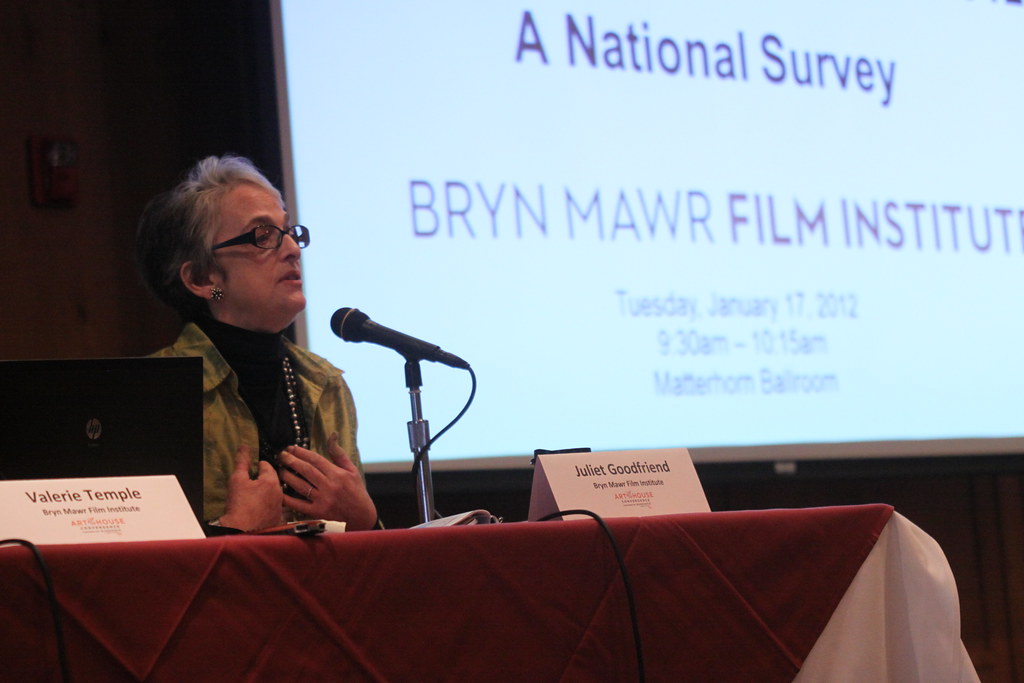
Valerie and I started off the substantive part of the Convergence with a very well-received report on the health of art houses taken from the national survey BMFI does each year. (A big thank you to our consultant, Cordelia Stone.) Art houses are doing well and in many cases better than the entire national market, but they face daunting expenses as they transition to digital.

We were thrilled to learn that David Bordwell, Jacques Ledoux Professor of Film Studies at University of Wisconsin-Madison, was attending. His numerous books and his penetrating blogs have transformed and informed our film viewing. He is just one of the very best film historians and analysts in the world. He enthusiastically incorporated our national survey into his blog.

Reproduced here (with permission) is an excerpt from David Bordwell’s take on the Convergence, with particular emphasis on digital cinema. To read his full post and find more of his insights into film past and present, visit his blog, Observations on Film Art.


An Excerpt from Pandora’s digital box: Art house, smart house
by David Bordwell

Theatres’ conversion from 35mm film to digital presentation was designed by and for an industry that deals in mass output, saturation releases, and quick turnover. A movie comes out on Friday, fills as many as 4,000 screens around the country, makes most of its money within a month or less, and then shows up on VoD, PPV, DVD, or some other acronym. The ancillary outlets yield much more revenue to the studios, but the theatrical release is crucial in establishing awareness of the film.

Given this shock-and-awe business plan, movies on film stock look wasteful. You make, ship, and store several thousand 35mm prints that will be worthless in a few months. (I’ve seen trash bags stuffed with Harry Potter reels destined for destruction.) Pushing a movie in and out of multiplexes on digital files makes more sense.

After a decade of preparation, digital projection became the dominant mode last year. Today “digital prints” come in on hard drives called Digital Cinema Packages (DCPs) and are loaded (“ingested”) into servers that feed the projector. The DCPs are heavily encrypted and need to be opened with passkeys transmitted by email or phone. The format is 2K projection, more or less to specifications laid down by the Digital Cinema Initiatives (DCI) group, a consortium of the major distributors.

Upgrading to a DCI-compliant system can cost $50,000-$100,000 per screen. How to pay for it? If the exhibitor doesn’t buy the equipment outright, it can be purchased through a subsidy called the Virtual Print Fee. The exhibitor can select gear to be supplied by a third party, who collects payment from the major companies and applies it to the cost of the equipment. The fee is paid each time the exhibitor books a title from one of the majors. See my blogs here and here for more background.

It’s comparatively easy for chains like Regal and AMC, which control 12,000 screens (nearly one-third of the US and Canadian total), to make the digital switchover efficiently. Solid capitalization and investment support, economies of scale, and cooperation with manufacturers allow the big chains to afford the upgrade. But what about other kinds of exhibition? I’ve already looked at the bumpy rise of digital on the festival scene. There are also art houses and repertory cinemas, and here one hears some very strong concerns about the changeover. “Art houses are not going to be able to do this,” predicts one participant. “We will lose a lot of little theatres across the country.”

The long, long tail
‘Plexes, whether multi- or mega-, tend to look alike. But art and rep houses have personality, even flair.

One might be a 1930s picture palace saved from the wrecking ball and renovated as a site of local history and a center for the performing arts. Another might be a sagging two-screener from the 1970s spiffed up and offering buns and designer coffees. Another might look like a decaying porn venue or a Cape Cod amateur playhouse (even though it’s in Seattle). The screen might be in a museum auditorium or a campus lecture hall. When an art house is built from scratch, it’s likely to have a gallery atmosphere. Our Madison, Wisconsin Sundance six-screener hangs good art on the walls and provides café food to kids in black bent over their Macs.

Most of these theatres are in urban centers, some are in the suburbs, and a surprising number are rural. Most boast only one or two screens. Most are independent, but a few belong to chains like Landmark and Sundance. Some are privately held and aiming for profit, but many, perhaps most, are not-for-profit, usually owned by a civic group or municipality.

What unites them is what they show. They play films in foreign languages and British English. They show independent US dramas and comedies, documentaries, revivals, and restorations.
In the whole market, art houses are a blip. Figures are hard to come by, but Jack Foley, head of domestic distribution for Focus Features, estimates that there are about 250 core art-house screens. In addition, other venues present art house product on an occasional basis or as part of cultural center programming.

Art house and repertory titles contribute very little to the $9 billion in ticket sales of the domestic theatrical market. Of the 100 top-grossing US theatrical releases in 2011, only six were art-house fare: The King’s Speech, Black Swan, Midnight in Paris, Hanna, The Descendants, and Drive. Taken together, they yielded about $309 million, which is $40 million less than Transformers: Dark of the Moon took in all by itself. And these figures represent grosses; only about half of ticket revenues are passed to the distributor.

More strictly art-house items like Take Shelter, Potiche, Bill Cunningham New York, Senna, Snow Flower and the Secret Fan, Certified Copy, Page One, The Women on the 6th Floor, and Meek’s Cutoff took in only one to two million dollars each. Other “specialty titles” grossed much less. Miranda July’s The Future attracted about half a million dollars, Uncle Boonmee Who Can Recall His Past Lives grossed $184,000, and Godard’s Film Socialisme took in less than $35,000. For the distributors, art films retrieve their costs in ancillaries, like DVD and home video, but the theatres don’t have that cushion.

Something else sets the art and rep houses apart from the ‘plexes: The audience. It’s well-educated, comparatively affluent, and above all older. Juliet Goodfriend’s survey of art house operators indicates that only about 13% of patrons are children and high-school and college students. The rest are adults. A third of the total are over sixty-five. As she puts it, “Thank God for the seniors!” However much they like popcorn, they love chocolate-covered almonds.

Almonds aside, how will these venues cope with digital? To find out, I went to Utah.

Read the rest of David Bordwell's Art House Convergence post here.


Photos of Valerie Temple and Juliet Goodfriend (c) Chuck Foxen.

Thursday, October 6, 2011

California Lawsuit Brings Theater Clearance Zones to Forefront

By Juliet Goodfriend, President, Bryn Mawr Film Institute

Last week the Los Angeles Times published an article detailing the lawsuit brought against Cinemark, one of the top theater chains, by the owners of the Palme d'Or, an independent theater in Palm Desert, California. The suit, which reporter Richard Verrier calls a "David-versus-Goliath battle in the desert," cites that Cinemark, which operates a nearby theater complex, has been "circuit dealing", using their clout to prevent distributors from allowing the smaller Palme d'Or to certain films. You can read the full article here.

This article brings to the foreground an unfair competitive practice that has troubled BMFI for years: chain theaters drawing unreasonable non-compete zones (so-called "clearance zones") around them and not letting independent theaters show the same film at the same time (showing "day and date"). In our region it is mostly the Clearview Bala and Anthony Wayne that we struggle against; rarely the Narberth.

The good news for BMFI is that distributors have learned that their films will earn much more here than at the local chains, so we are more likely to get the movies we want, when we want them. And we think you'll enjoy them more at our theater.

The legal case in California will no doubt unearth an older case in Philadelphia between the Roxy and the Ritz. The Roxy lost that one. Let's see how the new case comes out--maybe the little guy will win for once.

Tuesday, September 27, 2011

Juliet Goodfriend's Take on the 2011 Toronto International Film Festival

Toronto International Film Festival 2011
by Juliet J. Goodfriend, Executive Director, BMFI

This year, as in years past, I feel frustrated that I missed as many good films as I saw. No, I didn’t get to Shame, or Crazy Horse, or We Need to Talk About Kevin, or Le Havre, or Martha Marcy May Marlene, or Faust. All missed because of scheduling overload and conflicts. Nevertheless, I found enough good movies to keep us very busy in 2011 and saw quite a few that you will be happy not to see at BMFI.

Programming Main Attractions is rife with distributor negotiations, and my having seen a great many films helps us narrow our battleground to the territory with the most potential—artistically and commercially. Below are my take on the 33 I did catch. It has taken some time to get this written, as I came home with a dreadful cold in addition to some good film impressions. (Did you follow my tweets after each film as the festival progressed?)


16 Films I Would Like to Get for BMFI:

Albert Nobbs (d. Rodrigo Garcia)
Glenn Close played this role of a male servant on stage and we who never saw it should be delighted that the movie is an excellent translation. It is a very tender treatment of gender uncertainty, class, and the meaning of love. Need more? Nope!

Albert Nobbs

The Artist (d. Michel Hazanavicius) is a mostly silent, black and white homage to Hollywood that feels so good you want it to last longer. It seems to be true that great directors yearn to make a silent. This one succeeded in spades. And the little dog adds just the right touch.

The Awakening (d. Nick Murphy)
At last, a ghost movie that I can really endorse. As with others of its genre, this takes place in a “haunted” boys’ school in England. But it seems to me to move beyond other tales by engaging in the analysis of the source of the ghostly mysteries: in early trauma and guilt of the heroine. The methods of ghost-killing are ingenious and the whole movie is well constructed and entertaining.

A Dangerous Method (d. David Cronenberg)
Despite an annoying performance by Keira Knightley, this film passes the test because of 1) Viggo Mortenson, 2) Michael Fassbinder and 3) the interesting interplay between Freud and Jung. As with several other period pieces this year, the mise en scene makes up for a number of weaknesses. This is a must-see for spouses of psychiatrists!

Death of a Superhero (d. Ian Fitzgibbon)
Making imaginative use of graphic novel animation, this movie puts us into the head of an adolescent cancer patient. It is not sentimental, but it captures his parent’s fraught attempts to cure him and his buddies’ well-meaning attempts to de-flower him before he dies. One would not expect to be entertained by a film dealing with pediatric oncology, but this boy and this film are special and believable.

The Descendants (d. Alexander Payne) is perhaps the best movie I saw at TIFF. Pictorially vivid and real scenes of Hawaii—a setting rarely used for dramatic movies—and real emotions about the hardest experiences in life: death, marital deception, family discord. George Clooney has never been better. Hardened movie industry guys were crying on my row.

The Descendants

Flying Machine (d. Martin Clapp, Dorota Kobiela, Geoff Lindsey)
Starring Lang Lang playing Chopin, what a charming interlude for me during the hectic TIFF. The music is marvelous, the animation and live action lovely to look at but not tightly tied with a terrific plot. Instead the point is for parents to pay attention to their inner souls and creativity and to be present and inspiring to their children. A good moral, indeed. And with enough plusses that I would love to show it to our younger audiences, and I’d go again just to hear Lang play. He is voiced by another actor!

Footnote (d. Joseph Cedar) is an Israeli film that reveals and revels in a father-son schtick as only university-based Talmudic scholars could endure. Father-son issues date to Abraham and Isaac. Here the sacrifice takes a turn. A must see for male academics--both fathers and sons. I liked it very much, too.

Hysteria (d. Tanya Wexler)
OK, this goes over the top in a number of ways but it certainly tickled me! And that’s more than I would have expected from a history of hysteria. Except that it’s a history of vibrators--hence the giggles and fun. The credits alone are an education. It will captivate much of the movie-going audience, no matter their gender or age.

Hysteria

The Ides of March (d. George Clooney) is not a great movie. But it is good enough, especially as a directing effort of its star, and the acting of Ryan Gosling. My fault with it is its lack of genuine originality. We’ve seen this film before, and this treatment is very smooth and professional, but it does not offer warmth or human empathy. Nevertheless, it is engrossing and you don’t want to leave before it’s over. The ending will enrage some and delight others.

I’m Carolyn Parker: The Good, the Mad, and the Beautiful (d. Jonathan Demme) is the first film produced by our aspirational arthouse model, Jacob Burns Film Center, so I went to see it out of loyalty. It tells the tale of a remarkably out-spoken and determined resident of the Lower Ninth Ward in New Orleans following Katrina. We would all be better off with more Carolyn Parkers in our neighborhoods, that’s for sure.

In Darkness (d. Agnieszka Holland)
If two and a half hours in a sewer is not too hard on your senses, then see this film. As one friend said, it’s actually a refreshing relief when one character escapes the sewer to voluntarily go to a concentration camp! Nevertheless, this true story of the fourteen-month ordeal of a group of Polish Jews during the Holocaust is worth the stench and dampness. The “Righteous” Polish sewer worker who cared for “his Jews” experiences a genuine moral dilemma as his work endangers his family and co-workers. We still need to see these stories on film. And this director does not spare us the harsh realities. I did object to her stealing Spielberg’s red touches from Schindler’s List! A petty complaint, perhaps.

In Darkness


The Island President (d. Jon Shenk )
In this excellent documentary we follow, very intimately, the efforts of the young President of the Maldives who, at age 42, overturned a 30-year dictator and took on the task of saving this archipelago of 2000 islands from certain destruction by the rising seas of our man-made warmer climate. He has not yet achieved his goal, but watching him learn (and then teach) diplomacy and will pique the interest of all doc audiences. How his efforts are stunted by China and the USA, to name but a couple of challengers, will reconfirm our distrust of large nations’ motivations to correct the destructive direction of their societies.

The Kid with a Bike (d. the Dardenne Brothers) is just about perfect: characters you really care about, insights into the hearts of a troubled boy and a well-meaning foster mother, good pace and enough plot to keep you interested. These directors typically deal with troubled children or families, but never better than this time.

Page Eight (d. David Hare) is the smart and sophisticated spy story that one expects from this fine stage writer-director, and it doesn’t let you down. Bill Nighy is the cool spy whose every move is calculated to keep you wanting to see more. Why couldn’t this be the first of a long series? Even alone it is well worth the time. And there’s Michael Gambon, Ralph Fiennes, and Rachel Weisz showing their best as well.

Samsara (d. Ron Fricke) Transformative and transporting photography with a message that if nature isn’t destroying the earth, man certainly is. This is an utterly beautiful movie: think National Geographic and Koyaanisqatsi combined and HD enhanced. As huge scenes of nature or of mankind are captured in seemingly horizon-less views, they are instantly deconstructed into their composite details. And the power of the moving picture to create a mind-changing perspective is proven once again, e.g. I will never eat chicken that is not from my daughter’s farm again!

Samsara

14 Films I Would Not Bring to BMFI (not counting the ones I won’t even bother to list)

360 (d. Fernando Meirelles)
Almost a good movie, but not. One does wonder how there can be so many dumb women involved with bad men. And then one wonders who all these women are because it’s very hard to tell them apart.

Almayer’s Folly (d. Chantal Akerman)
Interesting to transplant Joseph Conrad’s 1895 novel to the 1950s in Malaysia. It is a beautiful but very slow-moving film that is good for a certain mood, but I am not certain what that mood would be.

Always Brando (d. Ridha Behi)
The scenery of Tunisia and the looks of the Brando double don’t compensate for the film’s weak premise and execution.

Damsels in Distress (d.Whit Stillman)
There may be some co-eds who identify with, or laugh at this, but not many, I bet. There was one very funny line (I bet it will be in the trailer) and for the rest, you have to like Greta Gerwig a lot. It was another disappointment.

Dark Horse (d. Todd Solondz)
This was one of several disappointments of the festival. The great cast had no material and poor direction (from a good writer-director) and there was no reason to expect the characters will ever grow up or amount to anything.

Elles (d. Malgorzata Szumowska)
Too much deviant kiddy porn as Juliette Binoche examines female sexuality among young prostitutes for an article she is writing. Binoche is always a pleasure to watch, but did I really want to see her masturbate? As we sometimes tell our exploring toddlers, “Not in the living room, in your own room,” and that goes for theaters, too.

Into the Abyss (d. Werner Herzog)
Not his best and who wants to get inside these dreadful characters anyway?

Keyhole (d. Guy Maddin)
Canada’s favorite experimental filmmaker muddled up some aspects of the Odyssey with his family’s home and his memory of growing up. Neither evocative nor interesting to me, though I liked his My Winnepeg.

Neil Young Journeys (d. Jonathan Demme)
Not very interesting, but lots of good lyrics (bad tunes) and whiskers.

Rampart (d. Oren Moverman)
I loved this director’s The Messenger, but this film was too raw and harsh. Woody Harrelson is excellent, but I could not watch it for very long.

This Side of Resurrection (d. Joaquim Sapinho)
Good surfing photography. End of story.

Trishna (d. Michael Winterbottom)
Moving Tess of the D’Urbervilles (Thomas Hardy) to current day rural and urban India made this movie a sure-fire travelogue but a dull tale. Another disappointment.

Twixt (d. Francis Ford Coppola)
This teaches the lesson that really great directors can trip and fall. Coppola inserts 3-D only twice in his return to the horror story genre. While that’s fun, it doesn’t help. Nor does it help that there is a connection in the plot and his personal family life. The master misses.

The Woman in the Fifth (d. Pawel Pawlikowski)
Another big disappointment from Kristin Scott Thomas and Ethan Hawke, both of whom seem dead in this film. Nothing to recommend it, though a lot of the audience waited till the end to leave and moan rather than bolting half way through.