This year I had only four days at the Toronto International Film Festival (TIFF) and each one was packed with four to six full-length movies and a handful of twenty-minute samplings in some rare free moments. I had trouble with Twitter, so abandoned it. Below are my faux tweets.
Themes this year a bit harder to discern, but one theme I noticed was passion, in its many forms: alive, dead, dying, gone bad. These films are indicated below with a (P) at the end of the film blurb. There were at least four films on “Words”, of which I saw three, indicated with a (W). “No crime goes unpunished” or Aquinas’ “the ends never justify the means” was the final theme of the last two films I viewed, indicated with an (E) for “ends”.
Going to TIFF is work. I am in search of movies to show at BMFI and I look at all films through that filter. “Yes” means we would show it, “No” means we would not show it, and “Maybe” means just that.
Labor Day (d. Jason Reitman) – USA
Would we like to show this? –Yes
Kate Winslet is again wonderful in this absorbing “hostage-romance” film. Tension maintained with rewarding results. (P)
Tim’s Vermeer (d. Teller) – USA
Would we like to show this? – Yes
Wealth enables this obsessive inventor to work out the technology behind Vermeer’s art. Very interesting doc, though a bit too self-indulgent.
Le Week-end (d. Roger Michell) – UK
Would we like to show this? – Yes
If only the wife in this 30-year marriage weren’t so sadistic and mean… but that’s part of the uniqueness of this aging couple rom-com. Scenes of Paris sweeten the taste and soften some of the truthfulness of their conflicts. Must now watch Le Weekend of Goddard to appreciate its references.
I Am Yours (d. Iram Haq) – NOR
Would we like to show this? – No
While this exposes the multicultural picture of Norway to some extent, it is narratively weak.
Prisoners (d. Denis Villeneuve) – USA
Would we like to show this? – Yes
A great director and wonderful cast, but a few loose ends in this remarkably tense and a bit too gruesome story mar its polish. (P)
This is Sanlitun (d. Róbert I. Douglas) – CHN/ISR/IRL
Would we like to show this? – No
Not a funny enough spoof on ex-pats in this stylish neighborhood of Beijing. The idea is there, but the execution did not have me laughing—and it was supposed to, I think. What does come through is the arrogance and naivete of westerners trying to make it in China. (W)
12 Years a Slave (d. Steve McQueen) – USA
Would we like to show this? – Yes
A remarkable true story that we all wish were fiction, expertly executed with a superb cast. Should we wonder why an Englishman was the one to bring it to our attention on the screen? It is far better than the trailer, and will be a “must see” for everyone. (E)
Bad Words (d. Jason Bateman) – USA
Would we like to show this? – Yes
Light and funny, at last, this spelling-B farce is a good night’s entertainment! (W)
Love is the Perfect Crime (d. Arnaud Larrieu) – FRA/SUI
Would we like to show this? – Maybe
I am a sucker for Mathieu Amalric, architecture, and the alps in winter, but the peculiarities of this thriller don’t quite live up to the setting and the cinematography. (E/P)
Gravity (d. Alfonso Cuarón) – USA/UK
Would we like to show this? – Yes, but not without 3-D
Finally, a film that rationalizes 3-D. Neither the two characters nor the appreciative audience (will) have much to talk about. Here a picture wins out over words (see below movie of similar title). Total immersion in CGI and exhausting.
Enough Said (d. Nicole Holofcener) – USA
Would we like to show this? – Yes
Charming and poignant, given the recent death of the male star, James Gandolfini. The naturalness of the characters enrich this sweet, but not saccharine, romance.
Words and Pictures (d. Fred Schepisi) – USA
Would we like to show this? – Yes
Why is the part of the eccentric American English teacher given to Brit Clive Owen, who cannot quite hide his accent? Any number of great male actors could have done it. At least Juliette Binoche is playing an artist whose unexplained French accent may make a bit more sense. Am I picky? Yes. This film deals with a wonderful subject, yet it is a bit too predictable and fey. Can’t the battle between words and pictures, fought by newly energized students in a prep school, be enough in itself without throwing in the 12 Step program to save the drunken English teacher? (W)
Walesa. Man of Hope (d. Andrzej Wajda) – POL
Would we like to show this? – Maybe
Poland’s greatest filmmaker combines reenactment and archival footage to explore the motivation and methods of this simple man who did so much to change the world in the 1980s. Worth seeing to remember him and learn what happened (probably) behind the scenes.
When Jews Were Funny (d. Alan Zweig) – CAN
Would we like to show this? – Yes
I can’t believe it, but I got a bit tired of the question, “Are Jews funnier than others?” However, there are enough laughs to satisfy most Jewish audiences, even if the filmmaker can’t quite focus on what his real questions are. Did you hear the one about the thirsty guy…? (W)
Fading Gigolo (d. John Turturro) – USA
Would we like to show this? – Yes
Of course we all will go to a movie written, directed, and co-starring John Turturro and Woody Allen (who MUST have had a hand in the directing and writing, don’t you think?) Turturro is a believable novice prostitute. Woody as pimp is funny and slightly embarrassing. His living with a black family and supporting a Hasidic widow are both confusing plot features that may be his idea of a perfect NY story. Sure you’ll go see it.
Wonders (d. Avi Nesher) – ISR
Would we like to show this? – Maybe
Alice in Jerusalem might be its subtitle, and that city is as much the star of this film as the humans who are caught up in a religio-criminal-fraud tangle that provokes giggles if not laughs.
American Dreams in China (d. Peter Ho-sun Chan) – HKG/CHN
Would we like to show this? – Yes
China’s economic success is powered by creative entrepreneurs who, in the case of this movie, are funny and inventive. Their goal is an English language school to prepare millions of young Chinese with better TOFL scores for entry into US colleges. Their friendship survives partnership travails. The choppiness of the narrative is challenging, but the heart of this film is solid. And Christopher Doyle’s camerawork is as remarkable, as usual.
Enemy (d. Denis Villeneuve) – CAN/ESP
Would we like to show this? – No
A great director entirely off his mark. This is a slow moving doppleganger story that looks like a psychological thriller but one leaves without an inkling as to what is going on in the psychology of the character. The entire audience was in the dark, I sensed.
Night Moves (d. Kelly Reichardt) – USA
Would we like to show this? – Yes
A very good tale that proves, as St. Thomas Aquinas argues, the ends do not justify the means. No matter that the environment (water, in this case) may be improved, be wary of your means. What’s wrong is wrong. OK, got the point. This movie brings it to life quietly and with some terrific acting and directing. (E)
Therese (d. Charlie Stratton) – USA
Would we like to show this? – Yes
Another case where the crime cannot be justified and the sinners get their just deserts. This is a close adaptation of Zola’s novella and beautiful and poignantly set. Jessica Lange is the strong centerpiece of this cast. It is a costume piece with finely carved characters, great atmosphere, and good pace. (E)
Spring is officially in full swing, and so is the programming here at BMFI! The last few weeks have been a whirlwind of activity. Here are some of our recent highlights.
Critically Acclaimed: An Evening with the Critics
Film critics and enthusiasts alike gathered for the highly anticipated "Critically Acclaimed: An Evening with the Critics". The May 10 event
celebrated film criticism and honored four top film critics—A. O. Scott, Lisa Schwarzbaum, Carrie Rickey, and Steven Rea—who discussed their work and what's
in store for film criticism in the 21st century. BMFI President Juliet Goodfriend moderated the in-theater event, which was recorded by SpectiCast and
is now available for digital distribution to art house theaters across the country. A Dinner with the Critics, hosted at the Merion Cricket Club, followed
the main event.
Juliet Goodfriend greets the evening’s speakers (left to right: A. O. Scott, Steven Rea, Lisa Schwarzbaum, and Carrie Rickey) before the program begins, while guests enjoy a reception in the atrium.
In the theater, our guest critics participate in a lively discussion about the future of film criticism.
Science on Screen Film Series
"Does science really work like it does in the
movies?" BMFI explored this question with its Science on Screen series,
which paired classic and recent films with introductory talks by notable
figures from related scientific fields who discussed their work and research. Audiences explored archaeology with Dr.
Harrison Eiteljorg II before Raiders of
the Lost Ark, delved into computer game production with indie game designer
Halsted Larsson (Jamestown: Legend of the
Lost Colony) in honor of Wreck-It
Ralph, got a taste of food anthropology with Dr. Solomon Katz to whet their
appetites for Babette’s Feast, and
braved the elements with Dr. Raluca Ellis in anticipation of Future Weather. The series was made
possible by a grant from the Coolidge Corner Theatre and the Alfred
P. Sloan Foundation.
Indie game designer Halsted Larsson of
Final Form Games talked shop before audiences were wowed by Wreck-It Ralph.
Food anthropologist Solomon Katz,
Ph.D., signs the guestbook before our screening of Babette’s Feast. Guests also enjoyed some tasty French pastries
before the show.
Future Weather producer Kristin Fairweather (left) poses
with Science on Screen speaker Raluca Ellis, Ph.D., and Philadelphia Women in Film and
Television (PWIFT)’s Veronica Stickelman. Following the film, Kristin answered
audience questions in a panel introduced by the Greater Philadelphia Film
Office and moderated by PWIFT.
Tri-Co Film Festival
Attendees from Bryn Mawr College, Haverford College, and Swarthmore College were dressed to the nines for the second Tri-Co Film Festival on May 1. Community members and students alike enjoyed the one-night festival, which featured 23 amazing films created by students at the three schools. The program was curated by students and judged by Shari Frilot, Senior Programmer at the Sundance Film Festival.
Student filmmakers receive the red
carpet treatment in the atrium before the start of the event. Photo credit:
Bryn Mawr College.
Juliet Goodfriend (center) clowns
around with one of the student curators and faculty advisor Roya Rastegar,
Ph.D. Photo credit: Bryn Mawr College.
Oliver! Sing-along
Guests were treated to a live performance by the Footlighters Theater players before belting out their favorite tunes as the Academy Award-winning film version of Oliver! played on the big screen.
Several cast members from Footlighters
Theater’s current production of Oliver!
performed before BMFI’s sing-along to the film version!
Kerri Grogan is BMFI’s
Staff Assistant, and although her first love is animation, she moonlights as a dice-rolling,
video gaming geek and comic artist.
I arrived early on Saturday morning this year. Alas that is a bit late, as there are many films that show only in the first day or two and never get repeated. Lesson learned. Nevertheless, in the nearly five days I did spend at the festival, about 23 films were ingested. Indeed, so many were really good films this year that I tended to stay to the end of most of them and therefore saw fewer to write about.
As usual, I found myself torn between movies that I should “preview” for their BMFI potential and those that might be shown only at a festival where this would be my only chance! In most cases I stuck to business and looked at movies that were likely to be available and attractive to us (in other words I saw no experimental films and not enough foreign language entries).
While there were more good films on my roster than ever before, there were a few that did not make the grade, for one reason or another. And, much to my frustration, there are a few I missed that I know we will want to get (eg. Anna Karenina, Stories We Tell, and Silver Linings Playbook). With more than 300 films, the real trial is selecting what to see. This year I tweeted after just about every film and I include my tweets below along with a few other thoughts that may have the benefit of distance-from-viewing.
The films are divided into two categories:
A. Films with great appeal for BMFI
B. Interesting films, but not necessarily for our theater
Films with great appeal for BMFI (in order of my having viewed them):
Frances Ha (Noah Baumbach, USA) Tweet: “Frances Ha focuses on the soul-challenged 20-30s but with some great lines and editing by Jen Lame whose parents are BMFI fans. Congrats.” This black and white film is all Greta Gerwig, so if you like her you’ll like it. She does “gawky” very well and her employment problems typify today’s college grads. For that reason alone it is not comfortable even though funny.
Frances Ha
A Late Quartet (Yaron Zilberman, USA) Tweet: “A Late Quartet captured me, as emotion, acting and Beethoven won the day… Faults and all, I fell for it.” Illness, aging, deception, overblown egos, illicit and unsatisfied love—all to the music of Beethoven’s last string quartet, what could be better? Using musician doubles would have made it better, since it’s too hard for non-string players to fake it. But I quibble. You will love it, as I did, with its flaws.
A Late Quartet
The Company You Keep (Robert Redford, USA) Tweet: “The Company You Keep conveys via Redford an important message and reminder about those who struggle with social action. Moderate/Extreme.” Having gone to Bryn Mawr College with Diana Oughton (who was killed in the “Weatherman” Greenwich Village mansion making a bomb) and Kathy Boudin (who served many years in prison for her part in a misguided, socially-motivated bank robbery), I wanted to see this film for insights into what my made my college-mates commit those well-intentioned but horribly immoral acts. The story shed light on the fugitive phase of Kathy’s life. However, it is carried a bit too far to be believable in the end. One wonders how individuals should demonstrate disagreement with the “state of things”. Reverend King was far more successful, but that’s an answer this film does not suggest. As a thriller it works wonderfully.
The Company You Keep
Hyde Park on Hudson (Roger Michell, UK) Tweet: “Beautiful recreation with Bill Murray catching FDR in essence if not entirely in diction.” Reviews have been mixed for this film, but it kept my interest and is a part of FDR’s life that most do not know. His connection with the stammering King George puts “sequel to The King’s Speech” in mind, but I treat it more kindly. Both men had significant disabilities that plagued their lives. Watching Bill Murray struggling as a paraplegic had me sobbing. And when he encourages the King to persist and be confident, more tears flow.
Hyde Park on Hudson
Thanks for Sharing (Stuart Blumberg, USA) Tweet: “Preferred Shame, but this one can be shown with no shame.” The topic: rehab for sex addicts. The stories: a bit weak. The cast: excellent. Shame put you in the skin of a sex addict, an uncomfortable place to be. Thanks for Sharing reassures you that rehab is possible, but it also alarms you about the prevalence of the addiction, especially in an era of teasing clothes and fashions. What should a young person wear in the city? Don’t ask these characters!
Thanks for Sharing
The Master (Paul Thomas Anderson, USA)
Tweet: “The Master in 70mm treat for eyes, ears but little for deeper brain. Terrific score and Phoenix soars.” Now that I have some distance from this film and the benefit of reading excellent criticism, I have much greater appreciation for it. I think it demands serious discussion and reflection on the relationship between an elder “master” and his acolyte. That this is not a plot-centric film does not detract from its interest.
The Master
Quartet (Dustin Hoffman, USA) Tweet: “Saw the other Quartet at public screening Dustin Hoffman introduced. Lovely, ancient musicians all still good.” These retired performers’ egos are now on the line, off stage. No need to have body doubles for this cast of wonderful musicians and singers (okay, maybe for Maggie Smith); the supporting roles are all retired professionals. Dustin Hoffman achieves a sensitive mix of fun, silliness, and sympathetic performances. The ravages of old age are relieved by music. Tell that to every youngster who resists music lessons in favor of sports. You can’t be an athlete at 85, but you can still enjoy playing an instrument or singing. You just have to practice, practice, practice when you’re young. Don’t get me started! Why didn’t my mother insist I practice more? (It’s always the mother’s fault.)
Quartet
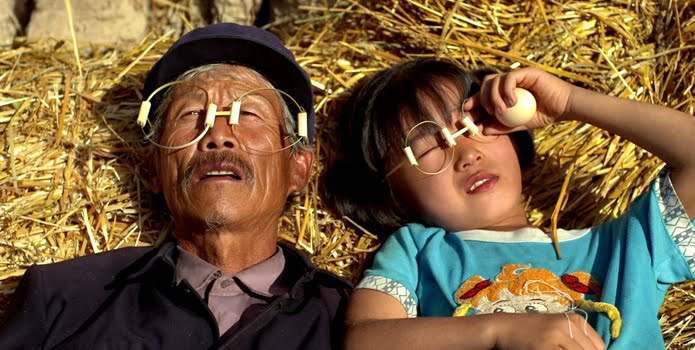
Fly with the Crane (Li Ruijun, China) Tweet: “Fly with the Crane, a Chinese elegy on death. So simple and captivating.” Death, the theme again, is treated with quiet reverence and curiosity. This movie argues against state-mandated cremation in China. As an old grandfather tries to explain death to his grandson and granddaughter they become partners in promoting burial—his own, alive. Tender with a bit of a bite, as you can imagine. Little commercial value, but would be great for our 3rd or 4th screening rooms when we get them built!
Fly with the Crane
The Hunt (Thomas Vinterberg, Denmark) Tweet: “The Hunt, best movie of the day but so wrenching and so late at night I could not endure it all. Wish I could see it again. Another prize.” This may be the best film I saw, but certainly not the easiest. When a whole community turns against a young teacher accused of sexual “abuse” in a kindergarten, the staid and reasonable Danish society no longer seems so desirable. Vinterberg is a master!
The Hunt
What Maisie Knew (Scott McGehee, David Siegel, USA) Tweet: “What Maisie Knew is poignant and as timely as when Henry James wrote it. Hard to watch the pain but a good flick.” James wanted to expose the neglect of some parents and society 100 years ago. This film makes that neglect palpable and credible in our own day. While the film does not follow the life of Maisie as far as the book does, there is quite enough material to chew on. And excellent acting.
What Maisie Knew
The Attack (Ziad Doueiri, Lebanon) Tweet: “The Attack, an excellent story reveals an Arab Israeli MD’s conflict and his wife’s hidden extremism. Well done though questions linger.” With some distance from the film I think it was a bit unrealistic and certainly not as interesting as Paradise Now, which also tried to examine the conflicts and motivations of suicide bombers. In The Attack, the husband’s search reveals deep cracks in his own integration into Israeli society.
The Attack
Argo (Ben Affleck, USA) Twitter: “Argo absorbs because of Affleck’s directing not his affect. An improbably true and tense thriller with a sappy but true end.” He is characteristically flat in this film, but Affleck’s directing is sharp and capable of evoking real sweat in the viewer. The story of how the USA saved six Americans who escaped Iranian hostage takers is surprisingly and alternately funny and suspenseful.
Argo
Kon-Tiki(Joachim Roenning, Espen Sandberg, Norway) Tweet: “Remember Kon-Tiki? This film brings it and Thor to life. Terrific.” Anyone who read Heyerdahl’s book or saw his documentary will want to see this film and those who never did will be in for a treat. It’s quite remarkable how the raft trip is captured on film and the color and imagery are spectacular, once it gets underway.
Kon-Tiki
Great Expectations (Mike Newell, UK) If you can see this during the bicentenary of Dickens’ birth, all the better. Its vividness makes for some troubling gore, but it keeps moving and stirs an interest in re-reading the original.
Great Expectations
Hannah Arendt (Margarethe von Trotta, Germany) This is a film worth seeing, despite poor acting in some of the supporting cast. Many a philosophy class will enjoy it and there is much value in bringing Arendt’s analysis of evil to the public square—the cinema. In von Tratta’s words, this film is an attempt to transform “thought into film.”
Hannah Arendt
The Patience Stone (Atiq Rahimi, Afghanistan/France) Tweet: “Patience Stone, one of the very best. An unspeakable drama of women’s life in Afghanistan. Beautifully made. Remarkable and probably won’t be seen.” On reflection, this film is somewhat too centered on the sexual frustration of the young wife of a comatose husband. But even with that distortion, it reveals—quietly and sympathetically—how repressed and abused are women by the Taliban (who are not named, per se). Her monologues with her husband spin out the details and consequences of the horrid mores of this society: rape and prostitution have more to offer than she experienced with him.
The Patience Stone
Interesting films, but not necessarily for our audiences:
Gebo and the Shadow (Manoel de Oliveira, Portugal/France) Tweet: “Oliviera still making films. One set, few characters, much angst about soul and life. Beautiful of course and easy French dialogue” One has to see the latest film by this 103-year-old master. Despite wonderful stars (e.g. Claudia Cardinale, Jeanne Moreau, etc.), the static nature of this adapted play does not make for easy viewing. Its focus on capitalism’s effect on personal relations and the beauty of its set make the effort worthwhile.
Gebo and the Shadow
Love, Marilyn (Liz Garbus, USA) Tweet: “An interesting twist on documentary where all her lines and others’ were declaimed by today’s stars misidentified in labels.” I found this documentary only barely satisfying. We don’t really need to know anything more about Marilyn, though seeing her handwritten diaries had the potential to bring her to life. Who the stars were who were reading those lines was totally confusing.
Love, Marilyn
At Any Price (Ramin Bahrani, USA) Tweet: “At Any Price reveals the ugly, competitive world of big farming. Writing sags but Dennis Quaid soars.” I went to see this to learn more about farming, and that it succeeded in teaching me. It is a good movie, well-acted and directed, but probably would not interest our audience. I should have seen Silver Linings Playbook instead!
At Any Price
Arthur Newman (Dante Ariola, USA) Tweet: “Lifeless, walkout… Blunt and Firth do USA accent well. But nothing to say. Waste of great actors.” Why were English actors chosen for these dull, American characters? Why even bother making this film?
Arthur Newman
To the Wonder (Terrence Malick, USA) Tweet: “To the Wonder… wonder how Malick lost his way. I wonder why I stayed and if there were 140 words in it. A lot of hayfields.” An absolutely irritating film. I had hay fever from the endless scenes of flat fields of grasses. And the trite way of filming “in love with a graceful French woman”—sprite-like dances around parks and 360 degree pans, give me a break. Should have walked out on this one, but I kept hoping for Malick redemption!
To the Wonder
Imogene (Robert Pulcini, Shari Springer Berman, USA) Tweet: “Imogene is surprisingly funny and endearing. A light and silly antidote to The Hunt and The Attack.” I was prepared not to enjoy this film at all. And, with time, I have come to believe I really should not have! So maybe I recommend this only as a break from really good, serious, films. It’s not got enough going for it.
Imogene
Spring Breakers (Harmony Korine, USA) Tweet: “What to make of Spring Breakers? Horrifying parody but how close to real makes me want to keep student loans at high interest!! Wow!” This was my “stretch” selection. I have not seen so much T-and-A in a non-pornographic film. I had no idea that the main male character was James Franco, so disguised was he with studded teeth. And I knew nothing about the director’s controversial filmmaking history. The cinematography is really inventive: “Harmony Korine thinks in pictures that no one else could even dream up” (Noah Cowan in TIFF catalogue). Please tell me that college is not what this film shows it to be.
The first-ever Tri-Co Film Festival, which will feature films created by the students at Bryn Mawr, Haverford, and Swarthmore Colleges, debuts this Wednesday at BMFI. We interviewed Erica Cho, a Visiting Assistant Professor of Film Production at Bryn Mawr and Swarthmore Colleges and the festival organizer. Keep reading for her insights into this celebration of student work.
What made you decide to create the Tri-Co Film Festival? Why now?
This is an exciting moment for film production at the Tri-Colleges. We’re seeing increasing student demand for production courses, and the beginnings of formal collaborations between the colleges in course offerings and faculty hires to address this demand. Because I was hired to teach production at both Swarthmore and Bryn Mawr, I’ve gotten to see how much the students can benefit from each other across colleges. Making films is inherently collaborative, and because there is a mix of Tri-Co students in each class, they’re already working together on each others’ projects; in class, I regularly screen work from the other campus, so this festival in a way formalizes ongoing exchanges. I’m hoping this inaugural festival will start a tradition of showcasing the diversity of student projects under the tutelage of all the film teachers, including Louis Massiah at Swarthmore and Vicky Funari at Haverford. Production has traditionally been underrepresented within the Tri-Co, and I see a need to continue to support and build in this area. My aim is to foster the study and making of film—the most socially relevant art of our age—and to create more connections between film production and the fine arts. Because I’ve been an active film festival programmer outside the college context for many years, I also want to use my experience and skills to help students gain a taste of participating in a festival and give them a chance to take their work and that of their peers seriously.
Who are the judges?
I invited independent film curator Chi-hui Yang to judge the festival submissions given his experience in many different film and art contexts. He’s worked as the Director of the San Francisco International Asian American Film Festival, a non-profit, independent festival committed to social change, community building, and nurturing the work of young filmmakers. He also programs for mainstream, establishment media like Comcast, as well as for the Flaherty Film Seminar and the Museum of Modern Art in New York City. So he’s someone who has experience adjudicating non-traditional films, narrative, documentary—a whole range of work.
What do the winners receive?
We’ll be giving out awards in Best Senior Film, Best Coursework Film, with the possibility of Honorable Mentions.
As the organizer, what do you hope the student filmmakers get from the experience?
I hope that the festival will encourage students to improve their craft, to take pride in the excellent work they’ve already done, and to begin to think of themselves as filmmakers who have something to contribute to broader audiences—beyond their individual classrooms or campuses. A festival format can also create an atmosphere of constructive competition and of challenging students to take responsibility for the images they are making and circulating. There is of course the question of building community and audiences across colleges—to give students, faculty, staff, and folks in the community to participate and appreciate student films and the issues they address. Finally, I hope to encourage students to consider future work and careers in not only filmmaking, but in programming and curating. The Tri-Colleges have real strengths in the humanities and in film studies, through the leadership of professors like Patricia White, Homay King, Nguyen Tan Hoang, Bob Rehak, and Sunka Simon—and I think that our students have the critical training to fill a real need for smart, progressive, independent practitioners in the industry.
Can you give us a taste of the kinds of films we can look forward to seeing on Wednesday?
There will be seven senior films featured and ten short pieces by other students who have made films as part of their pre-senior coursework. The competition was stiff—only ten out of 36 undergraduate coursework submissions were chosen. This year there will be mostly documentary and narrative films, one animation, and a few experimental pieces. Among the interesting themes that have emerged in this year’s 36 coursework submissions and seven senior productions are: the question of human intimacy in a digital age; queer and transgender identity explorations; and global perspectives on environmental change and labor issues.
Thanks, Erica! For more information about the program and to buy tickets, please click here, or you can visit the official Tri-Co Film Festival Vimeo page to see some of the submitted student work.
Sundance is in January, right? True, but our programmer Valerie Temple's reviews of the films she saw over her six days at the Sundance Film Festival are just as valid now as they were when snow was on the ground. Enjoy the festival time capsule! The Best and Worst of What I Saw at Sundance By Valerie Temple, BMFI Programming Manager
This year I went to Sundance, saw 24 films in six days, and somehow lived to tell the tale. I tried my hardest to see everything that sounded intriguing but, with more than a hundred films screening, it was inevitable that I would miss out on some good ones. I’m still upset that I got shut out of Bachelorette, for example.
But I did get to see some fantastic films and here I've helpfully broken down the movies I saw into nine handy categories that illustrate the running themes I noticed at the festival. Enjoy!
Best of the Fest: Beasts of the Southern Wild (d. Benh Zeitlin)
The most-buzzed about film at Sundance this year, Beasts of the Southern Wild is a remarkable achievement and totally deserving of its Grand Jury Award. This allegorical film about an intrepid six-year-old girl (played by incredible nonactor Quvenzhané Wallis) who lives with her mysteriously ailing father in a remote Delta community known only as “The Bathtub.” As they prepare for the apopcalyptic day when The Bathtub will be destroyed by rising waters, the film mixes in folkloric elements to create a truly unique work. Many of the films I saw this year skewed mainstream, but this film is a perfect example of why Sundance exists: To showcase important work made with an independent spirit.
These were terrible:
I arrived at the festival with the naïve belief that any film screened at Sundance would at least be watchable. Boy, was I wrong.
Filly Brown (d. Youssef Delara, Michael D. Olmos)
Gina Rodriguez is likable as would-be rapper Filly Brown, but this movie is just too cheesy to take seriously. With more melodramatic subplots than a telenovela, the film relies on stock characters (Drug-addicted Mom in Jail! Sleazy Record Producer! Mean White Lady!) and clichés instead of introducing us to any humans with anything resembling realistic motivations. The clunky dialogue also made for some unintentional laughs (“Why are you so insensitive, homes?”). The movie seems well intentioned, but it just didn’t work. Also, the music isn't any good.
The First Time (d. Jon Kasdan)
Ugh. I could not stop rolling my eyes at the dialogue in this treacly mess about two teenagers who meet, talk, and then (spoiler alert!) get together. That’s it. That’s all that happens. Playing out like a boring one-act play, the two leads endlessly jaw on about their problems with the opposite sex but they are far too attractive for any of this to ever make sense. I’ve never, ever met any teens who were so annoyingly wistful as the ones in this movie. It came as no surprise to find out that writer/director Jon Kasdan has a few episodes of Dawson’s Creek to his credit because the film takes the hyper-articulate nattering from that show and crams it into an artlessly framed John Hughes imitation. Given that the filmmaker’s dad is director Lawrence Kasdan (Body Heat, The Big Chill) and his brother is TV producer/director Jake Kasdan (Freaks and Geeks, New Girl), I’m thinking nepotism had a hand in getting this subpar film into Sundance.
Middle of the Road:
These two movies were solid, well-made films. They just weren’t favorites.
Middle of Nowhere (d. Ava DuVernay)
Tyler Perry should watch this movie before he attempts something like For Colored Girls again. This is how to tell a serious story for the African-American community without embarrassing yourself. Perry instinctually shoots for the lowest common denominator while this story of a loyal wife biding her time as her husband serves out a prison sentence aimed for something much more—and mostly succeeded.
2 Days in New York d. Julie Delpy)
Fans of Julie Delpy’s 2 Days in Paris should be excited because this is essentially the same movie, except Chris Rock is now playing the boyfriend instead of Adam Goldberg. Delpy’s brand of quirky humor sometimes works, but the scenes (and there are more than one!) of Chris Rock talking/doing stand-up to a cardboard cutout of Obama are cringe worthy and already dated.
Excellent Foreign Films:
Wish You Were Here (d. Kieran Darcy-Smith)
Four beautiful Australians take a holiday to Cambodia and one doesn’t come back in this film, my first of the festival, that could be best described as a dramatic take of The Hangover. The stunning location cinematography impressed and the complex narrative structure ensured a powerfully shocking climax scene.
Where Do We Go Now? (d. Nadine Labaki)
I never thought I would describe a musical comedy about Lebanese religious in-fighting as “crowd pleasing,” but Where Do We Go Now? was one of the most enjoyable films I saw at the festival. Although the concept was unusual, the disparate elements (light comedy, tender romance, political drama) blended well into a unique whole.
Madrid, 1987 (d. David Trueba)
A luscious young student and her gnarly old professor get stuck in a bathroom overnight – naked! What follows is boring, erotic, then boring AND erotic. Although solidly made, this film was just too heavy on dialogue and light on action to hold my attention.
Teddy Bear (d. Mads Matthiesen)
I loved this weird Danish drama about a 38-year-old bodybuilder who is so dominated by his tiny, scary mother that he lacks any ability to talk to the opposite sex. That is, until he takes a trip to Thailand because love seems easier to find there. Like Wish You Were Here, this film exposes the seedy underbelly of vacationing in a foreign country.
Good movies about thirtysomethings:
Hello I Must Be Going (d. Todd Louiso)
Since debuting opposite Kate Winslet in Peter Jackson’s Heavenly Creatures, Melanie Lynskey has had a tougher time breaking through in Hollywood than her ridiculously famous co-star. She’s a recognizable face, but mainly for filling the Joan Cusack, best-friend role in middling movies (Coyote Ugly, Sweet Home Alabama) and being the best part of a crappy television show ("Two and a Half Men"). But that may change once people see her fantastic work as the lead in Hello I Must Be Going, a great film about a 35-year-old woman who is completely directionless after a divorce and has to move in with her parents. She spends her days wandering around the house in the same t-shirt and no pants and seems adrift since leaving her cozy life with her husband. When she starts an unexpected relationship with a 19 year old, it’s somehow sweet and not creepy. Blythe Danner is just perfect as her mother.
Celeste and Jesse Forever (d. Lee Toland Krieger)
Rashida Jones co-wrote and stars in Celeste and Jesse Forever, another favorite of mine from the festival. The story about a divorcing couple who want to stay best friends even as they pursue other people made me think about every breakup I’ve ever had, but in a good way. Equal parts hilarious and heartbreaking, it's a sharply written movie that shows off Jones' comedic range. Also, it's nice to see Andy Samberg actually act.
Smashed (d. James Ponsoldt)
Mary Elizabeth Winstead and Aaron Paul are a young, married couple who love being drunk because it’s so much fun. But after a series of embarrassing and scary drunk escapades, Winstead decides to sober up, which puts a strain on the relationship. The film is refreshingly accessible, especially when compared to other films in the addiction canon, such as the bleak Leaving Las Vegas or preachy 28 Days. This is a couple you know and a story that might hit close to home. Megan Mullally and Nick Offerman have small but memorable roles.
Keep the Lights On (d. Ira Sachs)
Documentary filmmaker Erik and closeted lawyer Paul meet-cute through a casual encounter phone line (it was 1998, folks!) and what follows is an intensely personal, super-honest film that chronicles the dizzying high-highs and depressing low-lows of a decade-long relationship, one additionally complicated by crack addiction. I wish I could have seen the entire film, but I left early in order to catch a screening of The Comedy. As you’ll read below, that was an error in judgement.
Say No to Hipsters:
I didn’t see I Am Not a Hipster (because the title alone makes my skin crawl), but I got my fill of stylish disaffection with these two bile-inducing films.
The Comedy (d. Rick Alverson)
Tim Heidecker’s fat, aging hipster is possibly the most hateful character ever committed to celluloid. He’s an entitled jerk who doesn’t take anything seriously and acts like a giant asshole to everyone except his friends, who are also doughy, unshaven layabouts. Instead of a plot there are loose, unconnected scenes that feel more like sketch ideas (“Tim Bullies a Cab Driver Into Letting Him Drive,” “Tim Talks to Some Black People,” “Tim and Friends Go to a Catholic Church and Mess Around with the Holy Water and Climb on the Pews,” etc. etc.), all of which contain at least one good joke, but then drag on for excruciating lengths of time. It was a brutal viewing experience, and a lot of people couldn’t take it. At least a third of the audience walked out of my screening—the most walk-outs I saw during the entire festival. I wouldn’t recommend it, but it's probably destined to be one of those films that everyone will see just to talk about it.
Nobody Walks (d. Ry Russo-Young)
Apparently, nobody is walking in this film because they're all too busy having sex with Olivia Thirlby. She comes to town, sporting that disfiguring haircut that every beautiful girl seems to get post-college, and tries to work on the sound design for her art film about bugs (oh brother!), but can’t get any work done because every guy she encounters wants to have her and she always goes for it because there are no consequences in this world. There’s even a vaguely unsettling nighttime scene where a six-year-old boy in a sleep t-shirt takes her by the hand and makes her walk him back to his bedroom. I wanted to like this film—mostly because I feel bad that John Krasinski has never been in a good movie—but, save for the beautiful cinematography, I hated everything from the characters names (Kolt and Martine being the worst offenders) to the film’s subtly offensive attitude about women and sex. Lena Dunham co-wrote the screenplay, but she left out the heart and humor that I enjoyed in Tiny Furniture.
Good documentaries:
Searching for Sugar Man(d. Malik Bendjelloul)
After releasing two do-nothing albums in the U.S. in the 1970s, enigmatic singer-songwriter Rodriguez went on to become bigger than Elvis in South Africa. This musical detective story about the search for the mysterious musician is fascinating, but mostly what I enjoyed about this worthy doc is Rodriguez's amazing music. If you're not familiar with it, think of a pleasing blend of Bob Dylan and Smokey Robinson—do yourself a favor and download his songs “Sugar Man” and “I Wonder” right now.
West of Memphis (d. Amy Berg)
Although I haven’t seen any of the Paradise Lost movies, this look at the West Memphis 3’s fight for freedom, produced by husband-and-wife team Peter Jackson and Fran Walsh, seems comprehensive and zips along, despite its bulky two-hour-plus length. However, WM3-er Damien Echols and his wife Lorri Davis were also producers, so don’t expect a completely unbiased account. But Amy Berg’s adroit direction makes great use of the many interviews they scored with key players in the case.
Marina Abramovic: The Artist is Present (d. Matthew Akers)
This beautifully shot documentary offers a thorough history of the famous performance artist, as well as a fascinating behind-the-scenes look at her recent retrospective and much talked about new piece at MOMA last spring. I wish the filmmakers would have opted against including the scene where James Franco sat for the artist, but it was gratifying when an oblivious spectator asked him, “So, are you an actor?”
Finding North (d. Kristi Jacobson, Lori Silverbush)
This Tom Colicchio-produced documentary about hunger in America is in the slickly competent vein of Waiting for Superman and Food, Inc.--it’s well-researched and well-produced, but fails to leave a lasting impression.
Sundance It-Boy, Mark Webber:
Move over Michael Cera, there’s a new non-threatening boy in town! With three movies at Sundance this year, it looks like Snow Day's Mark Webber will be playing the guy you root for in every movie you want to see next year.
Save the Date (d. Michael Mohan)
Lizzy Caplan plays a commitment-phobe artist (her drawings in the movie were done by Jeffrey Brown) who hooks up with Mark Webber immediately after dumping Geoffrey Arend (y’know, that lucky guy who married Christina Hendricks). Alison Brie of Community plays her sister, who tries to be supportive, but is distracted by her upcoming wedding to Martin Starr. Since I adore everyone in this cast, it’s almost guaranteed that I would like this movie. But I must admit that Lizzy Caplan’s near-constant mugging and silly-talk did eventually wear thin.
For a Good Time, Call… (d. Jamie Travis)
Perpetual scene-stealer Ari Gaynor (remember her from when she was hilarious in Nick and Norah’s Infinite Playlist?) finally gets a lead role in this playfully raunchy film about two former enemies, now roommates, who start a phone-sex operation out of their NYC apartment. Lauren Miller, who co-wrote the film and is Seth Rogen's wife, is fine as the prissy girl who (literally) finds her voice in phone sex, but it's Gaynor’s big, brassy performance that makes this lady-centric flick a real must-see. Mark Webber and his scruff play Gaynor’s love interest, a dude she met during an, ahem, business call. Aww!
The End of Love (d. Mark Webber)
This Mark Webber fellow has quite the work ethic. In addition to Save the Date and For a Good Time, Call…, he also wrote, directed and starred in The End of Love, one of my favorite movies at Sundance this year. It's a poignant, semi-autobiographical drama about an aspiring actor living in Hollywood and grappling with single fatherhood, and Webber has added a dose of realism to it by casting his own infant son as his co-star. The two year old’s performance is revelatory (no joke) and unlike any I have ever seen before, probably because he’s not really acting. The way the camera captures these secret moments between a father and son is truly affecting.
Rock stars are depressing:
This Must Be the Place (d. Paolo Sorrentino)
Predictably, a movie in which Sean Penn hunts for Nazis while wearing Robert Smith drag is a big old mess. Penn’s falsetto performance quickly becomes grating and nothing quite gels in this quirk-filled collection of missteps.
For Ellen (d. So Yong Kim)
Paul Dano’s aspiring rock star is of the unpopular variety, all silver rings and heavy metal posturing. While initially interesting, Dano’s character is given a thinly developed story about his feeble attempts to get to know his young daughter before he loses parental rights once his divorce is finalized. What follows is a litany of long takes where nothing much happens, including an excruciating scene where the below-average child actor very slowly picks out a new toy at a store. Trust me, it’s boring. This is the most disappointing movie I saw.
Valerie Temple is the Programming Manager at Bryn Mawr Film Institute. She has an M.F.A. in Film Production from Boston University and thinks she's very funny. (Her words.)
Toronto International Film Festival 2011 by Juliet J. Goodfriend, Executive Director, BMFI
This year, as in years past, I feel frustrated that I missed as many good films as I saw. No, I didn’t get to Shame, or Crazy Horse, or We Need to Talk About Kevin, or Le Havre, or Martha Marcy May Marlene, or Faust. All missed because of scheduling overload and conflicts. Nevertheless, I found enough good movies to keep us very busy in 2011 and saw quite a few that you will be happy not to see at BMFI.
Programming Main Attractions is rife with distributor negotiations, and my having seen a great many films helps us narrow our battleground to the territory with the most potential—artistically and commercially. Below are my take on the 33 I did catch. It has taken some time to get this written, as I came home with a dreadful cold in addition to some good film impressions. (Did you follow my tweets after each film as the festival progressed?)
16 Films I Would Like to Get for BMFI:
Albert Nobbs (d. Rodrigo Garcia)
Glenn Close played this role of a male servant on stage and we who never saw it should be delighted that the movie is an excellent translation. It is a very tender treatment of gender uncertainty, class, and the meaning of love. Need more? Nope!
Albert Nobbs
The Artist (d. Michel Hazanavicius) is a mostly silent, black and white homage to Hollywood that feels so good you want it to last longer. It seems to be true that great directors yearn to make a silent. This one succeeded in spades. And the little dog adds just the right touch.
The Awakening (d. Nick Murphy)
At last, a ghost movie that I can really endorse. As with others of its genre, this takes place in a “haunted” boys’ school in England. But it seems to me to move beyond other tales by engaging in the analysis of the source of the ghostly mysteries: in early trauma and guilt of the heroine. The methods of ghost-killing are ingenious and the whole movie is well constructed and entertaining.
A Dangerous Method (d. David Cronenberg)
Despite an annoying performance by Keira Knightley, this film passes the test because of 1) Viggo Mortenson, 2) Michael Fassbinder and 3) the interesting interplay between Freud and Jung. As with several other period pieces this year, the mise en scene makes up for a number of weaknesses. This is a must-see for spouses of psychiatrists!
Death of a Superhero (d. Ian Fitzgibbon)
Making imaginative use of graphic novel animation, this movie puts us into the head of an adolescent cancer patient. It is not sentimental, but it captures his parent’s fraught attempts to cure him and his buddies’ well-meaning attempts to de-flower him before he dies. One would not expect to be entertained by a film dealing with pediatric oncology, but this boy and this film are special and believable.
The Descendants (d. Alexander Payne) is perhaps the best movie I saw at TIFF. Pictorially vivid and real scenes of Hawaii—a setting rarely used for dramatic movies—and real emotions about the hardest experiences in life: death, marital deception, family discord. George Clooney has never been better. Hardened movie industry guys were crying on my row.
The Descendants
Flying Machine (d. Martin Clapp, Dorota Kobiela, Geoff Lindsey)
Starring Lang Lang playing Chopin, what a charming interlude for me during the hectic TIFF. The music is marvelous, the animation and live action lovely to look at but not tightly tied with a terrific plot. Instead the point is for parents to pay attention to their inner souls and creativity and to be present and inspiring to their children. A good moral, indeed. And with enough plusses that I would love to show it to our younger audiences, and I’d go again just to hear Lang play. He is voiced by another actor!
Footnote (d. Joseph Cedar) is an Israeli film that reveals and revels in a father-son schtick as only university-based Talmudic scholars could endure. Father-son issues date to Abraham and Isaac. Here the sacrifice takes a turn. A must see for male academics--both fathers and sons. I liked it very much, too.
Hysteria (d. Tanya Wexler)
OK, this goes over the top in a number of ways but it certainly tickled me! And that’s more than I would have expected from a history of hysteria. Except that it’s a history of vibrators--hence the giggles and fun. The credits alone are an education. It will captivate much of the movie-going audience, no matter their gender or age.
Hysteria
The Ides of March (d. George Clooney) is not a great movie. But it is good enough, especially as a directing effort of its star, and the acting of Ryan Gosling. My fault with it is its lack of genuine originality. We’ve seen this film before, and this treatment is very smooth and professional, but it does not offer warmth or human empathy. Nevertheless, it is engrossing and you don’t want to leave before it’s over. The ending will enrage some and delight others.
I’m Carolyn Parker: The Good, the Mad, and the Beautiful (d. Jonathan Demme) is the first film produced by our aspirational arthouse model, Jacob Burns Film Center, so I went to see it out of loyalty. It tells the tale of a remarkably out-spoken and determined resident of the Lower Ninth Ward in New Orleans following Katrina. We would all be better off with more Carolyn Parkers in our neighborhoods, that’s for sure.
In Darkness (d. Agnieszka Holland)
If two and a half hours in a sewer is not too hard on your senses, then see this film. As one friend said, it’s actually a refreshing relief when one character escapes the sewer to voluntarily go to a concentration camp! Nevertheless, this true story of the fourteen-month ordeal of a group of Polish Jews during the Holocaust is worth the stench and dampness. The “Righteous” Polish sewer worker who cared for “his Jews” experiences a genuine moral dilemma as his work endangers his family and co-workers. We still need to see these stories on film. And this director does not spare us the harsh realities. I did object to her stealing Spielberg’s red touches from Schindler’s List! A petty complaint, perhaps.
In Darkness
The Island President (d. Jon Shenk )
In this excellent documentary we follow, very intimately, the efforts of the young President of the Maldives who, at age 42, overturned a 30-year dictator and took on the task of saving this archipelago of 2000 islands from certain destruction by the rising seas of our man-made warmer climate. He has not yet achieved his goal, but watching him learn (and then teach) diplomacy and will pique the interest of all doc audiences. How his efforts are stunted by China and the USA, to name but a couple of challengers, will reconfirm our distrust of large nations’ motivations to correct the destructive direction of their societies.
The Kid with a Bike (d. the Dardenne Brothers) is just about perfect: characters you really care about, insights into the hearts of a troubled boy and a well-meaning foster mother, good pace and enough plot to keep you interested. These directors typically deal with troubled children or families, but never better than this time.
Page Eight (d. David Hare) is the smart and sophisticated spy story that one expects from this fine stage writer-director, and it doesn’t let you down. Bill Nighy is the cool spy whose every move is calculated to keep you wanting to see more. Why couldn’t this be the first of a long series? Even alone it is well worth the time. And there’s Michael Gambon, Ralph Fiennes, and Rachel Weisz showing their best as well.
Samsara (d. Ron Fricke) Transformative and transporting photography with a message that if nature isn’t destroying the earth, man certainly is. This is an utterly beautiful movie: think National Geographic and Koyaanisqatsi combined and HD enhanced. As huge scenes of nature or of mankind are captured in seemingly horizon-less views, they are instantly deconstructed into their composite details. And the power of the moving picture to create a mind-changing perspective is proven once again, e.g. I will never eat chicken that is not from my daughter’s farm again!
Samsara
14 Films I Would Not Bring to BMFI (not counting the ones I won’t even bother to list)
360 (d. Fernando Meirelles)
Almost a good movie, but not. One does wonder how there can be so many dumb women involved with bad men. And then one wonders who all these women are because it’s very hard to tell them apart.
Almayer’s Folly (d. Chantal Akerman)
Interesting to transplant Joseph Conrad’s 1895 novel to the 1950s in Malaysia. It is a beautiful but very slow-moving film that is good for a certain mood, but I am not certain what that mood would be.
Always Brando (d. Ridha Behi)
The scenery of Tunisia and the looks of the Brando double don’t compensate for the film’s weak premise and execution.
Damsels in Distress (d.Whit Stillman)
There may be some co-eds who identify with, or laugh at this, but not many, I bet. There was one very funny line (I bet it will be in the trailer) and for the rest, you have to like Greta Gerwig a lot. It was another disappointment.
Dark Horse (d. Todd Solondz)
This was one of several disappointments of the festival. The great cast had no material and poor direction (from a good writer-director) and there was no reason to expect the characters will ever grow up or amount to anything.
Elles (d. Malgorzata Szumowska)
Too much deviant kiddy porn as Juliette Binoche examines female sexuality among young prostitutes for an article she is writing. Binoche is always a pleasure to watch, but did I really want to see her masturbate? As we sometimes tell our exploring toddlers, “Not in the living room, in your own room,” and that goes for theaters, too.
Into the Abyss (d. Werner Herzog)
Not his best and who wants to get inside these dreadful characters anyway?
Keyhole (d. Guy Maddin)
Canada’s favorite experimental filmmaker muddled up some aspects of the Odyssey with his family’s home and his memory of growing up. Neither evocative nor interesting to me, though I liked his My Winnepeg.
Neil Young Journeys (d. Jonathan Demme)
Not very interesting, but lots of good lyrics (bad tunes) and whiskers.
Rampart (d. Oren Moverman)
I loved this director’s The Messenger, but this film was too raw and harsh. Woody Harrelson is excellent, but I could not watch it for very long.
Trishna (d. Michael Winterbottom)
Moving Tess of the D’Urbervilles (Thomas Hardy) to current day rural and urban India made this movie a sure-fire travelogue but a dull tale. Another disappointment.
Twixt (d. Francis Ford Coppola)
This teaches the lesson that really great directors can trip and fall. Coppola inserts 3-D only twice in his return to the horror story genre. While that’s fun, it doesn’t help. Nor does it help that there is a connection in the plot and his personal family life. The master misses.
The Woman in the Fifth (d. Pawel Pawlikowski)
Another big disappointment from Kristin Scott Thomas and Ethan Hawke, both of whom seem dead in this film. Nothing to recommend it, though a lot of the audience waited till the end to leave and moan rather than bolting half way through.
Welcome to BMFI's blog. We're a non-profit art house movie theater and film education center in Bryn Mawr, Pennsylvania. Check here for the scoop on upcoming films, education courses, and information about the renovation of our 1926 theater.