Showing posts with label filmmaker appearance. Show all posts

Monday, March 11, 2013

HOW TO SURVIVE A PLAGUE: A Q&A with Activist Peter Staley

By Devin Wachs, Public Relations Manager, BMFI

AIDS activist Peter Staley never thought he’d be going to the Oscars. Yet this year he accompanied the director of the Academy Award-nominated documentary How to Survive a Plague on Hollywood’s big night. Featured in the film, Peter has been a key AIDS activist since shortly after being diagnosed with AIDS-related complex in 1985. He led ACT UP’s 1989 campaign to force lowering the price of AZT, the first FDA-approved drug treatment for HIV, and became the Founding Director of the Treatment Action Group (TAG), whose successful lobbying for radical changes in how the government's AIDS research efforts were managed led to the creation of the Office of AIDS Research. President Clinton appointed Peter to the National Task Force on AIDS Drug Development in 1994 and he has served on the board of amfAR, the foundation for AIDS research. 

In advance of Bryn Mawr Film Institute’s screening of How to Survive a Plague on Wednesday, March 13, Peter answered some questions via phone about the film and how its success has impacted his activism.


We’re so glad that you can come to BMFI’s screening.

It’s great to come home. I’ve been in New York since 1983, but I grew up in Berwyn and I went to Conestoga High School, class of ‘79.

That’s great. How to Survive a Plague was recently nominated for an Academy Award. What was it like attending the Oscars?
It was amazing, kind of dreamlike. As a gay kid, I grew up watching the Oscars from as early as I can remember and I never missed one. I never dreamed in a million years that I’d end up attending them. It was a dream come true—fun and exhilarating. Regardless of the outcome for the film, I had a blast.


Peter Staley (far right) with David France, Howard Gertler, and Joy Tomchin on the Oscars' red carpet.
Has the film’s success changed your activism strategy? How?

It has. I was largely inactive when the film came out. I’d just finished ten years of work on a website that I created for people with HIV [AIDSmeds.com] and I was looking for the next chapter of my life. Since this film came out at Sundance fifteen months ago, I’ve been traveling around with it doing Q&As and it’s gotten my juices going again. I’ve been working with current activists on some projects to put this recent celebrity to good use.

Can you tell us a little bit about your current projects?

One of them is a problem that a lot of people are frustrated with: the lack of engagement in AIDS activism from the community that started it all, the gay community. As the movie portrays, it was the gay community’s strongest moment. We rose up and fought back and got the treatments that are keeping people alive today. But after the treatments came out, we kind of turned our backs on the cause. Among gay men, specifically younger gay men of color—the fastest growing group of HIV positive Americans—infections are on the rise again. 55,000 Americans become infected with HIV every year. We’ve got a lot of work to do in this country. It’s not the death sentence it used to be, so people think the job is over, but it’s not. Getting the gay community reengaged in fighting HIV/AIDS is something I want to work on now.


An archival photograph of Peter Staley being arrested during a protest.
How did you get involved in the film?

Director David France came to me when he first got the idea, almost four years ago now. He told me his vision for the film and asked if I had some VHS tapes from those years. I had a whole bookshelf of them, mostly old news broadcasts. He cleared out my collection and went off and made the film. After that, I didn’t have much involvement myself except to come in for the contemporary interviews like the other featured activists did.

I remain stunned by the beautiful work of art he created and how he captured that extraordinary moment in time, especially considering that he’s a first-time filmmaker. I find the film to be intensely honest.

Thank you, Peter.
Learn about these brave AIDS activists' efforts to get life-saving medications developed and available for the patients who needed them and ask Peter Staley your own questions at Bryn Mawr Film Institute's screening of How to Survive a Plague and Q&A on Wednesday, March 13 at 7:30 pm.

Devin Wachs is the Public Relations Manager for Bryn Mawr Film Institute. She joined BMFI in 2005, following her graduation from Bryn Mawr College. If you send BMFI a message on Facebook or Twitter or are interested in onscreen sponsorships, she's the one who'll be in touch!

Monday, March 4, 2013

The $650 Film: Advance Interview with DOSTOYEVSKY MAN's Larry Loebell

By Devin Wachs, Public Relations Manager, BMFI

Can a feature film be successfully shot on an iPhone? Larry Loebell—award-winning director, writer, dramaturg, and professor—proved that it can, and how. His new drama, Dostoyevsky Man, is a locally made gem that features stage favorite Seth Reichgott as an out-of-work Russian Literature professor who turns to kidnapping in a bid to reclaim his job. The film, inspired by Fyodor Dostoyevsky’s novella Underground Man and adapted from Larry’s own play, was named a “top pick” by the Philadelphia Inquirer after premiering in the 2012 Philadelphia Live Arts/Fringe Festival.

Larry Loebell's Dostoyevsky Man stars Seth Reichgott as an out-of-work Russian Literature professor who takes extreme measures to get his job back.
Larry was kind enough to answer some questions via email in advance of Bryn Mawr Film Institute’s screening of the film. Keep reading to find out more about his inspiration, casting the lead, shooting on an iPhone, and how teaching has impacted his work.
The film script is adapted from your own play, The Dostoyevsky Man. What made you decide to revisit the story and turn it into a film?

Dostoyevsky Man was first written as a short screenplay when I was in graduate school getting my MFA in film. I actually shot a version of that script, though it was very rough. Over the intervening years, I have revisited the piece several times. In its first incarnation as a play it required seven actors. But it never quite felt right to me in that form, and I think the whole time I knew it was essentially a told story—a long monologue. For me, the story and themes have stayed relevant, perhaps even more so now than when I first wrote the piece, because of the social disruption caused by the economic downturn over the last few years. So there were artistic and philosophical reasons that I returned to it. But there was also a practical reason. It is the one play of mine that had not been produced. I thought it was a worthy project, and I was not ready to declare it an orphan. Thinking of it as a monologue and rethinking of it as a story for camera occurred at the same time. I knew that I could make it with a very small budget (which was all I had) if I made it as a one person movie with myself as the one person crew. And I thought aesthetically it would work as a story told to a smart phone camera, as if the main character was making his own video.

How did you decide to cast Seth Reichgott in the lead role?

I have spent the last fifteen years working in the theater and I met Seth some years ago when I dramaturged a play he was starring in. We hit it off, and I have seen a lot of his stage work since then. When I started thinking about producing this, there was really no one else I wanted in the role. I thought he brought the right mix of literary passion, anger, and humanity to the part. I knew he would be a great collaborator, and I think the results bear me out.

The film is shot on an iPhone. How did you determine that this was the technology you wanted to use?

In some ways the decision to use the iPhone was simple. It seemed to me to be aesthetically correct to shoot this project on an iPhone since that was the [story] set up. It’s a one person piece about a man telling his story into his own smart phone, so there was a certain practical logic. The question was whether the outcome would be watchable. I spent some time doing tests with my own phone, and also consulting with some tech-savvy friends, and I became convinced that I could achieve what I wanted using the phone as the primary camera and sound recording device—assuming I was careful about it. My initial assumption was that Dostoyevsky Man would never be projected. I knew I wanted it to be part of the Philly Fringe Festival but I thought that perhaps its public showings would be in a room with multiple small screens. I assumed that after its initial showing I would create a Vimeo channel for internet distribution. Also, I have a certain affection for the Golden Age of Television “Teleplays” and in many ways the writing of this piece seemed to me to parallel that style more than “film” style, and so small screen seemed more likely to me than large. But as we began to look at the footage, it became clear that it could be projected, and we ended up projecting it on rather large screens during the Fringe.

But there were also other factors in my original intention. I wanted to create an example for my students that spoke to how these democratized tools could be used to create finished work. My film students often feel limited by their lack of funds, and lack of access to top quality equipment, particularly. I wanted to use the tools I had at hand. And I also didn’t want to put a lot of money at risk. I already had the phone. I created a budget to do the rest. Our hard costs were under $650, which we made back at our premiere showings.

You teach film and video production as well as writing for the stage and screen at several local universities. How did your own experiences in academia influence the way that you approached the story?

I love college teaching and have been doing it part or full time since 1974. I have had my share of both positive and negative experiences in academia. I don’t think it is possible to spend as much time on college campuses as I have (or in any job, probably) and not experience both the best and worst of it. I have watched fine people exit places for reasons that were not unlike the ones I present in Dostoyevsky Man, and I have seen people who are simply time markers and place holders stay in academic positions long after they should have been gone. But overall, my own experiences have been very positive. I love the classroom and I find my students and my colleagues energizing, engaging, and inspiring. What more can one ask from one’s workplace? And I owe much of my skill as a writer and director to my own teachers whose lessons still echo in my imagination after all these years.
You can ask Larry your own questions at Wednesday’s screening of the film, after which he and lead actor Seth Reichgott will be interviewed by radio host Phillip Silverstone.


Devin Wachs is the Public Relations Manager for Bryn Mawr Film Institute. She joined BMFI in 2005, following her graduation from Bryn Mawr College. If you send BMFI a message on Facebook or Twitter or are interested in onscreen sponsorships, she's the one who'll be in touch!

Friday, November 30, 2012

Abracadabra in Bryn Mawr: An Interview with MAGIC CAMP Filmmaker Judd Ehrlich

By Devin Wachs, Public Relations Manager, BMFI

When I think of summer camp, I think of swimming, weird craft projects, and long hikes. But to the budding magicians who make the pilgrimage to Bryn Mawr College for Tannen’s Magic Camp, camp teaches them sleight-of-hand and showmanship, and gives them a place to be themselves. For one glorious week each year, they learn from top illusionists like Criss Angel and David Copperfield as the “magician’s code” of secrecy is lifted.

Emmy-nominated director Judd Ehrlich, a former camper himself, decided to revisit this oasis of alchemy for his latest documentary, Magic Camp, which will have its Pennsylvania Premiere at Bryn Mawr Film Institute on Tuesday, December 4, followed by a Q&A with Judd and a magic performance by campers and counselors.

A magic performance by campers and counselors will follow
BMFI's screening of Magic Camp on Tuesday, December 4
In advance of the premiere event, Judd answered some questions over the phone from his office in New York. Keep reading for his advice to aspiring filmmakers, the challenges of documentary production, and which filmmakers inspire him.
What drew you to this project? How did you discover Tannen’s Magic Camp?
I went to it as a camper. I grew up a couple of blocks away from Tannen’s Magic Shop, which is the oldest magic store in New York. I would hang out there and learned about the camp. When I arrived, I found this completely unique place where people from all over the country could share their passion for something that not everyone understands. This group of about a hundred kids were obsessed with the same thing. It was 24/7 magic with a staff of professional magicians who volunteered their time. There were no secrets; you could ask anyone how anything was done. I think that feeling extended beyond magic. It was a safe environment for kids who were not the captains of the football team, where they were free to be themselves and be accepted.
At Tannen's Magic Camp, loving magic is always in style.
Later when I became a filmmaker, I knew I wanted to do something about magic. The camp had been approached to do different projects—reality show type things—but it was important to them to work with somebody they could trust and that they knew understood the kids, the camp, and magic. They had to trust [the filmmaker] not to reveal too much about the secrets of magic, but also not take advantage of the campers and the special environment at camp. It was an honor and responsibility, and important as a filmmaker, because so much of making a documentary comes down to access and trust.

I was also thrilled that Tannen’s is now at Bryn Mawr College. When I went to the camp it was at a military academy on Long Island, but Bryn Mawr has a magical quality. I loved having the campus as a backdrop for these kids’ stories; it almost became another character in the film.
Tucked away just off the Main Line, Bryn Mawr College serves
as the campers' "real life Hogwarts".
This is your third documentary. What is your favorite aspect of documentary film production? The most challenging?
I love the whole process. In documentary you’re working with a very small crew so you have to be involved in every piece of it along the way. I come from an editing background, and a film really does get made in editing, especially a film like this that is a verite documentary. You go in with an idea of the story you’d like to tell but it’s dependent on what you capture. It can be very exciting but also daunting when you get back to the editing room with hundreds of hours shot. So many different films could be cut from the same footage; you have to find the best story.

What were some of the unexpected challenges of working with the film’s younger subjects?
When you make a documentary, you spend a lot of time trying to get your subjects to be comfortable in front of the camera and opening up. With camp being only a week long, we didn’t have the time to develop the kind of trust that we would if we were filming over a year or several months. I was worried that given the time constraints, some might not develop that trust and let us into their lives. But what I found time after time was that these kids were comfortable being themselves and talking about everything. Almost from the beginning, campers and staff gave themselves over to the process.
Ehrlich found the young magicians far from camera-shy.
You’re active in educating young filmmakers about documentary production. What is the #1 piece of advice you would give to an aspiring filmmaker?
Try to watch as many films as you can and draw inspiration from them. In a way, it comes back to the purpose of magic camp. It’s all about finding your voice and finding who you are. That is the project of adolescence in general, but it is also the challenge for the filmmaker, to find out who you are as an artist.

One thing that is unique about the film industry is that it’s still about apprenticeship. If you have a good work ethic and are passionate about what you are doing, you can start at the bottom and work your way up. I’ve seen a lot of people do this successfully. If you’re in a position to start interning, it’s a great way to prove yourself to be someone who is invaluable and it can lead to a job and you can work your way up. There are so many specialties in film—post-production, lighting, cinematography—where you can join a union and make a living doing something you love.
"[Magic Camp] is about finding your voice and finding who you are."
Speaking of inspiration, what are some of the films and documentaries that inspire you?
I took film classes in college, but I wasn’t a film major. For about four years after graduating I worked in social work and was in graduate school for counseling. It was a big change to make the leap into film, and documentary in particular. No small part of the decision was because my first apartment was half a block from the Film Forum. I would go to films constantly. These weren’t the movies playing at a multiplex; it was like my film school in a way. The filmmakers would be there and you could talk to them. I’d go to see Frederick Wiseman, Errol Morris, Werner Herzog, all these luminaries that have such a unique way of approaching documentary. When you see a lot of films outside of the mainstream you gain an appreciation for what the medium can do and how far it can be pushed.
I hope that our local aspiring filmmakers take the same kind of inspiration from Magic Camp and Judd’s Q&A at Tuesday’s Pennsylvania Premiere of the film.


Devin Wachs is the Public Relations Manager for Bryn Mawr Film Institute. She joined BMFI in 2005, following her graduation from Bryn Mawr College. If you send BMFI a message on Facebook or Twitter or are interested in onscreen sponsorships, she's the one who'll be in touch!

Thursday, November 15, 2012

Six MAGIC Films Shot at Bryn Mawr College

By Erin Korth, BMFI Intern

“Welcome to the real Hogwarts,” Magic Camp’s tagline boasts. This award-winning documentary chronicles the lives of campers at Tannen’s Magic Camp, a prestigious convention for young magicians held annually at local Bryn Mawr College. Magic Camp documents the campers as they compete to become the next Houdini, hoping to follow in the footsteps of famous camp graduates like David Blaine. This heart-warming film sees each young magician struggle with his or her own demons as the campers blossom into self-confident professionals.

An aspiring young magician pulls tricks with flair in Magic Camp
In honor of Bryn Mawr Film Institute’s screening of Magic Camp, check out these five other films shot at Bryn Mawr College.

Wide Awake (1998) 
Philadelphia-area native M. Night Shyamalan wrote and directed this 1998 drama-comedy, which tells the story of a schoolboy’s search for God at a Catholic boys’ school. Bryn Mawr College’s sweeping architecture served as a double for Waldon Mercy Academy in Lower Merion, where much of Shyamalan’s filming was done. Wide Awake follows a ten-year-old boy, who, in dealing with the death of his grandfather, seeks the answers to life and death.
Joseph Cross gets advice from baseball-loving nun Rosie O'Donnell in Wide Awake
The Sterling Chase (1999)
Double-cast with Rosemont College, Bryn Mawr played the part of the fictional Chadley University. The Sterling Chase revolves around three highly competitive college seniors, their pursuit of the coveted Sterling Chase Award, and the sacrifices required as each makes serious decisions about the type of person they want to become as they graduate.

The Paradigm Shift (2008)
Bryn Mawr College's signature stone architecture and old wooden staircases act as the backdrop to indie short The Paradigm Shift, the story of a frustrated history professor who asks his students to design a plan to assassinate the President of the United States.

Dare (2009)
Dare was written by BMFI Advisory Council member David Brind and stars top-billed performers Alan Cumming, Emmy Rossum, Rooney Mara, and Sandra Bernhard. The drama follows three graduating high school seniors as they wrestle with issues of identity and sexuality in the months preceding their graduation. Dare premiered at the 2009 Sundance Film Festival and received critical acclaim, with New York Magazine hailing it as “surprising and dangerous.”
Dare shoots inside Bryn Mawr College's Taylor Hall
Tenure (2009)
In Tenure, Bryn Mawr College snagged the role of Grey College, a fictional east coast liberal arts school. The quirky indie comedy traces the exploits of down-and-out English professor Charlie Thurber (played by Luke Wilson), whose only aspiration is to be a published, tenured professor. His life gets complicated when the college brings on Professor Elaine Grasso (Gretchen Mol), an impressive new hire whose credentials unwittingly threaten Charlie’s future at the school. Funny-man David Koechner joins Wilson and Mol as Charlie’s best friend and a Bigfoot-obsessed Anthropology professor, who convinces Charlie that the only logical course of action is to sabotage the endearing Professor Grasso’s career.
David Koechner and Luke Wilson prank the new professor in Tenure
Bryn Mawr College’s foray into the film industry has been brief but notable. Experience the fun of seeing this local Hollywood hot-spot on the big screen in Magic Camp, showing at Bryn Mawr Film Institute on December 4. The event will conclude with an appearance by director Judd Ehrlich, and performances by talented young magicians from the camp.

What are your favorite movies shot at local spots?


Erin Korth is a senior at Bryn Mawr College currently interning at Bryn Mawr Film Institute.

Saturday, October 6, 2012

Home Movie Magic: A Q&A with AMATEUR NIGHT Director Dwight Swanson

By Devin Wachs, BMFI Public Relations Manager

On Tuesday, October 9, Bryn Mawr Film Institute celebrates amateur filmmaking with a special screening of Amateur Night: Home Movies from American Archives, the new film by accomplished archivist and Home Movie Day co-founder Dwight Swanson, who will answer questions following the screening. This feature-length compilation features home movies by Alfred Hitchcock, the Nixon family, and the “Average Joe”, as well as amateur recordings chronicling historic moments, like the testing of an atomic bomb, the aftermath of Hurricane Katrina, and The Last Great Gathering of the Sioux Nation. The screening, which is free for BMFI members, is presented in conjunction with Home Movie Day's 10th anniversary.

Our theater manager Alexis Mayer interviewed Dwight Swanson via email. Keep reading to learn more about the origins of Amateur Night and what you can do to protect your own home movies.
How did Amateur Night come about? How did you choose which films to include?

The genesis of Amateur Night came at a meeting of the Association of Moving Image Archivists' amateur film committee. We were a group of archivists who were working with home movies, and while excited about the preservation projects we were undertaking, largely with the support of the National Film Preservation Foundation, we were frustrated that the fact that so many of them were going unseen. There just wasn't a history of doing public screenings of home movies and amateur films, and the filmmakers that used them were mostly using short clips rather than showing the films in their entirety.


"Our Day" by Wallace Kelly is a 1938 day-in-the-life portrait of the Kelly family of Lebanon, Kentucky.
Featured in Amateur Night courtesy of Martha Kelly and the Center for Home Movies.

At the time, and still today, we felt like we were battling with a lot of preconceptions about home movies, and so felt that instead of just getting on our soapboxes and giving lectures about the importance of home movies as cultural and aesthetic documents we would just give audiences something to watch. We came up with the idea of putting together a program that would spotlight some of the amazing films that archives around the country were collecting and preserving, so that we could give people a hint of the history of amateur filmmaking and show why we love the movies so much.

Where can people go to see more of these films?

Amateur Night will eventually have a video release, but a few of the individual films are available now. The Chicago Film Archives has included "Fairy Princess" and several other films by Margaret Conneely on their YouTube channel. "Nixon in Idaho Falls" is also on YouTube and it will be included in the forthcoming feature documentary Our Nixon. Wallace Kelly's "Our Day", the final film in Amateur Night, is available online with the new score by musician Rachel Grimes. Rachel re-recorded the score with a chamber orchestra and is selling it as a standalone DVD.


Amateur Night was preceded by a similar DVD project that the Center for Home Movies produced in 2007. Living Room Cinema: Films From Home Movie Day includes twenty-two home movies and amateur films that had been shown during the first two years of Home Movie Day events.

The archives who contributed the films to Amateur Night are also an excellent source for home movies, both in the archives and on their websites, as more and more films get digitized. And finally, we are still finding that some of the best home movies are still sitting in drawers and basements in the filmmakers houses (or the houses of the filmmakers' kids).

What should people do with their own home movies?

The best thing that can be done to extend the lifespans of the reels themselves is keep an eye on their storage conditions, and to keep them as cool and dry as possible. Also, make sure that they are identified in some way, so if they are discovered years from now people will know what is on them and will be less likely to discard them. Getting films transferred to video will make it much easier to view them and share them with friends and family. If you don't have a projector of your own or want to talk to preservation professionals, you should bring them to Home Movie Day on October 20th. It will take place in cities around the world, including at PhillyCAM in downtown Philadelphia.
Thank you, Dwight! You can ask him questions of your own after Bryn Mawr Film Institute’s screening of Amateur Night.

Dwight Swanson co-founded Home Movie Day and the Center for Home Movies. He received his M.A. in American Studies from the University of Maryland and graduated from the L. Jeffrey Selznick School of Film Preservation at the George Eastman House. He has worked as an archivist at the Alaska Moving Image Preservation Association, Appalshop, and Northeast Historic Film, has written and lectured extensively on amateur film and home movies, and is a past member of the National Film Preservation Board.


Devin Wachs is the Public Relations Manager for Bryn Mawr Film Institute. She joined BMFI in 2005, following her graduation from Bryn Mawr College. If you send BMFI a message on Facebook or Twitter or are interested in onscreen sponsorships, she's the one who'll be in touch!

Friday, September 7, 2012

Creating FAMILY: A Q&A with Filmmaker Patrick Wang

By Devin Wachs, Public Relations Manager, BMFI

Often when a debut filmmaker takes on too many roles in a production, it takes its toll on the final product. Not so with Patrick Wang, the force behind the acclaimed indie In the Family. For his work as the writer, director, producer, lead actor, and distributor of the sensitive drama—his first feature—Wang has received awards at several film festivals and the film was nominated for an Independent Spirit Award for Best First Feature.

But it wasn’t always easy for the thespian-turned-filmmaker; the film initially received rejection from almost 30 festivals before Wang’s inventive distribution strategy paid off, leading to fabulous reviews from the New York Times and Roger Ebert and winning In the Family places on over 25 best-of lists.


Bryn Mawr Film Institute will feature the independent drama for a special one-night showing next Wednesday, September 12 at 7:00 pm, followed by an in-person Q&A with Wang. The story of a gay Tennessee man (played by Wang) who becomes embroiled in a custody battle for the six-year-old child that he and his late partner were raising together, In the Family has been praised for its character-driven approach, subtle storytelling, and authentic-feeling Southern setting.

Wang answered my questions via email about his roles onscreen and off in In the Family, his inspiration, the importance of character, and capturing the South onscreen.

Before writing this film, you had taken a few years away from theater and film. What inspired you to write this story? Why now?

I remember being stunned by a statistic I read about how many kids in the U.S. were being raised by two dads or two moms. Part of the surprise was that I didn't know any of these families at the time. An image popped into my head one day of a particular family: two dads of mixed race raising a six-year-old kid in the South. They had a middle class life in a mid-sized town. I wondered about them and fell in love with them and the details of their lives. The writing came more from a place of curiosity than political urgency.

One of the remarkable things about this film is that, despite the hot-button issues it touches upon (eg. gay marriage, racial intolerance, adoption rights), it is framed as a personal drama, not a political statement. Would you discuss your decision to write In the Family that way?

I don't think I have much of a talent for making political statements. Political complexity baffles me, whereas when I think of the complexity of people’s lives, I seem to get somewhere. When I was younger, I would write from the top down. I'd have all the thematic material and philosophy mapped out, and all the details would be in service of these masters. I was a terrible bore, I'm sure as much to my readers as I was to myself. When you look at people, they are full of surprises, and that is everything. You watch them openly and carefully, and the drama reveals itself. The time for craft will come, but I believe you must observe the characters first. They teach you the politics, the structure, the art.

You have worn an astonishing number of hats for In the Family: actor, writer, director, producer, and now distributor. Which is the most challenging for you? The most rewarding?

I think the acting was the greatest challenge. Of all the positions I took on, I had the most experience as an actor, about 15 years coming into the project. But it is performance, and performance has to materialize at a particular time or you have nothing. So there was a very different type of risk involved with this job compared with the others.

I think being a distributor has been the most rewarding in that I have learned the most in the process. It has taught me so much about theater houses, communities, real-world projection, and responses. And I've met some of the neatest people in the most unlikely places.


Filmmaker Patrick Wang and his pint-size co-star Sebastian Brodziak in In the Family, a compelling drama about a gay Tennessee contractor trying to regain custody of his late partner's son.

How did you decide to cast yourself in film? What were some of the difficulties of directing your own performance?

After I had been resisting for a while, one of my producers finally convinced me to consider casting myself. I spent some time working on a couple scenes and then recorded them with a camera. They were awful, and so I thought, ‘Well that was a horrible idea.’ But then the next day I tried again, and I started to give myself the benefit of direction and trying to improve. I got better, but I needed to answer the tough question: how quickly could I progress through this role? So I spent several weeks in this cycle of performing, evaluating, and revising to test if it was likely I could become fluent in the role by the time I needed to start rehearsing the other actors. At the end of this test period, I determined that it would take five months of rehearsing six days a week on my own to get there. So that's what I did. Vanity is the greatest difficulty in directing yourself. Not necessarily that you're in love with yourself, but that the details of you naturally speak louder than the other details. I found I needed to practice mentally forcing the details into a normal balance to be able to properly evaluate what was going on.

How did you craft your character’s voice, first as a writer on the page and then as an actor, accent and all?

That's a great question. Generally, I think of a character's written voice as a combination of how they think and the particular social situation they are engaged in. One of the fascinating things about Joey is that he doesn't really change his voice based on who he's talking to. He is remarkably, at all times, comfortable with himself and without pretense. That makes the writing a lot easier and the performing a lot harder. To keep things dynamic, it becomes all the more important for Joey's thinking to be transparent when he speaks. I started with what I thought of as a pretty standard male Western Tennessee accent, but for the long stretches of dialogue that Joey has, I found the technical and emotional range a little narrow. So like a good pair of boots, I kind of just lived with the accent a little bit and let it stretch out where it wanted to. In the end, you have something that's not off the assembly line, but it's unique and comfortable.

You’ve said in other interviews that you had never been to Martin, Tennessee where In the Family is set when you wrote the film, yet the film is unanimously praised for its authentic Southern setting. What did you do to capture the town from afar?

There were a couple seeds of Martin in there. I happened to speak to a couple people from Martin at one point, I saw pictures of houses and vegetation, I saw a map and a demographic report. I've spent time in small towns and in different parts of the South. But I didn't dwell much on these things. Perhaps surface details of language and some mannerisms are different, but I assume the human heart behaves in Martin as it does in the rest of the world. I assume that possibility and diversity and change all flow through the town, in a unique way. Maybe the trick to nailing a setting is finding foreignness in some surrounding details, but not at the center of things.

In addition to your stage experiences as a director and actor, you are also an economist. How does the latter influence your approach to theater and film production?

In the decade I worked as an economist, the two most useful skills I learned were how to manage a team and how to walk into the middle of a mess and think clearly. Both skills translate directly to filmmaking. What's interesting to me is that a lot of decisions in the film industry are made in the name of business, but this is not business as I know the term. I know business as something inventive, dynamic, well-risked, and intertwined with humanity, not a thing apart. Not the dominant view in the film industry. I participate in the business of film not to be a cog in today's markets but to be part of creating tomorrow's more interesting markets.

Patrick Wang, Sebastian Brodziak, and Trevor St. John go through their morning routine in In the Family

After getting rejection letter after rejection letter from almost 30 film festivals, you decided to premiere the film yourself at one theater in New York City, which led to a fantastic New York Times review and great buzz (and, later, film festival accolades). What made you decide to take a chance on this distribution method?

Honestly, there weren't all that many possibilities left at the time. It was a bit of a Hail Mary, but I have an appetite for risk. And while in some respects I am a patient person, I wasn't going to spend a year waiting for someone else to get a clue. It's hard building something outside of the system, but at least you know where the responsibility lies and know that work is getting done. Progress may be slow, but you can keep it moving forward. I'd rather spend a year slowly building something than a year at someone's mercy.

Is there a question that you wish someone would ask about you or In the Family?

I wish Liv Ullmann would ask me for a copy of the film. I would say, “Yes, of course, Liv.”

Hear that, Liv? Thanks so much, Patrick.


Devin Wachs is the Public Relations Manager for Bryn Mawr Film Institute. She joined BMFI in 2005, following her graduation from Bryn Mawr College. If you send BMFI a message on Facebook or Twitter or are interested in onscreen sponsorships, she's the one who'll be in touch!

Monday, April 16, 2012

Cache of Art is No Desert Mirage

On Thursday, April 5, BMFI welcomed filmmaker Amanda Pope to talk about her documentary The Desert of Forbidden Art. BMFI guest blogger Diane Mina Weltman shares her thoughts about the film and Q&A.


Cache of Art is No Desert Mirage
By Diane Mina Weltman, BMFI Guest Blogger

"The work of art is the scream of freedom” 

This quote opens the documentary The Desert of Forbidden Art, which was recently screened at BMFI, and prepared the audience for one man’s persistent outcry in the name of artistic freedom.

Igor Savitsky’s indefatigable efforts to collect, display, and celebrate artwork long forgotten comprises half of the fascinating film. The other half focuses on the unlikely location where the 40,000 pieces of art are currently held and cements the case for the type of colossal impact a solitary soul can make in the world.

Amanda Pope, who along with Tchavdar Georgiev wrote and directed the film, attended the screening to take questions and share about the six year film production experience. Amanda’s delivery revealed a passion that stands alongside the efforts of Savitsky, who is the film’s main subject and whose determination helped save art that would have been literally buried in the sands of time. “When you start these things, you have no idea what the voyage will be like,” Amanda revealed about the twists in circumstances in making the film in parts of Karakalpakstan (Uzbekistan's desert northwestern republic) and Moscow.


Filmmaker Amanda Pope with BMFI President Juliet Goodfriend at the screening of The Desert of Forbidden Art
Igor Savitsky spent much of his life salvaging art, also traveling on an uncharted voyage.

In the 1930s Stalinist Russia, a cadre of artists sought the furthest Southern outpost of the Soviet Union to live and paint with some artistic freedom. These avant garde painters discovered an exotic part of central Asia in which bright color and beautiful intricate designs were commonplace—a far cry from the tightly controlled Socialist Realist message of happy laborers condoned by the government.

Fearing for their lives and livelihoods, the artists either destroyed or hid their vivid paintings in attics, under beds; anywhere out of sight from government eyes. Savitsky, who worked as a painter on a 1950s archaeological dig in Uzbekistan, became aware of the artworks’ existence and began saving what he found. So undervalued were these works that locals referred to him as the ‘garbage man’ who collected the seemingly worthless items. Savitsky’s own unrealized success as a painter motivated him to save what he saw as remarkable representations of this desert land.

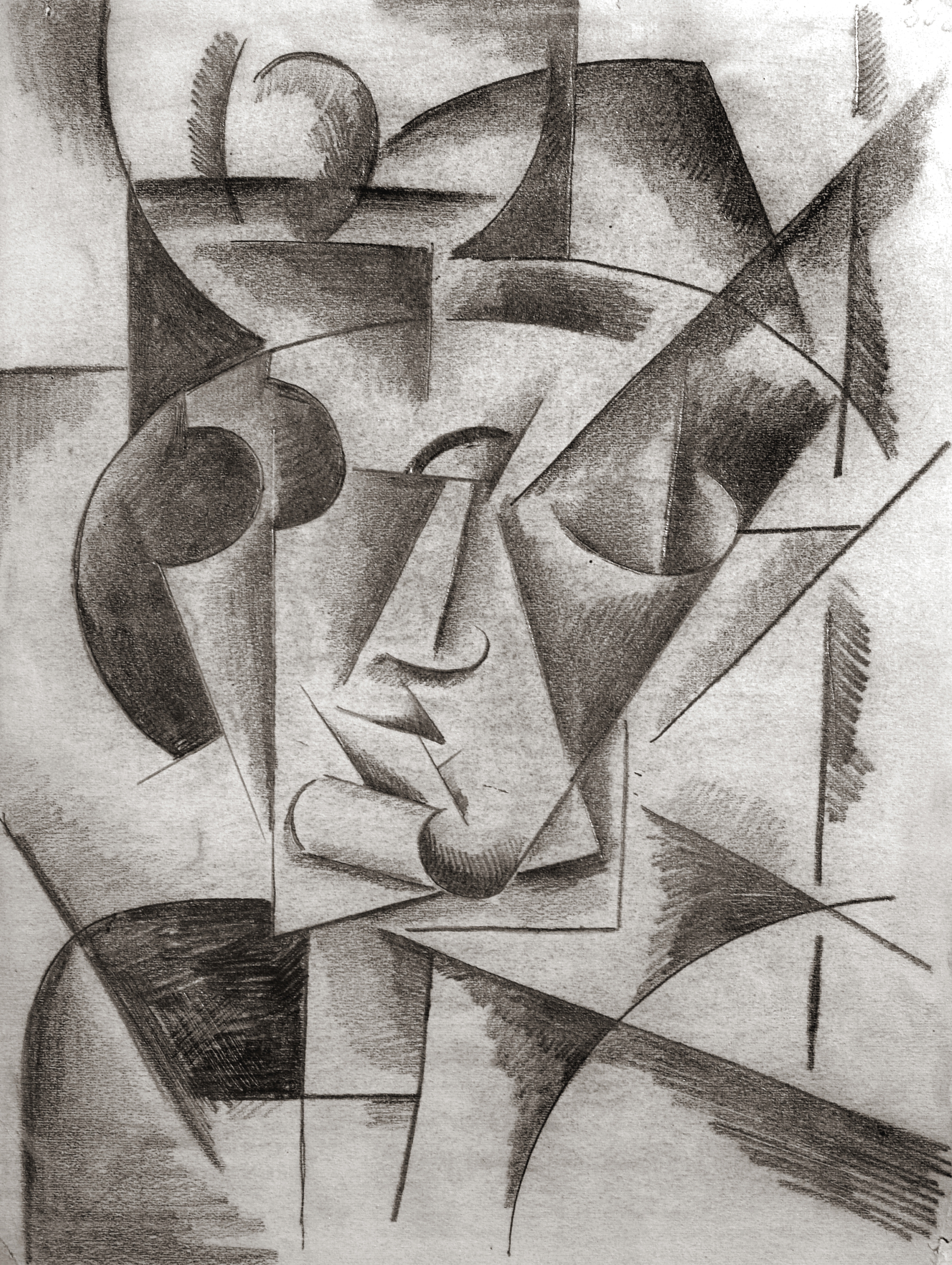
"Head" by Lyubov Popova, courtesy of the Savitsky Collection.

Though Savitsky’s primary motivation was his rabid desire to save art, seeing the poverty in which the artists’ families lived moved him to make good on paying them over time, even though he did not know where he would get the money. He literally helped keep people from starving. He fought human suffering and honored his debt to his fellow Russians, all the while doggedly preserving the work and building the Nukus Museum in Karakalpakstan to store and display all of it.

In compiling background about Savitsky, Amanda repeatedly heard about how he helped the artists’ widows who were starving. “He [Savitsky] was beloved and deserves to be honored,” she said with resolve. Savitsky’s zeal was uncompromising and apparently irresistible even to a local government boss who helped direct funds to build the museum housing the works. The irony that the oppressive, controlling government funded the museum was not lost on Amanda. “I am very attracted to projects that seem impossible,” she said. In this way, it seems she and Savitsky (who died in 1984) share similar verve.

"Crimson Autumn" by Ural Tansykbaev, courtesy of the Savitsky Collection.

Not only does the desert climate threaten the Nukus Museum contents today with ever-present oppressive heat and sand storms in remote Karakalpakstan, but a changing political climate in the region also challenges the museum’s purpose. Amanda sees the film’s mission as one way to get the word out about the treasured museum. “It is difficult to get support [for the museum] because no one knows about these artists,” Amanda explained. “It’s challenging to stay in Nukus—it’s not like staying in Paris and studying at the Sorbonne.”

Since its release in 2010, the film, according to Amanda, has been received with enthusiasm and some wonder, given that these unseen works were destined for oblivion. “The film is about recognizing those special cultural treasures that exist all over the world,” Amanda offered thoughtfully.

Filmmakers Amanda Pope and Tchavdar Georgiev on location
In the film Savitsky is quoted as saying, “The art surrounds us like air.” It is the filmmakers’ hope that, just like air, worldwide support will provide the Nukus Museum with the needed oxygen to continue keeping its contents alive, just as Savitsky intended.


Diane Mina Weltman is a BMFI member who enjoys attending performing and visual arts events and writing about them. Check out her blog, A Subject for Consideration.

Monday, April 2, 2012

THE DESTINY OF LESSER ANIMALS: A Life Changed, A Life Improved

If you missed filmmaker Deron Albright and actor/screenwriter Yao B. Nunoo's Q&A after last Tuesday's screening of The Destiny of Lesser Animals, BMFI guest blogger Diane Mina Weltman gives her take on the African crime drama and the Q&A that followed.


The Destiny of Lesser Animals: A Life Changed, A Life Improved
By Diane Mina Weltman, BMFI Guest Blogger

While it proves the premise that two wrongs don’t make a right, the film The Destiny of Lesser Animals offers layered dilemmas among its few characters and draws the audience into events where souls are won and lost by slim ethical decisions.

Set in Ghana, the film follows a police inspector, Boniface Koomsin (played by Yao B. Nunoo), who is desperate to retrieve his stolen passport but is equally uneasy about its counterfeit origins being discovered. (He saved money for ten years to purchase the passport so he could return to the US where he had previously lived.) He decides to report that his gun has been stolen so he can attach himself to an alternate investigation which can lead him to the passport thief.

Ghana’s gritty, dense urban areas and its winding rural towns give the film a colorful, yet dusty ambience in which Koomsin seeks justice and, as with most quests, unearths more about his true intentions in the process.


Director and producer Deron Albright—a St. Joseph’s University faculty member—calls the Philadelphia-area home. He lived in Ghana with his family while he researched and ultimately produced the film. He attended the recent screening at BMFI and fielded audience questions with the film’s star and screenwriter, Yao. The film is Deron’s feature directorial debut, but one of several collaborations with Yao, who recently experienced a very personal debut when he became a new father several days before BMFI's screening.

The Destiny of Lesser Animals filmmaker Deron Albright and actor/writer Yao B. Nunoo posed in the theater after the Q&A

Asked about the process of filmmaking in Ghana, where the friends first met, Deron commented that, “my visions of Africa began with conversations with Yao and it has been an evolution ever since.” Both men sought to create a film that told a universal story and happened to be set in Ghana.

Deron said that he saw The Destiny of Lesser Animals as offering a “refreshing change” from the enormous attention the Kony 2012 video has received. “This film is a preemptive response to the video,” he added thoughtfully. “People are comfortable with a certain narrative with a film about Africa,” Deron noted. “This film moves it in another direction because it is very issue-driven.” The film was “not designed to provide easy answers, but to engender questions.”

Because it was shot on location, each background conveys social messages about poverty and the role of one’s environment. The story also addresses what Deron referred to as Africa’s “brain drain”. As African citizens leave to live and work elsewhere, “it is almost assumed not if you’re going to leave, but when.” The character of Boniface, who had tasted life in the US and even found love there, is fixated on returning. His passion evolves, often painfully, into acceptance as his fierce urge to escape Ghana morphs into a desire to nurture his birth country.

Regarding the issue of national “brain drain,” Yao stated, “It is not something that people consciously talk about, but it’s something that happens.” He added, “When you tell a story you have an obligation to focus it exactly to a message, so we chose the topic and then make subtle mention of others.”

One of actor/writer Yao B. Nunoo's favorite scenes in the film features Xolasie Mawuenyega as a beggar girl.
Asked about their favorite parts in the film, Yao noted the scenes where Boniface and a beggar girl interact. “She is introduced (into the film) at a point that gives you (the audience) a nice breathing space.” Boniface and another officer uncover the violent, merciless path of the thief, and fall short in capturing him. When he faces the beggar girl’s haunting, innocent gaze, it gives him respite from the horror around him and forces him to consider how he can influence this child’s poverty-riddled life for the better.

Deron noted the scenes between Boniface and his uncle, an elderly fisherman (played by Sandy Arkhurst), as his favorite. “I really love his performance in those scenes.” Life’s purpose plays into the conversations between the two men, and one standout exchange ends with the uncle gently reminding Boniface about carefully choosing his direction saying, “As the sun rises and sets, we are meant to grow, not diminish.” These scenes with the uncle provide the film’s conscience as Boniface’s single-minded focus gradually widens. The seaside setting is a visual reminder of the world that lies beyond the Ghana coast, with the ocean’s ebb and flow moderating conversations between a patient uncle and a restless nephew.

Deron expressed his deep gratitude to those who worked on the film, stating, “One of the most heartwarming things is finding a team to work with, and many worked for no pay.” Many local family members and friends attended BMFI’s screening, providing stateside support in full.

Gratified by the consistent warm reception the film has received, Deron is especially pleased with its appeal to all ages in Ghana. “Thirteen and fourteen year olds came to see this film,” he said, “It is a universal story of the character (Yao) trying to do something.” Yao added the film appeals to an essential human yearning, citing, “In Ghana, so many people are hungry for a reflection of self.”


Diane Mina Weltman is a BMFI member who enjoys attending performing and visual arts events and writing about them. Check out her blog, A Subject for Consideration.

Friday, February 17, 2012

“The Red Machine” – Breaking Codes, Secrets, Trust

By Diane Mina Weltman, BMFI Guest Blogger

US Navy code breakers sit in a stark, unremarkable room. They mechanically reveal messages from Japanese correspondence using time-tested code-cracking methods. Their precision is abruptly broken when a new code stymies one seasoned operator.

What to do?

This is the opening from which the movie The Red Machine reveals a super-secret spy mission undertaken in Washington, D.C. in 1935.  BMFI screened the deliciously intense film on Saturday, February 11, along with a comical companion short “newsreel”, Gandhi at the Bat. Filmmakers Stephanie Argy and Alec Boehm, appearing with actor Roger Ainslie (Cmdr. Petrie), were all in attendance to answer audience questions.

The Red Machine actor Roger Ainslie and filmmakers Stephanie Argy and Alec Boehm pose with the poster for the spy caper in BMFI's lobby.

Stephanie and Alec brought their enthusiasm for the spy/detective movie genre (along with fun movie swag) and discussed how they concocted the espionage film. Their deep interest in detective-style storytelling began with a book. “We were in New Orleans book shop and came upon The American Magic Codes: Ciphers and the Defeat of Japan,” Stephanie recalled. The US military’s use of a safecracker to steal a book containing Japanese communication codes sparked for them. That idea ignited when they were making the Gandhi short film.

“The actors from Gandhi inspired us and gave face to the story we were trying to shape,” Stephanie said. Based on a short story of the same name by Chet Williamson in a 1983 New Yorker magazine, Gandhi is a supposedly secret newsreel about the peacemaker’s 1933 visit to the US in which he attends a Yankees vs. A’s baseball game. The hilarious writing was brought to life in part through the authentic-looking visual effects that Stephanie and Alec created.

Lt. F. Ellis Coburn (Lee Perkins) and Eddie Doyle (Donal Thoms-Capello) 

Petite and wearing a t-shirt with the word ‘SPY’ on it, Stephanie explained that she and her partner look at spy themes for the fun challenges they present for the audience and themselves. “We’re drawn to pulp, spy, and thief storylines for the intrigue everyone experiences.” Intrigue fills each scene of The Red Machine, as the plot crescendos. A naval officer and safecracker are paired to secure a Japanese code book locked away in a US embassy. Their unlikely match seems questionable, until they discover others’ secret agendas.

The Red Machine’s title is based on the names US Navy code breakers would give to the machines they worked to easily identify country and code origins. “We tried to get a photograph of the real Red Machine,” Stephanie added. The request for a photo from the NSA reaped no bounty, so they looked at lots of photos of cipher machines and collaborated with their prop master to build what they thought it might look like. However, two years later they found one such photo on the NSA website. “We asked the wrong question,” she laughingly added. ”The machine was always there, but we literally asked for a photo of it. The right question would have been, 'Can you take a photo of it and send it to us?’”

Literal translations aside, the device created for the film was seen by Stephanie and Alec as the vehicle to set the characters in motion. “The idea of this machine was as a sort of precursor to what eventually would become the computer,” Stephanie noted.

The couple’s teamwork continued in post-production with Stephanie working as the primary editor, and Alec as sound editor. To maintain objectivity, they followed advice from a colleague who understood the pitfalls of working on a project with a partner. “A friend suggested that we remember to keep a pair of fresh eyes on each step,” Stephanie recalled. Stephanie would edit the film and Alec was the ‘fresh eyes’ to her choices. Likewise, after Alec did sound editing, Stephanie offered her opinions.

Eddie (Thoms-Capello) puts his skills to work in The Red Machine

As for their unintended code used to describe how they felt about the difficulty of their projects on a given day, they used The New York Times crossword day of the week as their opinion shorthand. Stephanie explained, “You know, Monday puzzles are usually the easiest ones, and by Friday, they’ve grown substantially more difficult. So we would say something like ‘this looks like a Tuesday,’ to communicate how close to the mark something was.” I thought their use of daily puzzle appearance was the perfect tool for filmmakers who are so taken with clever mystery.

Asked about the challenges they faced in making the self-financed film, Alec (a possible doppelganger for actor Phillip Seymour Hoffman) used the analogy of a mine car. “Keeping the mine car on the rails in the mine shaft as much as possible was, by far, the biggest challenge for me,” he said adding “there are so many factors that can push you off course.”

Stephanie’s reply was introspective: “Saying our goodbyes.” She added, “Once the script was done, it was sad but we knew we had to cast the film so that made me happy.” The cycle of one piece ending and one beginning juggled the sadness and joy throughout until the film’s eventual completion. The couple’s mix of practical and intangible reflections reminded me, an avid movie goer, that the human factor behind the movie magic is always present on and off the screen.
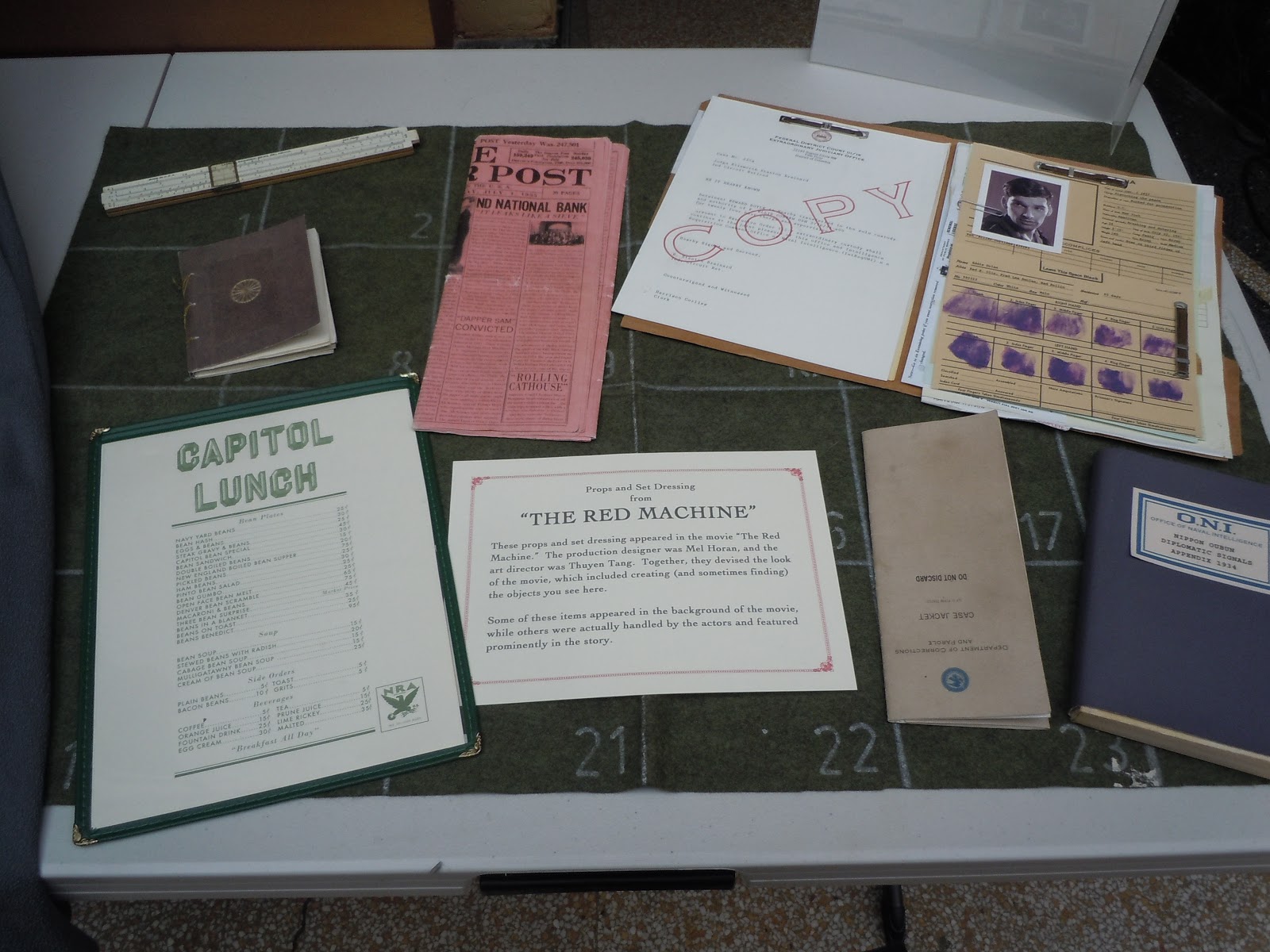
Some props and a costume from The Red Machine were on display in the atrium.
There were a lot of bean dishes (inexpensive protein) on the prop menu used for a scene in a Depression-era diner!

Stephanie’s closing remarks regarding the choice of the film’s time period offered a deeper glimpse into the couple’s purposeful approach to films. “Looking back on those times, we know they were very rough,” she shared, noting the Depression years and early events in pre-WWII Europe. “It’s our way of saying we got through those times and can get through these as well.”

Diane Mina Weltman is a BMFI member who enjoys attending performing and visual arts events and writing about them. Check out her blog, A Subject for Consideration.

Thursday, May 26, 2011

Filmmaker Appearance and FIDDLER Sing-along: A Good Week for BMFI Special Events

By Meredith Slifkin, BMFI Intern

Thanks to everyone who has been coming out to attend special events at BMFI! Last Tuesday, May 18, we were honored to have filmmaker Tigre Hill join us for a screening of his documentary, The Barrel of a Gun, and last night, Wednesday, May 25, everyone had a great time at the Fiddler on the Roof Sing-along. There was singing, dancing, matchmaking (maybe). Below are a few photos from the events:

Filmmaker Tigre Hill at The Barrel of a Gun screening and Q&A


Rachel Hancock, Asher Hancock, and Levi Hancock with grandmother Sybil Terres Gilmar in costume! 

Bernie Brenner also in costume at the Fiddler on the Roof Sing-along

Dan Schwartz in the same costume that he wore when he played Tevye at St. Joseph's Prep!
Thanks again to everyone who came out and helped to make these events a success. If you missed out on the sing-along, don't fret. Check out our upcoming Singing in the Summer film series!

Thursday, February 10, 2011

Producer Beth Rasin Keeps Her Eye on Ball

By Devin Wachs, Public Relations Coordinator

Last Thursday evening 280 squash fans enjoyed the Philadelphia premiere screening of the new documentary Keep Eye on Ball: The Hashim Khan Story, followed by a Q&A with producer Beth Rasin. As if that wasn’t enough, there was also a book signing with Trinity College squash coach Paul Assaiante and James Zug, the author of Run to the Roar: Coaching to Overcome Fear, at a reception sponsored by Trinity's alumni club before the film.


Keep Eye on Ball producer Beth Rasin and Run to the Roar author James Zug pose together before the screening. 

I had the chance to chat with Beth while the film played. A master of many trades, Beth has worked for organizations including Women’s World Cup Soccer and the US Olympic Committee. She is the Associate Director of the J.P. Morgan Tournament of Champions, the largest professional squash event in North America, and she managed the US Women’s National Squash Team for ten years. Currently, Beth is the Executive Director of PowerPlay NYC, Inc., a non-profit providing sports and life skills training for girls in underserved communities.

Here are some highlights from our conversation and the Q&A:
How did you get involved with the film?

I met Josh [Easdon, the director] in 2005. I was the Associate Director of the Tournament of Champions, which is like a who’s who in the international squash world. I helped him set up three days of interviews with the great players in the sport… Josh said that he didn’t know how to do fundraising, and I said, “I’ve done a lot, let’s talk.” We had coffee and I shared some ideas. He asked me if I wanted to be the producer. It was supposed to be a year-and-a-half long project. Six years later…

How did the project get started?

Josh is a squash-teaching pro who developed an interest in filmmaking fifteen years ago and got a Masters in Media Studies from the New School. He initially wanted to do a documentary about the history of squash, but Josh soon realized if he captured Hashim’s story, he would also capture the history of squash.

Hashim’s father was a butler at the British Officer’s club in Peshawar. He went to the club with his dad as a child. Later he became a ball boy there and developed an affinity for the game. In 1951 he was invited to play in the British Open, four years after the partition of India and Pakistan. No one had ever heard of Pakistan before. He gave Pakistan an identity around the world. He really was their first national hero! Even more impressive, he was already 37 at the time of his first British Open—long after most athletes are past their prime—and he won the next six years.
Squash champion Hashim Khan (right) shakes hands with M.A. Karim after winning his first British Open in 1951.
In the course of filming the documentary, you travelled to Pakistan with Hashim, then 92 years old. How were you received? What did you learn?

Most people expressed gratitude to us for making this film about their hero. The Department of State had issued travel warnings about Pakistan, so we weren’t sure what we’d run into, but we never encountered any anti-American sentiment.

I consider myself an educated person, but after we arrived in Pakistan, I realized that I didn’t know very much about the culture of that part of the world. I also didn’t know anything about Islam. As we progressed in making the film, the ability to explore these things was really interesting. Hashim’s story is quite compelling, and by telling it, I hope that we shed some light, beyond most of our current media sound bites, about that part of the world and also about what it means to be a Muslim; it’s not really that different from Christianity or Judaism.

The Pakistani people, and especially the Pashtuns (the tribe from which Hashim is descended), have an incredibly strong tradition of hospitality; they feel duty bound to provide hospitality and protection as long as you show them respect. Pakistan is one of the “poorer” countries I’ve travelled to, but they have this great sense of community and contentment in their lives. It was an eye-opening, life-changing journey. It reinforced for me that all of us have more in common as human beings than anything that divides us.

Did you run into any issues travelling as the only woman on the filmmaking team?

We went to a lunch honoring Hashim and I was the only woman in the room. Everyone who got up to spoke acknowledged my presence by starting off, “Gentlemen and lady…” I got an understanding of a different part of the world, but there was a lot of mutual respect.

Also, as a woman, I was the only one from the film who could meet Hashim’s eldest daughter and her eldest daughters. They follow a very conservative tradition and won’t meet men outside of the family.

What attracts you to sports?

Sports offers the opportunity to transcend the artificial boundaries that separate us: language, nationalities. And sports can also inspire us – when we watch athletes dig deep to perform at their very best we can be inspired to do that in our own lives.

I also just love being physically active. I’ve played a lot of sports—almost every sport under the sun—and nothing compares to squash. It is such a great combination of the physical and the mental—you have to do a lot of running and at the same time, a lot of thinking, because there are so many angles and different shots to hit. Even though squash is played in more countries around the world than any other sport, except soccer, the squash community is also very connected—as evidenced by the huge turnout for the film.

Would you produce another film?

Absolutely. After I’ve gotten a little sleep.
Thank you, Beth!
 
If you missed this screening of Keep Eye on Ball or would like to watch it again, you can order a DVD here.

Thursday, January 13, 2011

Exclusive Interview with MY DOG TULIP Filmmakers Paul and Sandra Fierlinger

By Meredith Slifkin

The holidays may be over, but there’s no reason to get the winter blues when there are such great events at BMFI! On Wednesday, January 19 at 7:30pm, there will be a special screening of My Dog Tulip followed by a Q&A with the filmmakers, Paul and Sandra Fierlinger. The Fierlingers will also teach a FREE Master Class at 2:00pm about animation in the digital world.

My Dog Tulip is the story of a man, his dog, and the extraordinary nature of canine-human friendship. This animated adaptation of the memoir by J.R. Ackerley has already earned widespread praise for filmmakers Paul and Sandra, who reside on the Main Line.

Paul and Sandra Fierlinger will teach a free Master Class at 2:00pm and
answer questions after the 7:30pm screening of My Dog Tulip on January 19.

Paul began working in Czechoslovakia in the 1950s, where he became the state’s first independent producer of animated films. In 1968 he escaped the Communist regime in Czechoslovakia, seeking solace in Holland and eventually the United States, where he continued to create animated films for television and the big screen. Paul was awarded the PEW Fellowship in the Arts in 1997 for his body of work.

Sandra is a native of Wayne, Pennsylvania, and graduated with highest honors from the Pennsylvania Academy of the Fine Arts. She has collaborated with her husband, Paul, on many projects, including short and feature films for Sesame Street and PBS.

I caught up with Paul and Sandra via email. Keep reading for their take on My Dog Tulip, animation, and their exciting new project!
My Dog Tulip features the voices of Christopher Plummer, Isabella Rossellini, and the late Lynn Redgrave.

Q: What drew you both to My Dog Tulip? Has it been a “pet” project of yours for awhile, or did you come across the Ackerley material recently?

Paul: The book has been with us since it first came out in the New York Review of Books Classics series. Soon after reading it I began to make notes which I stuck between the pages with a possible theatrical film in mind. After a few weeks we got busy with other projects and the whole idea just vanished from our thoughts and conversations. When the two producers who became the actual film’s producers first called us—this happened years later—I had no recollection of ever thinking of Tulip as a movie and was immensely surprised when I discovered my notes between the yellowing pages. Mind you, the producers called us to make Tom Sawyer, not Tulip, but as we talked about all sorts of other ideas, the four of us on that conference call agreed that My Dog Tulip was a good one.

Q: The animation in My Dog Tulip has such a distinct look to it. Would you tell us about the method of hand-drawn computer animation used? Will this technique play a prominent role in the future of the animation art form?

Paul: The computer software we used is called TVPaint (made in Metz, France) and it has been our primary production tool since its inception, twenty years ago. We have been their beta-testers for about fifteen of those years now. It has gone through a slow recognition process mainly because the world wide market for such an application is incredibly miniscule, and these five Frenchies, who are still together after twenty years, had both zero marketing skills and money. TVP is now a household name in any 2-D animator’s family, and all the prominent animation schools around the world; this happened by word of mouth only. The software has grown in those twenty years, too, of course, and has finally reached the well-deserved status of the best there is for handmade (or computer assisted; take your pick) independent productions of art films. Hand-drawn films are coming back in a big way.

The Fierlingers created My Dog Tulip using hand-drawn computer animation. 

Q: Was your style of animation at all influenced by the Czech cartoonists and animation artists from the golden age of Kratky Film?

Paul: That yes, and by the way I grew up in the United States during WWII, and by the dreaded boarding school in which I had to spend my first four years in Czechoslovakia, by my father’s insistence that I drop the idea of becoming an animator, by the fact that no one had ever thought possible that one person alone could draw films, by my first and second divorces, the dogs I had owned, the despair I had fallen into that I will be forever locked within the barbed wire borders of that horrible place ruled by a tyrannical Soviet system, by my escape back to the West, by every advertising agency I had ever done work for, by my third and final marriage on a boat off Ordinary Point on the Chesapeake Bay, and by my 41 years of life on or close to the Main Line.

Q: Sandra, when did you become interested in animation? How do your skills as a painter influence your work with computer animation?

Sandra: Animation was never in my vocabulary as an artist growing up on the Main Line. Then Paul hired me as a colorist, married me, and what else am I supposed to do? The garden is so small.

Q: Are you working on any new projects?

Paul: The film we are working on now is being done in a way no one else has ever done before us, unless you count Charles Dickens, but he was not an animator. Sandra and I have embarked upon the serialization of an animated graphic novel to be released in installments on an e-magazine website, yet to be determined. This work in progress will be screened as the core of our Master Class earlier in the afternoon. We will also be discussing the explosion of hand drawn animated illustrations and tiny art films made by tiny cameras all over the pages of internet e-readers, a new publishing phenomenon which already is beginning to happen.

Exclusive image from Paul and Sandra's new project, Slocum at Sea with Himself.
Excerpts will be featured in the free Master Class taught by the Fierlingers.

Thanks, Paul and Sandra! 

If you have questions of your own for the Fierlingers, join us at BMFI's Master Class or the My Dog Tulip screening.

The Master Class is free and open to everyone, but there are only a few spaces left! To register, email VTemple@BrynMawrFilm.org or call 610-527-4008 x109.

You can purchase tickets to the My Dog Tulip screening and Q&A by clicking here or visiting the Box Office.