
If you’re looking for something to do during the dog days of summer, Bryn Mawr Film Institute has got it. We have just gone to press with our Projections program guide, which includes information about summer film courses, series, seminars, and new releases. Keep reading to learn about the highlights, or click here for the full schedule and detailed descriptions. There's truly something for every film fan.
We asked for your suggestions and you selected three fantastic classics to be shown in our inaugural Audience Choice film series: On the Waterfront (1954), The Third Man (1949), and Lawrence of Arabia (1962). Enjoy Brando, Welles, and O’Toole on the big screen in these masterful cinematic achievements chosen by you.
For those that want to take a film course at BMFI but can’t commit to multiple sessions, the answer lies in this year’s Summer Classic Seminars. Each night is a stand-alone class built around one of the classics shown in the theater, featuring a lecture and a guided discussion of each. We’ll examine On the Waterfront on Wednesday, July 14, The Third Man on Wednesday, July 21, The Hidden Fortress (1958) on Tuesday, August 17, and The Lady Eve (1941) on Wednesday, August 25. Sessions go from 6:30 PM to 9:30 PM with the film screenings at 7:00 PM.
BMFI celebrates song and dance on the big screen this summer. Fred Astaire straps on his dancing shoes in the Fred Astaire Frenzy film series, featuring two films. Daddy Long Legs (June 8, 7:00 PM) and You’ll Never Get Rich (June 9, 7:00 PM) showcase some of Astaire’s best musical romances, co-starring Leslie Caron and Rita Hayworth. For fans looking to belt out a few show tunes, the Singing in the Summer film series is here. Dress up and sing along with the unforgettable movie musicals Oklahoma! (June 2, 7:30 PM), The King and I (July 7, 7:00 PM), and Mary Poppins (August 4, 7:00 PM). You’ll be sure to leave these events “Chim Chim Cheree”-ing all the way home! If you care for a more academic approach, BMFI’s film course Singin’ on Screen: The Musical will certainly increase your appreciation for the movie musical genre.
Another film series all ages can look forward to is Teens on Screen. Enjoy the movies that define the teenage experience through the decades, with George Lucas’s American Graffiti (1973), teen film extraordinaire John Hughes’s Sixteen Candles (1984), and Richard Linklater’s insightful Dazed and Confused (1993) showing on 35mm on Tuesday nights in June.
Those with their eyes on the darlings of film lore can come see the charm and gravitas of Audrey Hepburn, Elizabeth Taylor, and Barbara Stanwyck on Wednesday nights in August. With the Leading Ladies of the Silver Screen film series, choose from the comedy of Sabrina (1954), the romance of A Place in the Sun (1951), and the hilarity of The Lady Eve (1941), or see all three!
Did the Master of Suspense have a political agenda? See for yourself when Hitchcock returns to BMFI. Enjoy two 35mm screenings of Sabotage (1936) and Lifeboat (1944), shown in conjunction with the four-week film course Alfred Hitchcock: The Political Films.
Another cinematic auteur, Akira Kurosawa put Japanese cinema on the map and influenced many great filmmakers. BMFI is celebrating the legend’s 100th birthday with a five-film series of screenings every Tuesday in August. The Akira Kurosawa Retrospective features his crowning achievement, Seven Samurai (1954), as well as Rashômon (1950), The Hidden Fortress (1958), Stray Dog (1949), and Yojimbo (1961).
Fans of these foreign treasures can also look forward to the wonderful Jacques Tati Festival film series, featuring M. Hulot’s Holiday (1953), Mon Oncle (1958), Playtime (1967), and Trafic (1971). The films, screening four consecutive Tuesdays in July, are shown in conjunction with the course Pantomimes and Proverbs: The Films of Tati and Rohmer, which contrasts the comedy of Jacques Tati (and his alter ego Monsieur Hulot) with the drama and romanticism of Eric Rohmer to reveal new aspects of French cinema.
And of course, you’ll be delighted in the summer’s repertoire of new releases, including the Sundance Film Festival hit The Kids Are All Right, starring Julianne Moore, Annette Bening, and Mark Ruffalo; the French romance Coco Chanel and Igor Stravinsky; and much, much more. Become a member and check out the newest issue of Projections or visit BrynMawrFilm.org to see what is currently showing on our screens.
The summer has a whole lot in store at BMFI, so relax, take a break from the heat, and enjoy the shows!
Tuesday, May 18, 2010


Anna Adler's Adventures in Cannes: Round Three
University of Pennsylvania film student Anna Adler reports from the Cannes Film Festival, exclusively for BMFInsights!
Yesterday (Monday), I started my day by attending a lecture that my program from Penn set up for the students here. The lecturer's name was Geoffrey Gilmore, who is the Creative Director of the Tribeca Film Festival. He was very honest and gave great advice to us, who are all interested in getting involved in the film or media industries professionally one day. A specific, interesting thing I've been thinking about that he discussed is that it is really hard to determine audience behavior today, in particular which exact platform viewers prefer to watch movies on now--such as on a computer, an iPod or iPhone, through premium channel television programming, etc. In addition, Gilmore also talked about how it is really rare for viewers today to agree on whether or not a movie is "good" or "bad." I thought this was "right-on" because every time I have walked out of a film since I've been here, my friends and I always have very different reactions, even to something like Wall Street 2 (see previous post).

Check back for more of Anna's stories from the Riviera!
Yesterday (Monday), I started my day by attending a lecture that my program from Penn set up for the students here. The lecturer's name was Geoffrey Gilmore, who is the Creative Director of the Tribeca Film Festival. He was very honest and gave great advice to us, who are all interested in getting involved in the film or media industries professionally one day. A specific, interesting thing I've been thinking about that he discussed is that it is really hard to determine audience behavior today, in particular which exact platform viewers prefer to watch movies on now--such as on a computer, an iPod or iPhone, through premium channel television programming, etc. In addition, Gilmore also talked about how it is really rare for viewers today to agree on whether or not a movie is "good" or "bad." I thought this was "right-on" because every time I have walked out of a film since I've been here, my friends and I always have very different reactions, even to something like Wall Street 2 (see previous post).

After hearing Geoffrey Gilmore, I went to the Croisette to see three films: one by an independent production company called Brotherhood, which was about the dangers of fraternity pledging; a documentary on the President of the Cannes film festival titled Gilles Jacob, L'Arpenteur de la Croisette; and a horror movie called The Pack (La Meute). I enjoyed Brotherhood in the same way that I enjoyed The Perfect Host (see Thursday's post): it was disturbing, yet entertaining, and I was never bored. The documentary was really interesting, and I especially enjoyed the shots of Gilles Jacob interacting with some of the greatest directors, actors, and actresses throughout film history. Finally, I can say the horror movie was just definitely not for me!
Check back for more of Anna's stories from the Riviera!
Sunday, May 16, 2010
Anna Adler Reports from Cannes: Saturday and Sunday
Here is the second installment of Anna Adler's adventures at the Cannes Film Festival, exclusive to Bryn Mawr Film Institute.
Saturday morning, my friends and I woke up early to try to test our luck in getting into the Woody Allen movie that's playing here, You Will Meet a Tall, Dark Stranger. Only one of us was successful. It was a fun experience though standing outside the Lumiere Theater with our paper signs saying "un invitation pour Woody Allen S.V.P." One of the signs that someone wrote was funny; it said "I want to meet a tall, dark stranger...please give me an invitation!" When I couldn't get in, I decided to walk along the Croisette and explore. A few of my friends and I ate lunch along there--it was a beautiful day.
We then saw a documentary in the "marketplace," where a number of non-competition, smaller films are being shown. The documentary was called Gasland, directed by Josh Fox. It was about the dangers of natural oil on the environment. It wasn't my favorite, but it was educational and I learned something new here and there. After resting for a little bit, we then saw another non-competition movie called Jerry Cotton, which was a German film whose concept was very similar to Austin Powers.
Our Penn program gave us premiere passes to Greg Araki's film, Kaboom, which was an overall great experience, but the film was absolutely bizarre. I have never had a reaction to a movie like this before--the plot had so many twists and turns that I truly was left speechless at the end of the film. There really was no solution in the end of the film's plot at all--it was very avant garde-ish. My reaction to this movie is, I believe, very similar to people's when they first viewed Andalusion Dog back in the day (in fact, there was a reference made to this movie within Araki's film). It was very cool to do the whole red carpet thing in the evening and see everyone dressed up in black tie. The film was being shown at 12:30 am, so once it was over I was exhausted from this busy day!
Today (Sunday) my friends from the program and I decided to take a day trip to Monte Carlo, Monaco to see the Grand Prix. The train from Cannes to Monaco was only 16 euros round trip, and was only 1 hour and 5 minutes each way (the same time it takes on the Acela train from Philadelphia to New York City)! The Grand Prix was definitely an exciting day to visit. We were able to catch a quick glimpse of the racecars as they zipped by (and we definitely were able to hear them the whole time)! Many of the streets were closed off during the race, so afterwards we explored and got to know the city. We arrived back in Cannes late this evening, and I am looking forward to seeing what surprises tomorrow may bring!
Enjoy more of Anna's adventures in Cannes, coming soon!
Saturday morning, my friends and I woke up early to try to test our luck in getting into the Woody Allen movie that's playing here, You Will Meet a Tall, Dark Stranger. Only one of us was successful. It was a fun experience though standing outside the Lumiere Theater with our paper signs saying "un invitation pour Woody Allen S.V.P." One of the signs that someone wrote was funny; it said "I want to meet a tall, dark stranger...please give me an invitation!" When I couldn't get in, I decided to walk along the Croisette and explore. A few of my friends and I ate lunch along there--it was a beautiful day.
We then saw a documentary in the "marketplace," where a number of non-competition, smaller films are being shown. The documentary was called Gasland, directed by Josh Fox. It was about the dangers of natural oil on the environment. It wasn't my favorite, but it was educational and I learned something new here and there. After resting for a little bit, we then saw another non-competition movie called Jerry Cotton, which was a German film whose concept was very similar to Austin Powers.
Our Penn program gave us premiere passes to Greg Araki's film, Kaboom, which was an overall great experience, but the film was absolutely bizarre. I have never had a reaction to a movie like this before--the plot had so many twists and turns that I truly was left speechless at the end of the film. There really was no solution in the end of the film's plot at all--it was very avant garde-ish. My reaction to this movie is, I believe, very similar to people's when they first viewed Andalusion Dog back in the day (in fact, there was a reference made to this movie within Araki's film). It was very cool to do the whole red carpet thing in the evening and see everyone dressed up in black tie. The film was being shown at 12:30 am, so once it was over I was exhausted from this busy day!
Today (Sunday) my friends from the program and I decided to take a day trip to Monte Carlo, Monaco to see the Grand Prix. The train from Cannes to Monaco was only 16 euros round trip, and was only 1 hour and 5 minutes each way (the same time it takes on the Acela train from Philadelphia to New York City)! The Grand Prix was definitely an exciting day to visit. We were able to catch a quick glimpse of the racecars as they zipped by (and we definitely were able to hear them the whole time)! Many of the streets were closed off during the race, so afterwards we explored and got to know the city. We arrived back in Cannes late this evening, and I am looking forward to seeing what surprises tomorrow may bring!
Enjoy more of Anna's adventures in Cannes, coming soon!
Friday, May 14, 2010
Anna Adler Reports from Cannes: THE PERFECT HOST and WALL STREET 2
Bryn Mawr Film Institute is getting reports directly from the Cannes Film Festival, thanks to film student Anna Adler. She'll be checking in regularly from the French riviera, giving you the inside scoop on the festival and its films. Enjoy!
Yesterday (Thursday) I started the day in the "Croisette" with a few of my friends in the program by trying to get into any movie possible, and it seemed hopeless. Our student passes were not really getting us anywhere. As things were looking very poor, we were able somehow to sneak through the back of the "marketplace," where a bunch of independent production companies were screening a number of non-competition films and had little mini studio set-ups where they would be setting up deals with distributors. Once we were in the marketplace, we went up to all of these little mini-studios and were able to get free "invitations" to about twelve screenings throughout the festival. We felt very accomplished. We saw one of these films yesterday afternoon, called The Perfect Host (directed by Nick Tomnay of the Cinema Management Group LCC). While the plot had a number of twists (and was actually somewhat disturbing), I was never bored for one second and the film was very entertaining. The rest of my crew saw a few more movies yesterday, but I had to stay in and rest. Last night, we decided after dinner to go over to the Carlton Hotel and "people-watch," where we saw Josh Brolin, which was very exciting.
This morning, we had a few more of these type of screenings planned, but we decided to try to wait outside the Lumiere Theater with paper signs to see if we could get an invitation to the premiere of Oliver Stone's Wall Street 2: Money Never Sleeps (see the picture below).
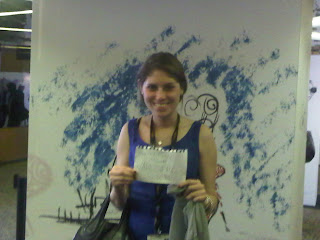
The sign said, "Un invitation pour Wall Street S.V.P." (SVP = s'il vous plait). As we were all laughing with each other about this unlikely attempt to get in, someone walking out of the theater handed me a ticket. As I jumped in excitement and waited in line to get into the premiere, someone asked if they could trade tickets with me (mine was a balcony ticket) so that he could sit with his wife. The ticket he gave me ended up being in the orchestra, and I sat in the fifth row of the premiere this afternoon. The entire experience was so exciting--although I never saw the original Wall Street, I really enjoyed the sequel. I am sure the experience behind viewing this film biased my opinion of this movie, but I thought the plot was great and entertaining.
Check back for more to come from Anna at Cannes!
Yesterday (Thursday) I started the day in the "Croisette" with a few of my friends in the program by trying to get into any movie possible, and it seemed hopeless. Our student passes were not really getting us anywhere. As things were looking very poor, we were able somehow to sneak through the back of the "marketplace," where a bunch of independent production companies were screening a number of non-competition films and had little mini studio set-ups where they would be setting up deals with distributors. Once we were in the marketplace, we went up to all of these little mini-studios and were able to get free "invitations" to about twelve screenings throughout the festival. We felt very accomplished. We saw one of these films yesterday afternoon, called The Perfect Host (directed by Nick Tomnay of the Cinema Management Group LCC). While the plot had a number of twists (and was actually somewhat disturbing), I was never bored for one second and the film was very entertaining. The rest of my crew saw a few more movies yesterday, but I had to stay in and rest. Last night, we decided after dinner to go over to the Carlton Hotel and "people-watch," where we saw Josh Brolin, which was very exciting.
This morning, we had a few more of these type of screenings planned, but we decided to try to wait outside the Lumiere Theater with paper signs to see if we could get an invitation to the premiere of Oliver Stone's Wall Street 2: Money Never Sleeps (see the picture below).
The sign said, "Un invitation pour Wall Street S.V.P." (SVP = s'il vous plait). As we were all laughing with each other about this unlikely attempt to get in, someone walking out of the theater handed me a ticket. As I jumped in excitement and waited in line to get into the premiere, someone asked if they could trade tickets with me (mine was a balcony ticket) so that he could sit with his wife. The ticket he gave me ended up being in the orchestra, and I sat in the fifth row of the premiere this afternoon. The entire experience was so exciting--although I never saw the original Wall Street, I really enjoyed the sequel. I am sure the experience behind viewing this film biased my opinion of this movie, but I thought the plot was great and entertaining.
Check back for more to come from Anna at Cannes!
Tuesday, April 20, 2010
David Brind Dishes on DARE
Filmmaker David Brind visited Bryn Mawr Film Institute on Wednesday, April 14 to teach a free Filmmaking Master Class and to introduce and discuss an evening screening of Dare, the high-school drama he co-produced and scripted. We have done a lot of really wonderful events here at BMFI since we re-opened in 2005, but this Master Class is one of my personal favorites. David was disarming and engaging, leading a no-holds barred discussion of Dare’s five-year journey from his MFA short at Columbia University’s Graduate Film Program to the feature’s premiere at the 2009 Sundance Film Festival. He dished about screenwriting, fundraising, the role of producers, agents and investors, and struggling to get good distribution even after a much-hyped premiere and good reviews. Keep reading for excerpts about how Dare made it to the big screen.

Dare stars Emmy Rossum (The Phantom of the Opera, The Day After Tomorrow) as Alexa, a clean-cut aspiring actress in the spring of her senior year of high school who decides to push her limits after an arrogant actor (Alan Cumming) tells her that she lacks experience and challenges her to do something that scares her. Remaking herself into a free spirited risk-taker leads her to seduce her acting partner, the rebellious, popular Johnny (Zach Gilford, NBC’s Friday Night Lights). When her shy best friend Ben (Ashley Springer) also pursues Johnny, the three must navigate an increasingly complicated situation as the school year draws to a close. Told in three parts, one focusing on each of the teens’ perspectives, Dare is set in the suburbs of Philadelphia and was filmed locally.

Excerpts from David's class:
A member of Bryn Mawr Film Institute’s advisory board, Philadelphia-born filmmaker David Brind wrote the screenplay and co-produced Dare, his first feature. He also wrote and produced the award-winning 2003 short film of the same name, which provided the basis for the feature. The short played at over fifty film festivals worldwide and was picked up by Strand Releasing as part of Boys’ Life 5, a series of gay-themed short films. David has also directed three short films, including Twenty Dollar Drinks with Sandra Bernhard and Tony Award-winner Cady Huffman, which premiered in competition at the 2006 Tribeca Film Festival.
Also a successful theater director, David directed Sandra Bernhard in her one-woman show titled Sandra Bernhard: Everything Bad and Beautiful, which ran for four months off-Broadway in 2006 and was restaged at Philadelphia’s Prince Music Theater in 2007. He participated as a director of the benefit performances of “The A-Train Plays” at New World from 2006 to 2008 and also directed Cady Huffman in her first one-woman show, which premiered at the Ars Nova Theater and later played at Birdland Jazz Club in 2007. Recently he directed a reading of playwright Jerome Kass’ Love Song that featured Matthew Broderick and Alan Cumming.
David received his B.A. from Yale University as a double major in Theater Studies and American Studies. He received his MFA in Screenwriting from Columbia University’s Graduate Film Program.
Watch a trailer and find more information about Dare here.

Dare stars Emmy Rossum (The Phantom of the Opera, The Day After Tomorrow) as Alexa, a clean-cut aspiring actress in the spring of her senior year of high school who decides to push her limits after an arrogant actor (Alan Cumming) tells her that she lacks experience and challenges her to do something that scares her. Remaking herself into a free spirited risk-taker leads her to seduce her acting partner, the rebellious, popular Johnny (Zach Gilford, NBC’s Friday Night Lights). When her shy best friend Ben (Ashley Springer) also pursues Johnny, the three must navigate an increasingly complicated situation as the school year draws to a close. Told in three parts, one focusing on each of the teens’ perspectives, Dare is set in the suburbs of Philadelphia and was filmed locally.

Excerpts from David's class:
What was your inspiration for the short?
The central image for the short was two boys by a pool with a champagne bottle on a ledge. Thematically for me it’s about that moment in adolescence when you have a real connection with the most unexpected of people.
What inspired the feature?
Alexa was a peripheral character [in the short]. I got to capture in that moment [she shares a look with Ben after he has had an intimate encounter with Johnny] that she knows something’s shifted. That moment was my way into the feature film. ‘Who is this girl? What does she know about her friend? What are her feelings about Johnny?’ So I wrote a scene about their conversation in my file-o-fax on a train about 1-1/2 months after shooting the [short] film. That scene made it to the screen [in the feature] unchanged. I started the feature script in September 2004 and finished the first draft in August 2005.
What fueled the expansion of the story from the short to the feature?
So hard to say. With Dare it was extremely personal. It felt like I knew these characters and they were in my head. I’ve always loved high school movies like The Breakfast Club and Sixteen Candles, and I wanted to subvert the stereotypes. Of course my own personal experiences from high school influenced the film as well, because you have to write what you know. It’s the oldest adage, but it’s true.
I never had any intention of exploring the same thing as the short. In the short I wanted to tell a twisty, sexy story about a boy who takes a risk and does something he doesn’t expect. In the feature I wanted to expand these three concepts of the good girl, bad boy, and outsider. The feature’s psychologically more complex and more personal. The short’s 17-18 pages, not much revision. With the feature, things get cut and rearranged and rewritten and some scenes don’t feel like my babies anymore.
How did you get support for the feature?
Strand Releasing [the distribution company for the short] connected us with different people to send the script to. There was one producer that courted us offering $500,000, but he wanted nudity and there wasn’t any in the script. (There’s sex, language, underage drinking and smoking, so I’m hardly a prude, but there’s no nudity.) The producer wanted me to add nudity and kept looking for places to do it: “Throw in a shower scene—I don’t know about you, but I shower naked.” Finally, he said, “If you want to get the nickel, you’ve got to show the pickle.” We said no.
Another person who really liked the script was Mary Jane Skalski (producer of The Station Agent, Mysterious Skin, The Visitor). After we passed on the one offer, we decided to throw ourselves at her mercy. She explained that she didn’t want to produce anything just then but said, “I really love your script so I guess I’ll have to produce.” She brought in casting director Kerry Barden (Good Will Hunting, The Visitor, Pineapple Express, Bad Boys II), and we started seeing a list of actors for roles.
Did the film change a lot in post-production?
We spent two months just editing the ending. The ending was found in the editing room.
The editor is hugely important. A film starts with a script, is retold by the director, and is retold again by the editor. Each one doesn’t know exactly what the other ones were thinking, so they bring their own unique spin to the project. It’s a collaborative medium and everyone contributes.
Did you intend to make a “gay film”?
I didn’t intend to tell a “gay” story. I felt like I wanted to tell this story and it had gay content. On a commercial level, having gay content is difficult, unless you’re gay, gay, gay all of the time. The question becomes, “Who do we market it to?”
A member of Bryn Mawr Film Institute’s advisory board, Philadelphia-born filmmaker David Brind wrote the screenplay and co-produced Dare, his first feature. He also wrote and produced the award-winning 2003 short film of the same name, which provided the basis for the feature. The short played at over fifty film festivals worldwide and was picked up by Strand Releasing as part of Boys’ Life 5, a series of gay-themed short films. David has also directed three short films, including Twenty Dollar Drinks with Sandra Bernhard and Tony Award-winner Cady Huffman, which premiered in competition at the 2006 Tribeca Film Festival.
Also a successful theater director, David directed Sandra Bernhard in her one-woman show titled Sandra Bernhard: Everything Bad and Beautiful, which ran for four months off-Broadway in 2006 and was restaged at Philadelphia’s Prince Music Theater in 2007. He participated as a director of the benefit performances of “The A-Train Plays” at New World from 2006 to 2008 and also directed Cady Huffman in her first one-woman show, which premiered at the Ars Nova Theater and later played at Birdland Jazz Club in 2007. Recently he directed a reading of playwright Jerome Kass’ Love Song that featured Matthew Broderick and Alan Cumming.
David received his B.A. from Yale University as a double major in Theater Studies and American Studies. He received his MFA in Screenwriting from Columbia University’s Graduate Film Program.
Watch a trailer and find more information about Dare here.
Friday, February 26, 2010
Sarah Schenk's SLIPPERY SLOPE
Sarah Schenck--writer/director, Bryn Mawr College alumna, and Hepburn Center Fellow--came down from New York to introduce and discuss her 2006 comedy Slippery Slope at Bryn Mawr Film Institute on Wednesday, February 24. Check out some highlights from the Q&A below.
In Slippery Slope, when an ardent young feminist needs cash to get her documentary "Feminism for Dummies" to Cannes, she takes a job directing an adult film... bringing her ideals to the set and awakening her own sexuality. The experience changes her professionally and personally in unexpected ways, jeopardizing her relationship with her politically-correct husband. The sexy screwball comedy gets big laughs, but also raises some serious issues about the uses and types of sexual imagery on film and the state of women's liberation. Slippery Slope premiered at the Montreal International Film Festival with three sold-out screenings and was honored with Best Film at the L.A. Broad Humor Festival.
Sarah Schenck, a Bryn Mawr College alumna and Hepburn Center Fellow, made her feature directorial debut with Slippery Slope. She has written three other feature screenplays. In 2004, Sarah was nominated for an Independent Spirit Award for producing Virgin, a $65,000 feature starring Robin Wright Penn and Elisabeth Moss. Her short films as writer/director/producer have won prizes in the U.K. and Belgium. She field produced the New York City segment of The College Track, a documentary about access to college for low-income students that aired nationwide in 2005 on PBS. Sarah has since made three documentaries for Project Renewal, New York City’s largest non-profit providing services to the homeless. She also makes half-hour documentaries on subjects relating to the food supply that air regularly on the Park Slope Food Coop’s cable television show. Sarah also recently began work as Video Producer and Director with Parent Earth, an internet start-up devoted to parenting, food, and environmental sustainability. She is currently raising funds for her next feature film, Primitive Streak.
Sarah received her B.A. in Art History from Bryn Mawr College and her M.A. in Political Economy from Stanford University. Before she became a filmmaker, Sarah served for six years as the New York City Comptroller’s Senior Advisor for Education Policy after working on public education policy for the 1992 Clinton/Gore presidential campaign. She has also worked for The New York Times in Rio de Janeiro researching a story on the sex industry; was a fellow at the Metropolitan Museum of Art and lectured on fifteenth century Flemish painting; worked as a product testing guinea pig for Procter & Gamble in Paris; and cared for patients in Mother Theresa’s hospitals in Calcutta.
In Slippery Slope, when an ardent young feminist needs cash to get her documentary "Feminism for Dummies" to Cannes, she takes a job directing an adult film... bringing her ideals to the set and awakening her own sexuality. The experience changes her professionally and personally in unexpected ways, jeopardizing her relationship with her politically-correct husband. The sexy screwball comedy gets big laughs, but also raises some serious issues about the uses and types of sexual imagery on film and the state of women's liberation. Slippery Slope premiered at the Montreal International Film Festival with three sold-out screenings and was honored with Best Film at the L.A. Broad Humor Festival.
You’ve done a lot of different kinds of jobs. How did you become a filmmaker?
I love film. I’ve always loved seeing movies.
While I was working at the City Comptroller’s office in New York doing education policy, I was at a party with a bunch of Columbia University film students and one had lost his art director. He knew I knew how to paint so he asked me to create a prison rec room set. I did, working nights and weekends, and took the opportunity to hang around the set while shooting. Watching him work with actors was transformative. Grad schools are a close knit community, and soon after I was asked to produce a short film. I’d run a political campaign, and producing a film is similar, there are a lot of transferable skills. Eventually I left my job at the Comptroller’s Office to become a full-time filmmaker.
I did other shorts as a director and writer and produced a feature just before Slippery Slope, Virgin, which got nominated for a bunch of Independent Spirit Awards. It helped that it had Robin Wright Penn in it. I knew that with Slippery Slope I needed to write scripts I could make on the money I could raise, with no stars.
Why did you make a comedy?
I love comedy, it’s an effective, direct way into the subconscious, a way to deal with sensitive and sore issues. Someone more articulate than myself said, “Dying is easy; comedy is hard.” And I agree with that—it's a challenging genre.
What would you do differently?
There’s an alternate ending [that BMFI’s audience got to enjoy, and which is also on the DVD], and I think maybe I chose the wrong one. Also, the sex scenes. I work with actors in a different way when nudity and sex are involved. Those scenes didn’t come out the way that I wanted; I wanted them to look more disorienting and a little less “soft-core”. I had story boards and had it all planned out, but other things took precedence and I wasn’t able to shoot those scenes the way I wanted to.
How long did it take you to write the script?
I wrote the script based on an idea I’d had for some time. Once I sat down to write it, it took about seven months or so, but I was also working on other things. Because I’d done some other scripts and produced a feature, I knew what I could do with the budget of a first-time filmmaker.
What was your budget and how long did it take to make Slippery Slope?
Slippery Slope had a $300,000 cash budget from eighteen private investors, as well as tremendous in-kind support, so it was about a $500,000 film, a much bigger budget than what I’d had to work on before. It took two years, including post-production and one day of re-shoots. We did 3-1/2 weeks of principal photography and then went to the cutting room, a pretty standard process.
For my current project, Primitive Streak, I didn’t feel up to fundraising again, so I am following an alternate model, using a smaller cast and shooting whenever time allows, then cutting and posting short episodes on line. Ultimately, we’ll re-cut and join the episodes to become a feature film.
What kind of distribution did the film get after its premiere at the Montreal International Film Festival?
It’s very difficult to get a theatrical release for a small independent film, so it’s a treat to get to see it on the big screen with you tonight. A distributor [Life Size Entertainment] did take us on, but not for a theatrical release. We sold to HBO Hungary, and some other markets. It’s a hard time for distributors, there are a lot of good films out there that never get released. The challenge with filmmaking is that it is such an expensive medium that if you’re not commercially successful, it’s hard to continue.
I loved Jim True-Frost on TV’s The Wire and it was so fun to see him in Slippery Slope. How was it working with your actors?
I think Jim True-Frost [who plays the protagonist’s very P.C. husband in Slippery Slope] is so wonderful to watch. There are people who really hate his character, so it’s interesting to see how the portrayal is received. His wife said to me that Slippery Slope is his favorite movie that he’s ever been in!
The hard thing about film, unlike painting, is that it’s a very expensive thing to do. Because we were able to pay SAG wages, we were able to get some wonderful actors. They were like racehorses, incredibly fine-tuned, and they brought great suggestions for the script and insight into their characters.
How did you go from working in Mother Theresa’s hospitals to being a filmmaker? How do those other experiences impact your thinking about your work?
It’s funny, I spoke earlier today at Bryn Mawr College about this. Every day I struggle with a sense of failure because there’s so much need [in the world]. I’ve taught kids to read and I know how to shingle a house, so wouldn't those activities be a better use of my time? But being a filmmaker is kind of like marriage. I think people get married when they feel like they have to be together; being an artist is the same kind of thing. You do it because you have to, because part of you can’t not. I love to communicate through film, and I also try to do little things to make the world a better place.
Sarah Schenck, a Bryn Mawr College alumna and Hepburn Center Fellow, made her feature directorial debut with Slippery Slope. She has written three other feature screenplays. In 2004, Sarah was nominated for an Independent Spirit Award for producing Virgin, a $65,000 feature starring Robin Wright Penn and Elisabeth Moss. Her short films as writer/director/producer have won prizes in the U.K. and Belgium. She field produced the New York City segment of The College Track, a documentary about access to college for low-income students that aired nationwide in 2005 on PBS. Sarah has since made three documentaries for Project Renewal, New York City’s largest non-profit providing services to the homeless. She also makes half-hour documentaries on subjects relating to the food supply that air regularly on the Park Slope Food Coop’s cable television show. Sarah also recently began work as Video Producer and Director with Parent Earth, an internet start-up devoted to parenting, food, and environmental sustainability. She is currently raising funds for her next feature film, Primitive Streak.
Sarah received her B.A. in Art History from Bryn Mawr College and her M.A. in Political Economy from Stanford University. Before she became a filmmaker, Sarah served for six years as the New York City Comptroller’s Senior Advisor for Education Policy after working on public education policy for the 1992 Clinton/Gore presidential campaign. She has also worked for The New York Times in Rio de Janeiro researching a story on the sex industry; was a fellow at the Metropolitan Museum of Art and lectured on fifteenth century Flemish painting; worked as a product testing guinea pig for Procter & Gamble in Paris; and cared for patients in Mother Theresa’s hospitals in Calcutta.
Friday, January 29, 2010
Filmmaker presents HERB AND DOROTHY at Bryn Mawr Film Institute
How could a postal worker and a librarian acquire one of the foremost contemporary art collections? Over 140 people learned about two such collectors at Bryn Mawr Film Institute’s screening of Herb & Dorothy on Wednesday, January 27. Megumi Sasaki introduced and discussed her documentary about art collectors Herb and Dorothy Vogel, who devoted their lives to filling their one-bedroom Manhattan apartment with one of the world’s finest collections of Minimalist and Conceptual art. Devin Wachs, BMFI’s PR Coordinator, got a chance to talk to Megumi about her film before the screening. Read the interview below.

Herbert and Dorothy Vogel began collecting art in the early 1960s, and over the next thirty years the couple gathered an astonishing assortment of Minimalist and Conceptual art. Living on her salary as a librarian, the couple spent his postal clerk paychecks entirely on expanding their art collection. New pieces had to follow two rules: they had to be affordable and fit in the couple’s tiny, one-bedroom Manhattan apartment. Before they moved their collection to the National Gallery of Art in Washington, D.C. in 1992, every corner (including the bathroom and the kitchen) was filled with over 4,000 works by more than 200 artists. Featuring art by such luminaries as Sol LeWitt, Christo and Jeanne-Claude, Richard Tuttle, Chuck Close, Robert Mangold, Sylvia Plimack Mangold, Lynda Benglis, Pat Steir, Robert Barry, Lucio Pozzi, and Lawrence Weiner—many of whom the couple also consider friends—the collection had appreciated considerably and was worth millions of dollars, but this remarkable couple never sold off a piece or treated the collection as a financial investment.
Megumi’s film captures how these unorthodox collectors see the art they love. Herb & Dorothy received the Golden Starfish Award for the Best Documentary Film and Audience Award from the 2008 Hamptons International Film Festival, as well as Audience Awards from the 2008 SILVERDOCS Film Festival and the 2009 Philadelphia Cinefest. The film was also named one of their “Best of Fest” of the Palm Springs International Film Festival in 2009.
Filmmaker Megumi Sasaki on Herb & Dorothy:
How did you get involved with the Vogels?
I was filming a piece for Japanese television on a Christo and Jeanne-Claude exhibit and I saw the Vogels’ names everywhere. Someone told me who they were. I hoped to do something with that story. I went downstairs and bought the collection catalogue, but didn’t do anything with it then. One and a half years later I met the Vogels in person at an event for Christo and Jeanne-Claude in New York. I introduced myself to them and vaguely told them an idea for this project—I knew that it had to be visual, TV or film. One week later I was invited to their apartment. That was September 2004.
Did you know it was going to be such a big project when you started?
Before I started, I didn’t know anything about art or filmmaking. I thought I was making a small film about two small people. I thought it would take six months. [Underestimating the project] was a huge mistake—it took four years and almost bankrupted me. Herb and Dorothy taught me a lot about art, passion, and how to have passion for life. It’s a story about two small giants.
Where there any stories that didn’t make it in the film? Did it change during editing?
I filmed over 120 hours of footage. All of the major stories made it into the film. However, when I first came up with the first cut, there was a lot of talking by curators and art historians and professionals. I didn’t know a lot about minimalist and conceptual art, and was relying on them to explain it. We did a test screening, and people hated it. It was almost a textbook kind of film about art. I learned that if I wanted to talk about minimalist and conceptual art, it had to be through Herb and Dorothy. That was hard though, because they don’t talk about why they like a piece of art; they just think it is beautiful. It is in their faces, how they see art. It was difficult to figure out how to show that.
How did your extensive background as a journalist and TV producer impact how you approached Herb & Dorothy, your first feature?
It did two things. First, it helped me to tell the story. I didn’t want to make just an art film, I wanted it to appeal to the general public. So in a way it helped me that I wasn’t part of the art world, so I could just tell the story from a lay person’s point of view and break down the language. I didn’t want to assume that the audience had prior knowledge of art, like most art documentaries. The second thing is that when I look back on it now, it looks like an extension of a television piece. I think that it’s maybe too informative, explaining too much, forcing my view.
What are you working on now?
I’m working on a short sequel. The Vogel collection donated fifty works to fifty states as part of a nationwide gift project in art. I’m looking at the reaction of local museums, how the gifts are affecting them, and how local people accept them. I’ve been working on it since the end of 2008; it’s a matter of funding now.
Herb & Dorothy is available for sale and on Netflix. Visit the film’s official site for more information: http://www.herbanddorothy.com/.
Megumi Sasaki produced and directed Herb & Dorothy. Born and raised in Japan, she began her career as a freelance journalist whose big break came when she covered the aftermath of the fall of the Berlin Wall for Yomiuri Shimbun, Japan’s highest-circulation newspaper. Megumi then spent four years at NHK, Japan’s sole public broadcaster (akin to the BBC), as an anchor, news director and reporter for Ohayo Nippon, a popular morning news program. As a freelance television documentary news director and field producer, she developed programs for Japan’s premiere documentary series, NHK Special, as well as for commercial networks including TBS, TV Asahi, Nippon Television and TV Tokyo. In 2002, Megumi founded her production company, Fine Line Media, to facilitate her new interest in feature documentary projects, of which Herb & Dorothy is the first.

Filmmaker Megumi Sasaki at BMFI's screening of Herb and Dorothy.
Herbert and Dorothy Vogel began collecting art in the early 1960s, and over the next thirty years the couple gathered an astonishing assortment of Minimalist and Conceptual art. Living on her salary as a librarian, the couple spent his postal clerk paychecks entirely on expanding their art collection. New pieces had to follow two rules: they had to be affordable and fit in the couple’s tiny, one-bedroom Manhattan apartment. Before they moved their collection to the National Gallery of Art in Washington, D.C. in 1992, every corner (including the bathroom and the kitchen) was filled with over 4,000 works by more than 200 artists. Featuring art by such luminaries as Sol LeWitt, Christo and Jeanne-Claude, Richard Tuttle, Chuck Close, Robert Mangold, Sylvia Plimack Mangold, Lynda Benglis, Pat Steir, Robert Barry, Lucio Pozzi, and Lawrence Weiner—many of whom the couple also consider friends—the collection had appreciated considerably and was worth millions of dollars, but this remarkable couple never sold off a piece or treated the collection as a financial investment.
Megumi’s film captures how these unorthodox collectors see the art they love. Herb & Dorothy received the Golden Starfish Award for the Best Documentary Film and Audience Award from the 2008 Hamptons International Film Festival, as well as Audience Awards from the 2008 SILVERDOCS Film Festival and the 2009 Philadelphia Cinefest. The film was also named one of their “Best of Fest” of the Palm Springs International Film Festival in 2009.
Filmmaker Megumi Sasaki on Herb & Dorothy:
How did you get involved with the Vogels?
I was filming a piece for Japanese television on a Christo and Jeanne-Claude exhibit and I saw the Vogels’ names everywhere. Someone told me who they were. I hoped to do something with that story. I went downstairs and bought the collection catalogue, but didn’t do anything with it then. One and a half years later I met the Vogels in person at an event for Christo and Jeanne-Claude in New York. I introduced myself to them and vaguely told them an idea for this project—I knew that it had to be visual, TV or film. One week later I was invited to their apartment. That was September 2004.
Did you know it was going to be such a big project when you started?
Before I started, I didn’t know anything about art or filmmaking. I thought I was making a small film about two small people. I thought it would take six months. [Underestimating the project] was a huge mistake—it took four years and almost bankrupted me. Herb and Dorothy taught me a lot about art, passion, and how to have passion for life. It’s a story about two small giants.
Where there any stories that didn’t make it in the film? Did it change during editing?
I filmed over 120 hours of footage. All of the major stories made it into the film. However, when I first came up with the first cut, there was a lot of talking by curators and art historians and professionals. I didn’t know a lot about minimalist and conceptual art, and was relying on them to explain it. We did a test screening, and people hated it. It was almost a textbook kind of film about art. I learned that if I wanted to talk about minimalist and conceptual art, it had to be through Herb and Dorothy. That was hard though, because they don’t talk about why they like a piece of art; they just think it is beautiful. It is in their faces, how they see art. It was difficult to figure out how to show that.
How did your extensive background as a journalist and TV producer impact how you approached Herb & Dorothy, your first feature?
It did two things. First, it helped me to tell the story. I didn’t want to make just an art film, I wanted it to appeal to the general public. So in a way it helped me that I wasn’t part of the art world, so I could just tell the story from a lay person’s point of view and break down the language. I didn’t want to assume that the audience had prior knowledge of art, like most art documentaries. The second thing is that when I look back on it now, it looks like an extension of a television piece. I think that it’s maybe too informative, explaining too much, forcing my view.
What are you working on now?
I’m working on a short sequel. The Vogel collection donated fifty works to fifty states as part of a nationwide gift project in art. I’m looking at the reaction of local museums, how the gifts are affecting them, and how local people accept them. I’ve been working on it since the end of 2008; it’s a matter of funding now.
Herb & Dorothy is available for sale and on Netflix. Visit the film’s official site for more information: http://www.herbanddorothy.com/.
Megumi Sasaki produced and directed Herb & Dorothy. Born and raised in Japan, she began her career as a freelance journalist whose big break came when she covered the aftermath of the fall of the Berlin Wall for Yomiuri Shimbun, Japan’s highest-circulation newspaper. Megumi then spent four years at NHK, Japan’s sole public broadcaster (akin to the BBC), as an anchor, news director and reporter for Ohayo Nippon, a popular morning news program. As a freelance television documentary news director and field producer, she developed programs for Japan’s premiere documentary series, NHK Special, as well as for commercial networks including TBS, TV Asahi, Nippon Television and TV Tokyo. In 2002, Megumi founded her production company, Fine Line Media, to facilitate her new interest in feature documentary projects, of which Herb & Dorothy is the first.
Monday, November 16, 2009
More Than Your Money’s Worth: Tatia Rosenthal Talks "$9.99"
On Thursday, November 12, Bryn Mawr Film Institute hosted the Philadelphia Jewish Film Festival’s screening of the innovative stop-motion animated feature $9.99. Based on the short stories of and co-written by famed Israeli author Etgar Keret, the surreal, existentialist drama “offers slightly less than $10 worth about the meaning of life.” The screening was followed by a Q&A with director and co-writer Tatia Rosenthal, as well as a special look at one of the puppets used in the film. Keep reading for highlights from the Q&A with Tatia.

Highlights from the Q&A with Tatia Rosenthal:
What was it like to work with Etgar Keret?
It was great. I brought a book of short stories by Etgar Keret with me on the way to film school in New York. I finished it all on the flight, and I said then, “I must work with him.”
How did you finance the film?
We wrote the screenplay together in 1999, but it took seven years to finance. Producers said, “Make it for under $1 million or don’t make it at all,” so we didn’t make it at all for seven years. It eventually got financed because a producer wanted to make the first Australian-Israeli co-production. The final budget was $3.5 million and it took six months for him to get it financed.
How do you work with the puppets and simulate things like water and fire?
They are silicon puppets with metallic skeletons called armatures, so they’re poseable. Everything was on a 1/6 scale, so the puppets were 11”. There were about three or five puppets created for each character. Their clothes are sewn separately and can be changed. It took two years to produce the film with five animators working at any one time, nine total. We shot it with consumer grade still cameras downloaded straight to computers. The water droplets are KY Jelly—there’s nothing better to simulate water in stop-motion animation—but the bodies of water and the fire were computer generated later.


Why do stop-motion animation?
I’ve always liked it. I love the textures. You don’t get that the same way with computer animation, although that is changing. Now, the more money you have for your production, the more that computer animation can look like stop-motion animation, and vice-versa. I never got into hand-drawn animation; I'm not that great of an artist.
What do you think the film means?
I think that Etgar is a very ambivalent writer, but I think that there’s a real emotional basis to these stories. You may not have one solution to the meaning of life, but as long as you get up in the morning and there’s someone who loves you, you’re doing okay.
Which character do you empathize with the most?
It’s funny, Etgar says that when a director makes a film, it’s about where they are in life. When I was making the short, he said I was about “if I don’t get the money I’m going to shoot myself.” [laughs] It’s not the plot [of $9.99] but the multi-organism nature of it that fit where I was. It is a bit melancholy—I was homesick, making the film in Australia far from the people that I loved. So maybe it’s not as funny as it could have been. But there’s hope in it, too.
In $9.99, the live-at-home slacker Dave buys a book for the low price of $9.99 that offers him the meaning of life, and he wants to spread the knowledge. However, his family and neighbors—including his father, a retiree with a live-in guardian angel, fighting fiancés, a debt-ridden magician, a fetishistic supermodel, and a little boy with a dream—are too absorbed in their own lives and quests for happiness to listen. Their intertwined stories are voiced by Oscar-winner Geoffrey Rush, Anthony LaPaglia, and a cast of talented Australian actors. The exquisite naturalistic animation took nine animators from around the world forty weeks to complete, working at the rate of four or five seconds of completed footage per animator per day.
The Philadelphia Jewish Film Festival, presented by the Gershman Y, is the second longest running, critically-acclaimed series of its kind in the United States. The complete schedule is available online at www.gershmany.org.
Find more information about $9.99, Tatia Rosenthal, and the process of creating stop-motion animation at www.9dollars99movie.com.

Filmmaker Tatia Rosenthal signs BMFI's guest book
$9.99 is filmmaker Tatia Rosenthal’s feature debut. Born in Tel Aviv, Rosenthal is now based in New York where she graduated from the NYU Tisch School of Arts with a BFA in Film & Television in 1998. Her first short stop-motion animation Crazy Glue (1998) was also based on an Etgar Keret story. While working as an animator for Nickelodeon and Scholastic, she directed A Buck’s Worth (2005), an interpretation of the opening scene of $9.99 that premiered at the Sundance Film Festival. Rosenthal has received the $100,000 Richard Vague Production Fund Award and the 2002 Maryland Producers’ Club Award, and was a Fellow of both the Sundance Writers and Directors Labs in 2001.
Highlights from the Q&A with Tatia Rosenthal:
What was it like to work with Etgar Keret?
It was great. I brought a book of short stories by Etgar Keret with me on the way to film school in New York. I finished it all on the flight, and I said then, “I must work with him.”
How did you finance the film?
We wrote the screenplay together in 1999, but it took seven years to finance. Producers said, “Make it for under $1 million or don’t make it at all,” so we didn’t make it at all for seven years. It eventually got financed because a producer wanted to make the first Australian-Israeli co-production. The final budget was $3.5 million and it took six months for him to get it financed.
How do you work with the puppets and simulate things like water and fire?
They are silicon puppets with metallic skeletons called armatures, so they’re poseable. Everything was on a 1/6 scale, so the puppets were 11”. There were about three or five puppets created for each character. Their clothes are sewn separately and can be changed. It took two years to produce the film with five animators working at any one time, nine total. We shot it with consumer grade still cameras downloaded straight to computers. The water droplets are KY Jelly—there’s nothing better to simulate water in stop-motion animation—but the bodies of water and the fire were computer generated later.


Top: Tatia Rosenthal shows off a puppet used in her stop-motion film $9.99.
Bottom: The same character (on the left, in a different outfit) in a shot from the finished film.
Bottom: The same character (on the left, in a different outfit) in a shot from the finished film.
Why do stop-motion animation?
I’ve always liked it. I love the textures. You don’t get that the same way with computer animation, although that is changing. Now, the more money you have for your production, the more that computer animation can look like stop-motion animation, and vice-versa. I never got into hand-drawn animation; I'm not that great of an artist.
What do you think the film means?
I think that Etgar is a very ambivalent writer, but I think that there’s a real emotional basis to these stories. You may not have one solution to the meaning of life, but as long as you get up in the morning and there’s someone who loves you, you’re doing okay.
Which character do you empathize with the most?
It’s funny, Etgar says that when a director makes a film, it’s about where they are in life. When I was making the short, he said I was about “if I don’t get the money I’m going to shoot myself.” [laughs] It’s not the plot [of $9.99] but the multi-organism nature of it that fit where I was. It is a bit melancholy—I was homesick, making the film in Australia far from the people that I loved. So maybe it’s not as funny as it could have been. But there’s hope in it, too.
In $9.99, the live-at-home slacker Dave buys a book for the low price of $9.99 that offers him the meaning of life, and he wants to spread the knowledge. However, his family and neighbors—including his father, a retiree with a live-in guardian angel, fighting fiancés, a debt-ridden magician, a fetishistic supermodel, and a little boy with a dream—are too absorbed in their own lives and quests for happiness to listen. Their intertwined stories are voiced by Oscar-winner Geoffrey Rush, Anthony LaPaglia, and a cast of talented Australian actors. The exquisite naturalistic animation took nine animators from around the world forty weeks to complete, working at the rate of four or five seconds of completed footage per animator per day.
The Philadelphia Jewish Film Festival, presented by the Gershman Y, is the second longest running, critically-acclaimed series of its kind in the United States. The complete schedule is available online at www.gershmany.org.
Find more information about $9.99, Tatia Rosenthal, and the process of creating stop-motion animation at www.9dollars99movie.com.
Friday, November 13, 2009
Kelly beats Astaire? You decide!
Yesterday Philadelphia Inquirer film reviewer Carrie Rickey mentioned BMFI's own Director of Education, Andrew J. Douglas, Ph.D., in her blog, Flickgrrl.
On November 18, Andrew will debate Drexel professor Paula Marantz Cohen about the merits of Gene Kelly over Fred Astaire. But why wait? Enjoy Andrew and Carrie's cases for Kelly and Astaire below.
Here's an excerpt of Carrie's argument for Astaire:
Whose side do you favor?
On November 18, Andrew will debate Drexel professor Paula Marantz Cohen about the merits of Gene Kelly over Fred Astaire. But why wait? Enjoy Andrew and Carrie's cases for Kelly and Astaire below.
Here's an excerpt of Carrie's argument for Astaire:
Fred Astaire defies gravity; Gene Kelly is earthbound. Astaire is spirit; Kelly flesh. Astaire is the embodiment of grace, Kelly of athleticism. For Astaire, dance is the vertical expression of horizontal feelings for another; for Kelly, it is the expression of self. Astaire made dancing look easy; Kelly made it look like a workout. Astaire begot Michael Jackson; Kelly begot Patrick Swayze.
Flickgrrl stands firmly in the Astaire camp, while noting the paradox that though Astaire is the best screen dancer ever, Kelly's Singin' in the Rain is the best dance musical. Though she admires Kelly -- especially in An American in Paris, Singin', The Pirate and On the Town -- she cannot say that she likes him. Because however superb Kelly's choreography and artistry, his aggressive muscularity suggests that he thought there was something sissy about a man dancing.And here's Andrew's rejoinder:
As usual, Carrie’s description of the two performers and her case for Astaire were eloquent and accurate, but I must take issue with two facets of her assessment, the first being the notion that Kelly gets docked because his physique implied he thought dancing was for sissies. If his physique was any kind of message at all, I think it's far more likely that Kelly thought that many American men of the mid-twentieth century thought dancing was less than masculine, and to give them pause long enough to take in one of his numbers (or better yet a whole musical), he emphasized his--and the art form's--athleticism. Think of him as a "big-tent" dancer.
I also object to the comparison to Patrick Swayze. While Swayze was a beloved actor and had far more dance talent than he displayed in Dirty Dancing (let alone in Ghost or Roadhouse), his skills, influence, and cinematic impact paled in comparison to Kelly's. I think a more appropriate heir to Kelly's place in the cinematic firmament is Jackie Chan. While he's an action star rather than a dancer, there is often impressive choreography, grace, and athleticism to his "numbers", he directs many (if not all) of his "performances", he (like Kelly) is involved in various aspects of the production of his films, and he's had a tremendous impact on the practitioners and audiences of his chosen form.The live debate takes place at International House (3701 Chestnut Street, Philadelphia) next Thursday, November 18 at 7:00pm as part of an evening celebrating the vanguard dancers sponsored by the Institute of Contemporary Art. Following the debate, screenings of Top Hat and An American in Paris will prove that no matter who's side you favor, both stars are winners.
And I know what you're thinking: "Andrew, have you ever seen The Tuxedo?" That's a fair point, but over the course of a decades-long career, everyone is bound to have a few missteps. After all, Gene Kelly had Xanadu and Fred Astaire had The Amazing Dobermans. In any case, I suspect we won't be able to definitively settle this, but it sure is fun to debate.
Whose side do you favor?
Wednesday, November 11, 2009
Yoo-Hoo, Aviva Kempner!
On Sunday, November 8, Bryn Mawr Film Institute welcomed Aviva Kempner, director of the acclaimed new documentary Yoo-Hoo, Mrs. Goldberg. A reception and Q&A with Aviva followed the 1:00 pm screening of her film, which explores the career of Jewish broadcasting maven Gertrude Berg whose radio and television shows The Goldbergs pioneered situation comedy. Many thanks to the event’s co-sponsors, the former Philadelphia Weekend Film Festival’s Lonnie Levin, Marsha Beck, and Pam Schneider. Keep reading for highlights from the Q&A.

Akiva received the 1996 Guggenheim Fellowship, the 2000 DC Mayor’s Art Award, the 2001 Women of Vision award from D.C.’s Women in Film and Video chapter, and the 2001 Media Arts award from the National Foundation for Jewish Culture. She recently received the 2009 San Francisco Jewish Film Festival’s Freedom of Expression Award for her significant contribution to creating positive images of Jewish heroes in film and her work as a Jewish film curator.

Highlights from the Q&A with Aviva Kempner:
How did you get into filmmaking?
I went to law school and did well but I was never good on standardized tests. My mother hates it when I say this, but I flunked the bar twice, so I became a filmmaker. My mother passed as a Polish-Catholic in Germany and her parents were killed in Auschwitz. My father was one of the American forces, a Lithuanian who had moved to Pittsburgh, and I was born in Berlin. My filmmaking is my way of working out being a child of survivors, and the need to make films about under-known Jewish heroes.
Why Molly?
Thirty years ago, I decided to make a film about Jews fighting Nazis and it turned out to be about the Partisans of Vilna, the Jewish resistance in the Vilna ghetto. As I was getting ready for the Partisans opening, I heard that Hank Greenberg had died, on September 4, 1986. For my dad, as an immigrant Jew, baseball was the way that you became American. I’m happy with that movie [The Life and Times of Hank Greenberg] because it counters the stereotype of the Jewish “nebbish”. When I was at the Jewish Museum in New York I saw an exhibit called Jews Entertaining America where they recreated the Goldberg’s living room and I said, ‘That’s next’.
Why don’t more people know about Gertrude Berg today?
Well, Shout Factory is releasing a DVD of Goldberg shows, but she is not known because the show was never syndicated, in part because it was shot in Kinetoscope, but also because of her co-star [Philip Loeb] being blacklisted. Also, I have a ‘pioneer theory’ that the first ones are not noted until there’s a New York Times obit or they’re awarded a Nobel Prize.
What’s your process as a documentary filmmaker?
For every film I’ve made there’s an hour longer film. With Molly, there was really a strong 2-1/2 hour version, but you can only do about 90 minutes. First I go for the best stories, interview the best people, and I overshoot. Then I research for the best [archival] footage and stills; I only think as a director. Then I still have to turn around at the end and think like a producer and pay for the incredible footage.
How did you film Molly?
My previous work was all shot on 16mm and edited on a Steenbeck before Molly; now I’ve given in. I shot Molly in high-end HD and used Final Cut Pro [to edit].
What are some of the things that didn’t make it into the final film?
I had to cut stories about Anne Bancroft and Steve McQueen appearing first on The Goldbergs and twenty more minutes of Eli Mintz stories [about the actor who portrayed Uncle David].
I’ll tell you one now about Philip Loeb [who played Mr. Goldberg]. He was a jokester. Zero Mostel and his wife Kate were his closest friends. One night Kate called Philip saying, “Come over tonight for dinner, come as you are.” The Mostels lived in a building where the elevator went straight to their floor. When the doors opened, there was Philip, naked, wearing just a tie. No one says a word about it all night until Philip’s about to leave. Then Zero says, “Your fly is down.”
Do you know how your documentaries will end when you begin?
I’ve been very lucky with my third acts. With The Partisans of Vilna, I knew that some survived. But I didn’t know that when Hank was unfairly traded to Pittsburgh in 1947 he was the most welcoming to Jackie Robinson, because he knew what it felt like [to be discriminated against]. When I started Molly, I didn’t know about the blacklisting of Philip Loeb. With that dramatic third act, there’s a much richer movie.
How did you get to interview Ruth Bader Ginsberg for Molly?
I saw her at an embassy party and went over and introduced myself... After we finished filming her interview at the Supreme Court, I sent an email to all of the people I went to law school with saying, ‘Aviva finally made it to the lawyer’s lounge of the Supreme Court, but she did it her way!’
What’s the international response to Molly been like so far?
The film plays best to us Americans who remember her, but it does have universal appeal. So far it’s playing in Canada—Toronto right now, and the reviews were good—but not as many Canadians grew up with her. I’m waiting to hear from the Berlin Film Festival. I try to show all my films there... Molly will show in Israel this summer.
What’s your hope for this film?
Well, I spent last night talking to Alan Ball [Six Feet Under, American Beauty], and I told him that the one thing I hope to get out of this film is that someone make a dramatic film about [blacklisted actor] Philip Loeb. He was never a communist, just a dedicated Union activist. He unfairly lost his livelihood for his union beliefs.
What’s next for you?
I’ve co-written a script with a Native American screenwriter. It is not about an underdog Jewish hero; it is about an underdog Native American hero, but it is still tribal. For me, there are two more documentaries I really want to make. The first is about the “Rosenwald schools”, started by Julius Rosenwald, a part-leader of Sears, Roebuck who worked with Booker T. Washington and built over 5,000 schools in the Deep South to promote the education of African-Americans in the first half of the twentieth century, before Civil Rights. The second project is about union leader Samuel Gompers, first President of the AFL [American Federation of Labor].

Gertrude Berg began her media career as the creator, principal writer, and star of The Goldbergs, a popular radio show about a Jewish family living in New York City. The radio program premiered a week after the stock market crash in 1929 and remained a favorite for its seventeen years on the air. Following World War II, Berg took the opportunity to reinvent the show for the exciting new medium of television, and, in 1949, The Goldbergs became television’s first character-driven domestic sitcom. Combining social commentary, family values, and lots of humor, Berg won the hearts of America and blazed a trail for women in the entertainment industry. The Oprah of her day, she published a cookbook, created a clothing line for housewives, and wrote an advice column called Mama Talks. Her television show was even made into a Paramount Pictures movie called Molly, with Berg as screenwriter and producer. In 1950 she received the first ever Best Actress Emmy, and in 1959 she won a Tony for Best Actress in A Majority of One.
Akiva’s documentary explores this fascinating and powerful woman’s journey by using archive footage and interviews with luminaries including Supreme Court Justice Ruth Bader Ginsburg, actor Ed Asner, producers Norman Lear (All in the Family) and Gary David Goldberg (Family Ties), and NPR correspondent Susan Stamberg.
Find more information about Yoo-Hoo, Mrs. Goldberg, Aviva Kempner, and Gertrude Berg at http://www.mollygoldbergfilm.org/.

Filmmaker Akiva Kempner (second from left) with Murray Levin, Lonnie Levin, David Beck, Marsha Dorman, and BMFI President Juliet Goodfriend (seated)
Aviva Kempner previously garnered rave reviews for her work as the writer, director and producer of The Life and Times of Hank Greenberg, a film about the Jewish slugger who fought anti-Semitism in the 1930’s and 40’s. The 1998 film was awarded top honors by the National Society of Film Critics, the National Board of Review, the New York Film Critics Circle, and the Broadcast Film Critics Association. Greenberg received a George Peabody Award and was nominated for an Emmy. Akiva also produced and co-wrote Partisans of Vilna, a 1986 documentary on Jewish resistance against the Nazis, and was the executive producer of the 1989 Grammy-nominated record, Partisans of Vilna: The Songs of World War II Jewish Resistance. She also writes film criticism and feature articles for numerous publications, including The Boston Globe and The Washington Post.
Akiva received the 1996 Guggenheim Fellowship, the 2000 DC Mayor’s Art Award, the 2001 Women of Vision award from D.C.’s Women in Film and Video chapter, and the 2001 Media Arts award from the National Foundation for Jewish Culture. She recently received the 2009 San Francisco Jewish Film Festival’s Freedom of Expression Award for her significant contribution to creating positive images of Jewish heroes in film and her work as a Jewish film curator.

Akiva Kempner signs Bryn Mawr Film Institute's guest book at the reception
Highlights from the Q&A with Aviva Kempner:
How did you get into filmmaking?
I went to law school and did well but I was never good on standardized tests. My mother hates it when I say this, but I flunked the bar twice, so I became a filmmaker. My mother passed as a Polish-Catholic in Germany and her parents were killed in Auschwitz. My father was one of the American forces, a Lithuanian who had moved to Pittsburgh, and I was born in Berlin. My filmmaking is my way of working out being a child of survivors, and the need to make films about under-known Jewish heroes.
Why Molly?
Thirty years ago, I decided to make a film about Jews fighting Nazis and it turned out to be about the Partisans of Vilna, the Jewish resistance in the Vilna ghetto. As I was getting ready for the Partisans opening, I heard that Hank Greenberg had died, on September 4, 1986. For my dad, as an immigrant Jew, baseball was the way that you became American. I’m happy with that movie [The Life and Times of Hank Greenberg] because it counters the stereotype of the Jewish “nebbish”. When I was at the Jewish Museum in New York I saw an exhibit called Jews Entertaining America where they recreated the Goldberg’s living room and I said, ‘That’s next’.
Why don’t more people know about Gertrude Berg today?
Well, Shout Factory is releasing a DVD of Goldberg shows, but she is not known because the show was never syndicated, in part because it was shot in Kinetoscope, but also because of her co-star [Philip Loeb] being blacklisted. Also, I have a ‘pioneer theory’ that the first ones are not noted until there’s a New York Times obit or they’re awarded a Nobel Prize.
What’s your process as a documentary filmmaker?
For every film I’ve made there’s an hour longer film. With Molly, there was really a strong 2-1/2 hour version, but you can only do about 90 minutes. First I go for the best stories, interview the best people, and I overshoot. Then I research for the best [archival] footage and stills; I only think as a director. Then I still have to turn around at the end and think like a producer and pay for the incredible footage.
How did you film Molly?
My previous work was all shot on 16mm and edited on a Steenbeck before Molly; now I’ve given in. I shot Molly in high-end HD and used Final Cut Pro [to edit].
What are some of the things that didn’t make it into the final film?
I had to cut stories about Anne Bancroft and Steve McQueen appearing first on The Goldbergs and twenty more minutes of Eli Mintz stories [about the actor who portrayed Uncle David].
I’ll tell you one now about Philip Loeb [who played Mr. Goldberg]. He was a jokester. Zero Mostel and his wife Kate were his closest friends. One night Kate called Philip saying, “Come over tonight for dinner, come as you are.” The Mostels lived in a building where the elevator went straight to their floor. When the doors opened, there was Philip, naked, wearing just a tie. No one says a word about it all night until Philip’s about to leave. Then Zero says, “Your fly is down.”
Do you know how your documentaries will end when you begin?
I’ve been very lucky with my third acts. With The Partisans of Vilna, I knew that some survived. But I didn’t know that when Hank was unfairly traded to Pittsburgh in 1947 he was the most welcoming to Jackie Robinson, because he knew what it felt like [to be discriminated against]. When I started Molly, I didn’t know about the blacklisting of Philip Loeb. With that dramatic third act, there’s a much richer movie.
How did you get to interview Ruth Bader Ginsberg for Molly?
I saw her at an embassy party and went over and introduced myself... After we finished filming her interview at the Supreme Court, I sent an email to all of the people I went to law school with saying, ‘Aviva finally made it to the lawyer’s lounge of the Supreme Court, but she did it her way!’
What’s the international response to Molly been like so far?
The film plays best to us Americans who remember her, but it does have universal appeal. So far it’s playing in Canada—Toronto right now, and the reviews were good—but not as many Canadians grew up with her. I’m waiting to hear from the Berlin Film Festival. I try to show all my films there... Molly will show in Israel this summer.
What’s your hope for this film?
Well, I spent last night talking to Alan Ball [Six Feet Under, American Beauty], and I told him that the one thing I hope to get out of this film is that someone make a dramatic film about [blacklisted actor] Philip Loeb. He was never a communist, just a dedicated Union activist. He unfairly lost his livelihood for his union beliefs.
What’s next for you?
I’ve co-written a script with a Native American screenwriter. It is not about an underdog Jewish hero; it is about an underdog Native American hero, but it is still tribal. For me, there are two more documentaries I really want to make. The first is about the “Rosenwald schools”, started by Julius Rosenwald, a part-leader of Sears, Roebuck who worked with Booker T. Washington and built over 5,000 schools in the Deep South to promote the education of African-Americans in the first half of the twentieth century, before Civil Rights. The second project is about union leader Samuel Gompers, first President of the AFL [American Federation of Labor].

Gertrude Berg as Molly Goldberg, the first woman of television
(Courtesy of the Goldberg Family Estate)
(Courtesy of the Goldberg Family Estate)
Gertrude Berg began her media career as the creator, principal writer, and star of The Goldbergs, a popular radio show about a Jewish family living in New York City. The radio program premiered a week after the stock market crash in 1929 and remained a favorite for its seventeen years on the air. Following World War II, Berg took the opportunity to reinvent the show for the exciting new medium of television, and, in 1949, The Goldbergs became television’s first character-driven domestic sitcom. Combining social commentary, family values, and lots of humor, Berg won the hearts of America and blazed a trail for women in the entertainment industry. The Oprah of her day, she published a cookbook, created a clothing line for housewives, and wrote an advice column called Mama Talks. Her television show was even made into a Paramount Pictures movie called Molly, with Berg as screenwriter and producer. In 1950 she received the first ever Best Actress Emmy, and in 1959 she won a Tony for Best Actress in A Majority of One.
Akiva’s documentary explores this fascinating and powerful woman’s journey by using archive footage and interviews with luminaries including Supreme Court Justice Ruth Bader Ginsburg, actor Ed Asner, producers Norman Lear (All in the Family) and Gary David Goldberg (Family Ties), and NPR correspondent Susan Stamberg.
Find more information about Yoo-Hoo, Mrs. Goldberg, Aviva Kempner, and Gertrude Berg at http://www.mollygoldbergfilm.org/.
Subscribe to:
Posts (Atom)
