Showing posts with label Alan Webber. Show all posts

Thursday, August 1, 2013

Director Robert Mulligan: Two Summer Gems

Bryn Mawr Film Institute is hosting a Summer Family Favorites screening of To Kill a Mockingbird, directed by the late Robert Mulligan. In honor of Saturday's showing, film fan Alan Webber takes a look at two of Mulligan's best films, including To Kill a Mockingbird.


Director Robert Mulligan: Two Summer Gems
By Alan Webber, BMFI Patron and Film Fan

Robert Mulligan (1925-2008), like his contemporary Sidney Lumet, was part of a new wave of filmmakers who learned their craft in the “golden age” of television. He is a neglected American film director who is due for a major reassessment if his consistent quality is recognized. He fully mastered what can be called a “classical” style, which was essentially unassuming and minimalist in technique.

Robert Mulligan directed six films in the 1960s alone, including To Kill a Mockingbird (1962) and Up the Down Staircase (1967). He was well known for directing dramatic films that were tender, nostalgic, and filmed with very fluid camera motions.
Some critics took him to task for lacking a strong directorial vision, yet he was often praised for a fluid camera, a strong narrative ability and a fidelity to his source material. More popular with audiences than with critics, he did not receive the same acclaim as other contemporaries like John Frankenheimer and Arthur Penn. Yet, sensing a kindred spirit, French director François Truffaut was a vocal champion.

Mulligan’s most notable talent was, like Truffaut’s, a special sensitivity in the handling of young people. It was this enduring interest in youngsters on the cusp of self-discovery in an adult world that that occupied him from his first film to last and is most evident in two of his finest: To Kill a Mockingbird (1962) and Summer of ’42 (1971). The films are set in summers ten years apart and make great vacation viewing.

To Kill a Mockingbird
Maycomb, Alabama, 1932

Mulligan’s greatest achievement “remains one of the most well-respected and emotionally engaging films in the American cinema,” as Charles Derry puts it. This alone should be enough to demand a reevaluation. It is a movie which continues to please audiences everywhere, whether they remember it from their past or whether they see it today for the first time. It is, like Harper Lee’s Pulitzer Prize-winning novel from which it was adapted, moving, passionate, and told with great humor and tenderness.

The film recounts the childhood experiences of six-year-old “Scout” Finch (played by Mary Badham) during the Great Depression in the fictional town of Maycomb, Alabama. When her widowed father Atticus Finch (Gregory Peck), a principled and respected attorney, defends a black man falsely accused of raping a white woman, Scout and her brother Jem (Phillip Alford) witness the horrors of racism. They also learn valuable lessons about courage, compassion, tolerance, and prejudice.

Phillip Alford and Mary Badham as Jem and Scout, respectively, in To Kill a Mockingbird. Director Robert Mulligan was adept at working with young actors, a trait that carried through to the end of his career.

But bringing Ms. Lee’s celebrated novel of the Deep South in 1932 to the big screen was not an easy task. Studios didn’t want to produce it, for it was “only” a story about a middle-aged Southern lawyer with two kids. There was no romance or onscreen violence and it was certainly devoid of action. Who would want to see this?

But, as Marc Lee has noted, and Mulligan skillfully demonstrates, "…the story is in their characters, their failings and fragility, their heroism and nobility of spirit. It’s in the depiction of heart-breaking cruelty and heart-warming humanity. It’s in the innocence of a child’s world overshadowed by the evil that adults do.” It is also a daughter’s loving evocation of her dad as seen through her childhood eyes.

In the film, Mulligan demonstrates his greatest skill: a keen attention to the inner lives and self-discovery of young people. He coaxed nuanced performances from Mary Badham (Scout) and Phillip Alford (Jem) and guided Gregory Peck to an Oscar.

The film is not without critics though, most notably Roger Ebert, who has castigated To Kill a Mockingbird for its misplaced liberalism and heroics. For most, however, the film remains an enduring classic.


The American Film Institute named Atticus Finch the greatest movie hero of the 20th century. The film was ranked number 34 on AFI's original list of the 100 greatest movies of all time, but moved up to number 25 on the 10th Anniversary list in June 2008. I believe Elmer Bernstein’s musical score is among the finest ever written and was the first soundtrack album I ever purchased. I still listen to it today. It placed 17th on the AFI’s list of greatest film scores.

Summer of ‘42
Nantucket Island, 1942

Summer of ’42 is a coming-of-age drama based on the memoirs of screenwriter Herman Raucher. In his early teens, he and a bunch of friends would summer on Nantucket Island. In 1942, Raucher engaged in a one-sided romance with a married woman, Dorothy, who had come to the island while her husband had gone off to war. With some modifications, this is the tale Raucher brings to the screen, along with all the coming-of-age hijinks that you would expect from teenage boys and girls centered on their sexual self-education and experimentation. Warner Bros. liked the script so much that they asked Raucher to novelize the story. The resulting book was published prior to the film’s release and it became a runaway bestseller.


The film's screenplay was so well-received that it was made into a novel before the movie was released. For that reason, many people mistakenly think the story was based on a novel.

Summer of ‘42 opens with an adult Raucher recalling in narration (Mulligan provides the voiceover) his time as 15-year-old “Hermie” (Gary Grimes) on the island with his best friends, the sex-obsessed Oscy (Jerry Houser) and timid Benji (Oliver Conant). The teens in this film are archetypical and I knew a half-dozen “Oscy”s in my own high school years with the same obsessions. Early on, the boys encounter Dorothy, played by a radiant 22-year-old Jennifer O’Neill.

She is the bride of a naval officer who is shortly sent off to war. Hermie casually develops a relationship with her, which soon becomes a one-sided romance on his part while he carries home her groceries, puts boxes in her attic, and shares awkward talks over her “exquisite” coffee.

Hermie goes to visit her one night and discovers that her husband has been killed in the war. In Dorothy’s sorrow and grief she takes 15-year-old Hermie to her bed. The sequence was filmed by famed cinematographer Robert Surtees with the simplicity and sensitivity that is a signature of all Mulligan’s films, especially those involving young people. Dorothy leaves the island the next day having written Hermie a note trying to explain their carnal experience and what he should remember. The mark she leaves on Hermie’s psyche is positive, profound, and lasting. Hermie never sees her again, but Herman Raucher carried her with him the rest of his life and gained joy and strength from that knowledge.


The film is sentimental and nostalgic in the best Hollywood tradition, although some critics held this overt sentimentality against Mulligan in later assessments. Summer of ‘42 was a major box-office hit and the film received five Academy Award nominations. Composer Michel Legrand won Best Original Score for one of the most memorable ever written.

Robert Mulligan made some other fine films with adolescents at their core, including Up the Down Staircase (1966). The film features an Oscar-nominated performance from Sandy Dennis and remains one of the finest depiction of “teaching” ever on screen. His final film and one of his best, The Man in the Moon (1991), features the debut of a 14-year-old Reese Witherspoon, and is a subtle, beautifully realized coming-of-age story of young love. Ebert considered it to be a “masterpiece of language and mood.” Again, Mulligan’s sensitivity to performance and period detail is evident. It is a deeply poetic and moving film.

The film was a postscript to a fine career, for by 1991 Mulligan’s time in the limelight had passed as Hollywood had, as Richard Corliss remarked, “jettisoned sentiment and subtlety for sharks and light sabers” and Mulligan had “outlived the mood he so delicately captured.”

Can Mulligan regain some of his luster? It’s possible, but as Charles Derry has noted, “His taste may be too fine and his feelings too sentimental to attract contemporary regard in a culture which thrives on the sexy, profane conflicts…” common in films today.

Other notable Mulligan films are: Fear Strikes Out (1958), Love with the Proper Stranger (1964), Baby, The Rain Must Fall (1965), Inside Daisy Clover (1966), The Other (1972), and Same Time, Next Year (1978).


Alan Webber is a BMFI patron and film fan.

Monday, March 18, 2013

Alan Webber: Why I Love BADLANDS

BMFI patron and film fan Alan Webber shares with us his reflections on Terrence Malick's directorial debut Badlands, the first film featured for discussion in our four-week Special Topic: Philosophy on Film - Terrence Malick’s World program, which starts on Thursday and is sponsored and presented by the Greater Philadelphia Philosophy Consortium.


Death and Poetry on the Prairie
By Alan Webber, BMFI Patron
*Spoiler alert*

One of the perks of getting married is that your spouse brings to the marriage all of the great books and authors she has come to love. Thus, it came to be that my wife introduced me to the “prairie” stories and novels of Willa Cather (1873-1947), most notably My Ántonia (1918). A true masterpiece of American literature, My Ántonia is a lyrical tribute to the Eastern European immigrants who settled the harsh landscape of the Nebraska prairie where Cather had spent her youth. In My Ántonia, the land becomes a character and shapes everyone on the hardened soil and under the vast prairie sky. It is a novel of astonishing beauty.

Like Cather, Terrence Malick also is enraptured with nature, and this is immediately evident in his debut feature film, Badlands (1973). This film changed the way I view all movies, and in its own way, Badlands is as much a masterpiece as My Ántonia.  In addition, when writing and directing Badlands, Malick was inspired by real events that took place in the same Nebraska landscape where Cather had grown up.

Caril Ann Fugate and Charles Starkweather, the inspiration for Terrence Malick's Badlands
Charles Starkweather, the notorious “Mad Dog Killer”, emerged from rural Nebraska as a poor 19-year-old in the waning weeks of 1957. He fashioned himself to be another James Dean after seeing Nicholas Ray’s Rebel Without a Cause, and was frantic to marry his baton-twirling, 14-year-old girlfriend, Caril Ann Fugate. Starkweather had failed at every job he encountered, which was another reason he wanted to get out of the Nebraska town where everyone thought of him as a loser. He had what people today would call an “attitude problem,” himself noting that, “...the more I looked at people the more I hated them, because I knowed (sic) that there wasn’t any place for me with the kind of people I knowed (sic).”

He and Caril Ann would embark on a two-state murder spree that horrified the country and left eleven people dead, including her mother, stepfather, and half-sister. They were captured on January 29, 1958. Charlie was executed seventeen months later, while Caril Ann served seventeen years in prison, always claiming that she was a reluctant participant.

Charlie and Caril Ann’s deadly exploits from 1958 have inspired more than a few American artists, and several films have been directly influenced by them, including Tony Scott’s True Romance (1993) and Oliver Stone’s Natural Born Killers (1994).

Terrence Malick's prairie landscapes in Badlands are integral to the film.
In Malick's version of the events, the story is moved to the South Dakota prairie where Martin Sheen, in a great screen performance, plays Kit, a 25-year-old garbage man who begins dating Holly (Sissy Spacek), a 15-year-old schoolgirl who is inflamed with romanticized notions of love despite her boring life. She is smitten with Kit because he looks like James Dean and, as she says, “he wanted to die with me.” When Holly's father (Warren Oates) discovers the relationship and forbids Kit from seeing his daughter anymore, he is gunned down. Kit and Holly end up on the run from the law, and as they make their escape, they leave a trail of death behind them. Holly’s stream-of-consciousness narrates events, revealing her belief in her romance-novel fantasy to be unwavering and stating that it is “better to spend a week with one who loved me for who I was than years of loneliness.”

Martin Sheen and Sissy Spacek as the murderous young lovers in Badlands
When Kit sets fire to Holly's childhood home, I realized that Badlands was no ordinary film. This scene is set to the music of Carl Orff's "Musica Poetica", mesmerizing pieces of artistry that are echoed again as Kit and Holly go into hiding in a forest and roam mindlessly across the empty prairie. There is additional music by Eric Satie and George Tipton, which is touchingly romantic in contrast to the events on the screen.

It is this contrast between the violence of Kit and Holly’s lives and the lyricism of Malick’s visual and aural expression that gives the film its greatness. As they are driving north to Canada, the lights of Missoula, Montana on the horizon, they seem to enter a mythic landscape. We almost hope they will make it and forget the violence that they have wrought. In a big, stolen Cadillac, they leave paved roads and ride across unfenced prairies that connect them to the pioneer settlers who came to the land in the century before, and whom Cather loved so dearly.

On the way, as Roger Ebert has noted, “There is always much detail, of birds and small animals, of trees and skies, of empty fields or dense forests, of leaves and grain, and always of too much space for the characters to fill… There is a strong sense of humans uneasily accommodated by the land.” This is a recurring theme in Malick’s films, as it is in Cather's “Prairie” tales, especially My Ántonia. Badlands is haunting, violent, and disquieting--a lyrical descendant and an artistic equal of Cather's masterpiece--and one of the greatest American films.


Thanks, Alan!

Film fans, if you would like to submit a post of your own about a movie or film star that you love, please contact
Devin Wachs with your idea.

Wednesday, November 21, 2012

Alan Webber: Ingmar Bergman Resurrected

Film fan Alan Webber discusses the perceptions about Ingmar Bergman's work in honor of BMFI's two upcoming classes about the Swedish auteur and our screening of Bergman's Wild Strawberries.


Ingmar Bergman Resurrected
By Alan Webber, BMFI Patron and Film Fan

When I was a young adult in the late ‘60s and thought seriously about movies for the first time, Ingmar Bergman was a God. He was always part of the conversation when serious cinema was discussed and he even became part of the language of movies. A film was “Bergmanesque” if it was in black and white, had subtitles, had pretensions to high art, and was incomprehensible. But, unknown to me, there were always serious reservations in intellectual and critical circles about his value and importance as a filmmaker.

Ingmar Bergman is the subject of two upcoming film classes at Bryn Mawr Film Institute
This is humorously dealt with in a scene from Woody Allen’s Manhattan (1979). Isaac (Woody), a 44-year-old television writer, has just been introduced to Mary (Diane Keaton), who is the current mistress of Isaac’s best friend, Yale (Michael Murphy). Isaac is walking with the two after accidentally meeting them at a gallery with his current flame, 17-year-old Tracy (Mariel Hemingway). While strolling, Yale and Mary have been discussing new additions to their personal “Academy of the Overrated,” which currently includes such notables as Isak Dinesen, Carl Jung, Gustav Mahler, F. Scott Fitzgerald, and Walt Whitman. The conversation proceeds with further additions to the Academy:
Mary: Ah, well, how about Vincent van Gogh?

Isaac: Van Goch? She said Van Goch? Van Goch...

Mary: Or Ingmar Bergman?

Isaac: Bergman? Bergman is the only genius in cinema today, I think.

Yale: He's a big Bergman fan.

Mary: God, you're so the opposite, I mean you write that absolutely fabulous television show, it's really, really funny, and his view is so Scandinavian, it's bleak, my God, I mean, all that Kierkegaard, right? Real adolescent, you know, fashionable pessimism, I mean, the silence, "God's silence": OK, OK, OK, I mean, I loved it when I was at Radcliffe, but I mean, all right, you outgrow it, you absolutely outgrow it.

Isaac [aside]: Get her away from me, I don’t think I can take much more.
Ingmar Bergman makes the "Academy of the Overrated" in Woody Allen's Manhattan.
In this scene, Keaton confirmed all my beliefs about Ingmar Bergman at the time; I had probably not even seen one of his films yet, though I was an avid movie fan.

At the time of Manhattan’s 1979 release, Ingmar Bergman had been part of the psyche of serious American moviegoers for nearly 25 years and he had been making films in Sweden since 1946. Beginning with a series of films in the mid-50s which included Smiles of a Summer Night (1955), The Seventh Seal (1957), Wild Strawberries (1957) and The Magician (1958), Bergman introduced a new seriousness to cinema which critics and audiences around the world relished with abandon. As Stephen Holden has noted: “Attendance at Mr. Bergman’s films was a lot like going to church... (he) was an intellectual god whose work could reward a lifetime of intellectual study.” The doctrine of this church was that film was art of the highest order and many young people in the '50s who saw a Bergman film for the first time were overwhelmed with an almost religious conversion. For a young Woody Allen it was primarily Wild Strawberries that struck him the most profoundly and told him Bergman was a magical filmmaker. He noted: “There had never been anything like it, this combination of intellectual artist and film technician. His technique was sensational.”

The Seventh Seal - Art or “Fashionable Pessimism”?
But, as Mary reflected in her wonderful and funny response to Isaac above, there were dissenters in the ranks. Many critics lashed out at his films as obscure, meaningless, and perhaps, as Mary says “adolescent fashionable pessimism.” But he would often win back critics and audiences alike with films like Persona in 1966. Yet in 1968, Pauline Kael of The New Yorker thought that Bergman was "a tiresome deep thinker of second-rate thoughts…absurdly gloomy and self-absorbed – a man living in alone in the world and stewing in his own intellectual juice." She felt that a “pall of profundity” had come to signify his work and many people had unfortunately “come to believe that this pall was art.” Ouch! That’s a pretty devastating commentary from an important thinker. Ironically, it came in a glowing review of Bergman’s Shame (1968), which she called a masterpiece. But it was the “pall” that kept me and many others from looking at his films with any seriousness and attention. I took it for granted that they were beyond my capacity for understanding. In the late ‘60s, I was more interested in the charms and sentimentality of Frank Capra and the seriousness of George Stevens. In the ‘70s, during a great golden era of American film, my interest then turned to Terrence Malick, Sidney Lumet, Francis Ford Coppola and Woody Allen.

Times changed and for many it appeared by the early ‘70s that the religion of high art that dominated the 1950s and ‘60s was increasingly quaint and provincial and Bergman’s reputation began to slide. And today, as Richard Corliss has noted, “not many artists worry about God’s silence” at all and there are “few tortured agnostics.”

April 1966 - A Bergman Obsession
Even upon Bergman’s death in 2007, in spite of the glowing accolades, some voices were heard commenting on OP-ED pages of his relative unimportance to current cinema studies and maintained that Bergman truly was “overrated” and that his star had rightly faded as evidenced by the fact that he was not being studied in film schools or debated among film buffs with the same intensity that accrued to Alfred Hitchcock or Orson Welles.

So is Ingmar Bergman still relevant today? Does he remain an important filmmaker? Woody Allen appears to think so:
"I think his films have eternal relevance, because they deal with the difficulty of personal relationships, lack of communication between people and religious aspirations and mortality, existential themes that will be relevant a thousand years from now. When many of the things that are successful and trendy today will have been long regulated to musty-looking antiques, his stuff will still be great."
I know I’m going to give him another look. I must. Bergman is a towering figure in the history of film.


Alan Webber is a BMFI patron and film fan.

Through a Lens Darkly: The Films of Ingmar Bergman, Part I begins November 28 at BMFI, taught by Maurizio Giammarco, Ph.D., of the Intellectual Heritage Program at Temple University. The class is sold out, but a second class continuing the discussion of Bergman and his work will be taught in January. Details will be posted soon on BrynMawrFilm.org. BMFI will also be showing Wild Strawberries on the big screen on Wednesday, December 12.

Friday, May 25, 2012

Alan Webber: Why I Love Vincente Minnelli's THE LONG, LONG TRAILER

In honor of BMFI's four-week course on famed director Vincente Minnelli, Lust for Life: The Cinema of Vincente Minnelli, BMFI patron and film fan Alan Webber reflects on his favorite Minnelli comedy, The Long, Long Trailer.


Breezin’ Along with Lucy and Desi
By Alan Webber, BMFI Patron

When I first read that BMFI was offering a look at the work of director Vincente Minnelli in June, I tried to recall all I knew about his films. Minnelli, one of Hollywood’s most prolific directors, left a legacy of varied classics including The Band Wagon, Gigi, and Some Came Running. He was skilled in all genres.

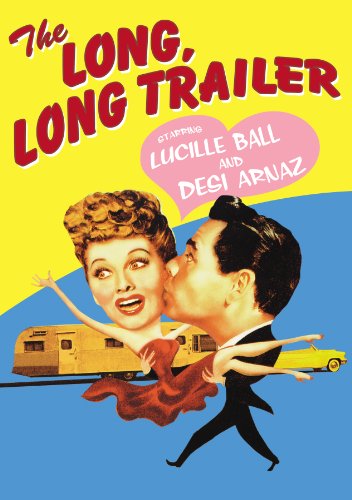
My favorite Minnelli film is the sun-drenched comedic confection The Long, Long Trailer (1954) starring Lucille Ball and Desi Arnaz. They were at the height of their TV fame when they were contracted by MGM to make this, the first of two films. Despite the fact that audiences could get Lucy and Desi for free on TV each week, the film was a big hit at the box office. When I first saw it as a nine-year-old boy in New Rochelle, New York at the Loew’s Theatre on the cold winter morning of its February premiere, there was a line around the corner. I have been laughing ever since.


The story is essentially fluff. Newlyweds Tacy (Ball) and Nicky (Arnaz) decide that rather than settling down in a new home, they should adopt a more mobile lifestyle because of the extensive travel requirement of Nicky’s engineering job. The Bride persuades her new husband to buy a trailer against his will and drag it behind a newly minted American car as they move from location to location. Thanks to their naiveté in such matters, they purchase a colossal RV that costs five times what they had planned. It’s at this time that the 37’, three-ton New Moon Trailer becomes one of the stars of the film. The viewer takes pleasure as the couple fights over every turn and parking spot while they make their way around a pre-freeway California. It’s typical of the type of chaos Lucy and Desi brought to the ‘50s and is inspired silliness. The film is also ablaze with Minnelli’s distinctive use of color and features a glorious view of the American West at mid-century before Holiday Inns and McDonalds scarred the landscape. In the middle of the adventure is a sublime rendition of the song “I’m just Breezin’ Along with the Breeze,” which the viewer will be humming long after the film is over.
Lucy convinces Desi to buy a trailer beyond their means in The Long, Long Trailer.

Some critics carped that the film was just an extended Lucy episode. In many ways it was, yet underneath the laughter is some sardonic commentary on American consumerism, technology, fads (RVs), and the prosperity of the Eisenhower years. Ironically, the film also bears some resemblance to two earlier Minnelli films, Madame Bovary (1949) and Father of the Bride (1950). Film enthusiast Michael E. Grost notes, “In all three films the wives are addicted to a luxury, a product, or a lifestyle. Lucy’s character is really a wife who spends at a level far above her means and gets her husband into financial trouble.” Thus, the film can be seen a urgent warning of the dangers of materialism and the consumer goods society that was to dominate American life in coming decades. That’s the darker side.

The Long, Long Trailer is a big, lemon-colored gumdrop of a film from the halcyon days of the ‘50s and shows Minnelli at his comedic best. It has the kind of joyful, innocent chaos that is rare today. I’m still laughing. I promise that you’ll find something to tickle your funny bone. Join us!


Thanks, Alan!

The Long Long Trailer will be shown and discussed as a part of the film course Lust for Life: The Films of Vincente Minnelli, taught by Maurizio Giammarco, Ph.D., at BMFI. The four-week class starts Wednesday, June 6 at 6:30 pm.

Film fans, if you would like to submit a post of your own about a movie or film star that you love, please contact Devin Wachs with your idea.

Tuesday, January 31, 2012

Alan Webber: Why I Love Moira Shearer

On the anniversary of Moira Shearer's death, BMFI patron and film fan Alan Webber shares with us his movie memories of the luminous dancer and actress and her best-known performance in The Red Shoes.


Autumn Bonfire
By Alan Webber, BMFI Patron

Like many American males I first fell in love in the darkened balcony of a movie theatre. The reader has no need for caution here: I was no stumbling Clearasil-addicted teenager groping at elbows, but a young boy of six years. It was somewhere around 1950 in Larchmont, New York and my mother dragged me, a runny-nosed youth I’m sure, to a matinee one October Saturday. It was a nearly perfect autumn day and I remember that my new white sneakers brushed against the embers of burning leaves at the curb of Chatsworth Avenue on the way. Little did I know of  what was in store for me that crisp day or the gifts I was about to receive…the first of a lifetime of movie loves and my first movie memory.

Moira Shearer in The Red Shoes

A little over two hours later when “FINIS” lit across the blackness, I knew that I was totally infatuated with movies and this alluring beauty on the screen. I didn’t know what “FINIS” meant but the film appeared to end very tragically for her in Monte Carlo…wherever that was. I knew it was very far from Larchmont.

Her name in the film was Victoria Page and she was a fiery redhead who raged across my innocence in a spinning fantasy of Technicolor and dance. “Vicki” was her screen name, but I gradually learned she really was Moira Shearer of the Sadler Wells Ballet and I have never fallen out of love with her in The Red Shoes, Michael Powell and Emeric Pressburger’s eccentric, melodramatic and voluptuous masterpiece. Even director Powell was taken by her "cloud of  red hair," which "flamed and glittered like an autumn bonfire.” In retrospect, I see that she was my very first Object of Desire even before my younger self flirted with an idea of sex. She was also the probable origin of a lifelong smoldering fondness for fair-skinned redheads.


After the release of The Red Shoes in 1948 she became the best-known ballet dancer in the United States and perhaps the world and with this fame she was able to popularize ballet more than any other contemporary. Many today, myself included, believe that it is still the greatest ballet movie ever made and Moira Shearer was crucial to this success. However, the reception of the film by the public wasn’t without problems. “The film was a huge success when it opened in London in the spring of 1948,” she said to one interviewer, “but, just as I had suspected, the British public didn’t much approve of my appearing in it…..I just wish I had been a more rounded performer at the time.” It was never a movie she wanted to make for she believed she was a novice at acting and felt hampered by her lack of experience. If she felt that way, it didn’t show on the screen.

Following The Red Shoes, Moira Shearer made four other films in which she danced and acted including The Tales of Hoffman for Powell and Pressburger and Black Tights for choreographer Roland Petitt. Her dancing career essentially ended in 1952, after which she acted, wrote, and lectured.

She died on January 31, 2006 at the age of 80.

In the film, Vicki, who has fallen in love with the ballet company’s composer, is warned, “A dancer who relies upon the 'doubtful comforts' of human love will never be a great dancer…never.”

On those scarlet autumn days when I am in a reflective mood and the air is crisp again and I watch The Red Shoes, I can rely on these “doubtful comforts” and remember the Moira Shearer of my boyhood, the autumn bonfire, who has warmed my heart for a movie-going lifetime.


Thanks, Alan!

Film fans, if you would like to submit a post of your own about a movie or film star that you love, please contact Devin Wachs with your idea.